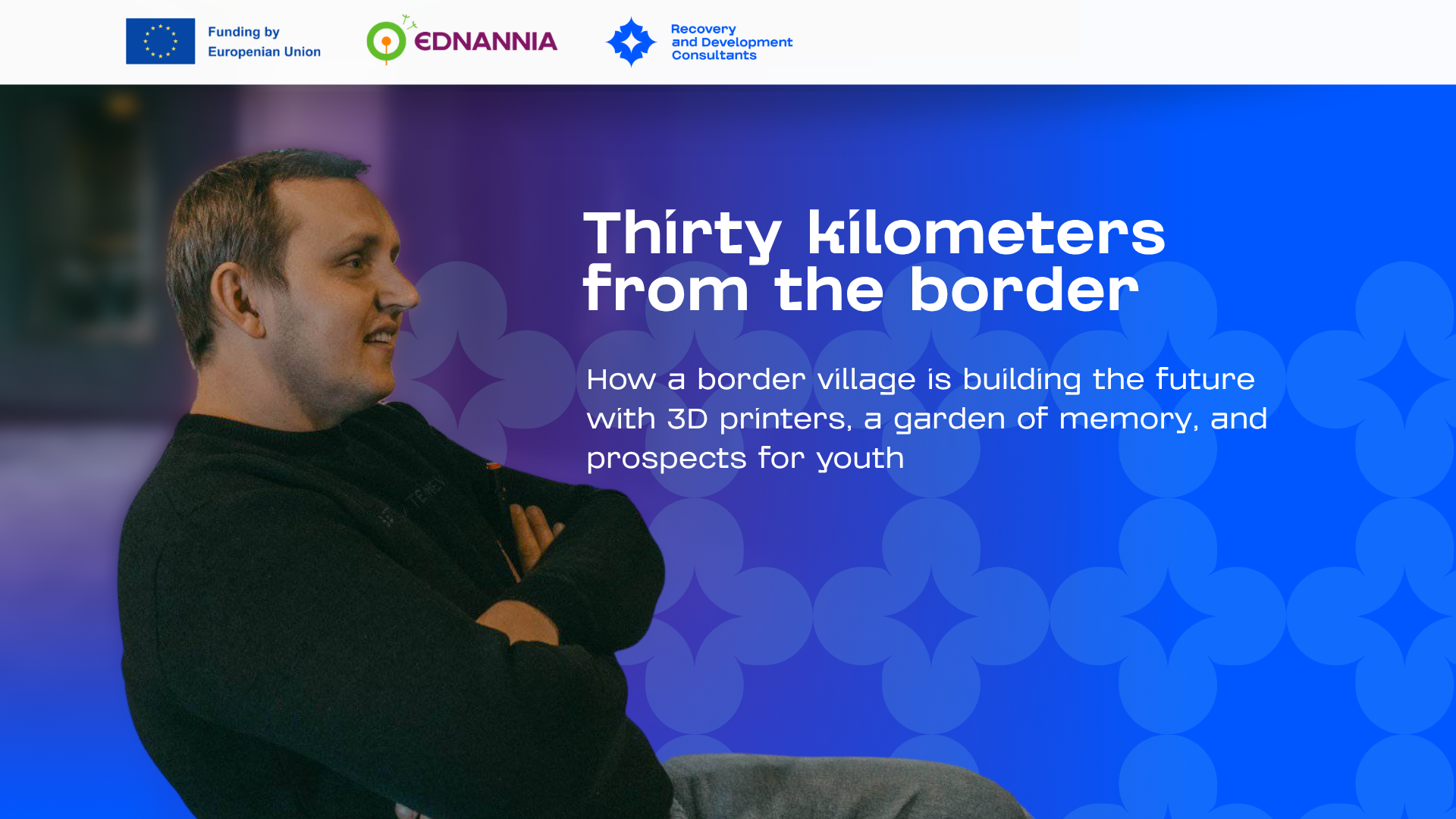
The village of Vykhvostiv in Chernihiv region is located thirty kilometers from the border with two countries — Belarus and Russia. Although many people left the village back in 2022, there is work here: fields are cultivated, a mill operates, and there's a large cattle-farming operation. Internally displaced families from more dangerous areas are moving to Vykhvostiv. For example, one family arrived with six school-age children.
Mykola Sylenko has been the director of the local school for five years now. At the same time, he headed the STO initiative group — "Brave to Create and Unite" (Smilyvi Tvoryty ta Ob'yednuvaty).
"Our biggest idea is to make the community so comfortable that young people stay to live here, adults feel at ease, and young families don't worry about having nowhere to go or work with their children," he says.
From a Trampoline to a 3D Printer
The Tupychiv community, which includes Vykhvostiv, is small, but there weren't enough resources for everyone.
"So our initiative group looked for opportunities, learned to write project proposals, and took part in various competitions — and gradually results started to appear."
Now the village has a youth educational space, a 3D-modeling club with two printers that children work with. In two greenhouses, schoolchildren grow plants, and the sixth grade grows seedlings for sale so the money raised can go toward renovating their classroom.
Another initiative is the "Alley of Unbreakability," which grew into an entire garden. It was planted by a school graduate who became passionate about agronomy and growing seedlings. When he went to serve in the army, he passed all the seedlings on to the school.
"Now we have a really wonderful garden. It's a memorial to our defenders — everyone who serves," says Mykola Sylenko.
"If You Don't Try — It Definitely Won't Work"
Mykola Sylenko learned about ISAR Ednannia through the NGO "Agency of Urban Initiatives," partners of the initiative group who helped open the space in the community.
Applying was a bit frightening, since competition for the first wave was fierce.
"While filling out the application, I tried to read every single detail and do everything the form asked. Honestly, at first I didn't believe I'd get through. Many really impressive organizations applied, and I wasn't coming from a registered organization but from an initiative group. So when I received the invitation to join the program, I was very happy," he recalls.
Mykola Sylenko says that before joining the program, he lacked a number of important skills and knowledge. First, the ability to write project applications: out of ten submitted, only one would be approved, and that was already considered a success. Second, he lacked experience cooperating with local government bodies. Third, he barely understood how international organizations work and how to interact with them.
The Training: "It's Not All That Complicated"
The first day of training turned out to be the hardest and, at the same time, the most memorable.
"When we met the participants and trainers, I realized I was surrounded by really great people who had already accomplished a lot in their lives. There were strong representatives of local government and civil society. And everyone was so different, so interesting. I just wanted to keep asking questions and listening," he shares.
During the program, participants were constantly mixed into different groups, pushed to step outside their comfort zones, and not allowed to stay in a familiar environment. According to Mykola Sylenko, the program is designed so participants can better understand the value of people and the interactions between them.
The training had almost no lectures in the usual sense. Instead, there was communication among participants, exchange of experience, and practical exercises.
"It felt like we kept arriving at the right answers ourselves. It turned out that everyone actually already knew everything: you just had to remember it, systematize it, and structure the knowledge. What seemed very difficult to me during the first and second days of training later turned out to be simple and easy," he says.
After the first wave, when the opportunity arose to apply for the trainers' program, Mykola Sylenko decided to try that too.
"It would have been embarrassing not to apply," he laughs. He got through that selection as well.
Life After the Training
According to Mykola Sylenko, after taking part in the "Recovery and Development Consultants" program, it became much easier for him to communicate both with grant providers and with local residents.
One result was negotiations with the organization Save Aid, which had opened 2 educational spaces in the community. After the negotiations, the organization agreed to expand one of them, which operates on the basis of the gymnasium. Renovation is currently underway there, and the space will triple in size thanks to the addition of adjacent premises.
At the same time, the community is implementing an ISAR Ednannia project — creating "Ednannia Park" next to the educational space. The idea is for it to be a place for community residents to relax and socialize. Plans include setting up a Wi-Fi zone, children's entertainment, and photo zones.
Another successful initiative was an engineering festival held with the participation of local government bodies and residents. During the event, children together with their parents built various engineering structures and creations.
"It was an entertaining and educational event. We managed to get funding to hold it, and also got people interested enough to come," Mykola Sylenko says.
The community also regularly organizes communal work days (toloky) and joint events that help bring residents together around the development of the settlement. Recently, residents cleaned up the village park together.
"If before we thought we constantly lacked people, now it turns out we have enough people. They're active and creative, and we no longer search for them. We search for ideas and learn how to communicate them properly, and the people find us themselves," he says.
According to Mykola, an important change was rethinking approaches to working with the community.
"We've always had a lot of ideas, but implementing them and communicating them properly to people — that was the hard part for us. Now we handle that more easily," he sums up.
Together with the "Agency of Urban Initiatives," Mykola Sylenko developed a 5-year strategic development plan for the organization as its regional representative. At the same time, the community and the agency are working together on a recovery plan.
Attitudes toward grants have also changed:
"Before joining this project, we tried to look for opportunities where it was easier — where it was simpler to get through and competition was lower. Back then we only managed to get through one out of ten selections, and that was already considered a success. Now, even one successful selection out of five feels like too little for us."
Another important change is understanding the value of human contacts. After the program, Mykola Sylenko began traveling on business trips more often, because he realized that "warm contacts" are one of the most important resources.
"Without a doubt, first place goes to people, and people again," he sums up.
And to those who are still hesitant about whether to apply for the "Recovery and Development Consultants" program, Mykola Sylenko says simply: if you have a goal and a mission — don't think twice. Try it — it's definitely worth it. Because if you don't try, it definitely won't work.