The "Consultants for Recovery and Development" program is a training initiative by ISAR Ednannia, implemented with support from the European Union. It prepares specialists who help communities recover and develop, build partnerships between authorities and citizens, launch local change projects, and attract funding. Participants include people from NGOs, local self-government, and business initiatives who are already working at the local level and want to do so more systematically.
Olena Kovtun heads the Department of International Cooperation, Economic Analysis, Strategic Planning, and Communications of the Executive Committee of the Boyarka City Council. Before working in local self-government bodies, she spent 19 years running her own language school. After the start of the full-scale invasion in 2022, Olena joined the city council as a volunteer, and later moved into local self-government to be able to implement systemic changes in the community.
At the same time, she continues to work in the civil society sector: she helped create two youth spaces, actively supports the work and development of the Youth Council under the Boyarka City Council, and has developed and delivered a number of training programs for executive body employees and residents from socially vulnerable categories. A separate area of her work is developing veteran spaces, one of which was recognized in 2025 as one of the best veteran practices in Ukraine.
"We started uniting and building contacts with veteran organizations not only in Kyiv region, but also in Kharkiv, Zaporizhzhia, and Kherson regions," Olena says.
Partnership Instead of Confrontation
When Olena Kovtun saw the announcement about recruitment for the "Consultants for Recovery and Development" program on ISAR Ednannia's page, she immediately decided to join. What interested her most in the program was the part dedicated to building dialogue and partnership between authorities and the community.
"What interested me most was the module on building dialogue and partnership between the community and authorities. That's exactly what we're lacking most today. That's when I thought: I definitely need this training. Because I really want us to be able to sit down at the same table, discuss our problems and challenges together, and look for solutions jointly," Olena says.
After completing the basic program, she also applied for the trainers' program.
Olena says one of the program's advantages was the combination of online and offline learning. What she remembers most is the live communication with like-minded people, since it was during these conversations that participants shared their own experience, ideas, and solutions that had already worked in their communities.
"You go for a coffee break, start sharing your experience, and someone tells you how a similar problem was solved in their community. And then you see how knowledge works in real life and which solutions actually worked," she says.
Life After the Training
Olena delivered her training within the trainers' program together with Myroslava Zhylina from the "Podilska Hromada" Community Foundation. Enrollment was open, so anyone interested could join. The group included representatives of local self-government, the youth council, people with experience of losing their homes, and veterans. The topic of the meeting was participatory engagement, dialogue, and partnership.
"We wanted to bring together people with completely different experiences, different stories, from different regions, and show them that they have points of connection and shared pain," Olena says. "The key realization is that partnership is possible between different roles, if there's a will to build it," she adds.
After the training, Olena felt more confident in her knowledge and began consulting not only her own community but also communities from Kharkiv, Zaporizhzhia, Kherson, and Mykolaiv regions.
One of the first results after the training was work on the Medium-Term Priority Public Investment Plan (MTPPIP). Boyarka was the first in the region to take on this new tool, so initially few understood how it worked. Olena figured out all the requirements on her own and later trained city council employees and deputies.
"We can plan projects based on our own vision, while residents may not see the need for them. That's why it's important for the investment council to have equal representation of both executive bodies and the residents themselves — the people we're making these projects for," she explains.
When Boyarka became one of the first to develop an MTPPIP, colleagues from other communities began reaching out for advice. Olena shared her experience, documents, and developments, and talked about participation in international programs, cooperation with partners, and implementation of various projects.
The "Consultants for Recovery and Development" program also helped within the city council itself. Boyarka became the first community in Kyiv region to approve a 1325 Action Plan on gender equality.
"Gender equality here is perceived exclusively as a feminist movement. But Resolution 1325 is much more than that. And it's the kind of policy a community needs, especially if it wants to participate in European Union programs," Olena says.
Olena is currently preparing the program for an international forum together with the team from the city's sister city in Latvia. The forum will address how communities can cope with challenges and become stronger amid war and uncertainty. Veterans will also share their stories and experience at the forum.
The main conclusion Olena drew for herself after the program is that knowledge only works when it's applied in practice. And real change in communities begins with trust, not with positions or status.
That's why Olena encourages other organizations not to be afraid to apply for the "Consultants for Recovery and Development" program:
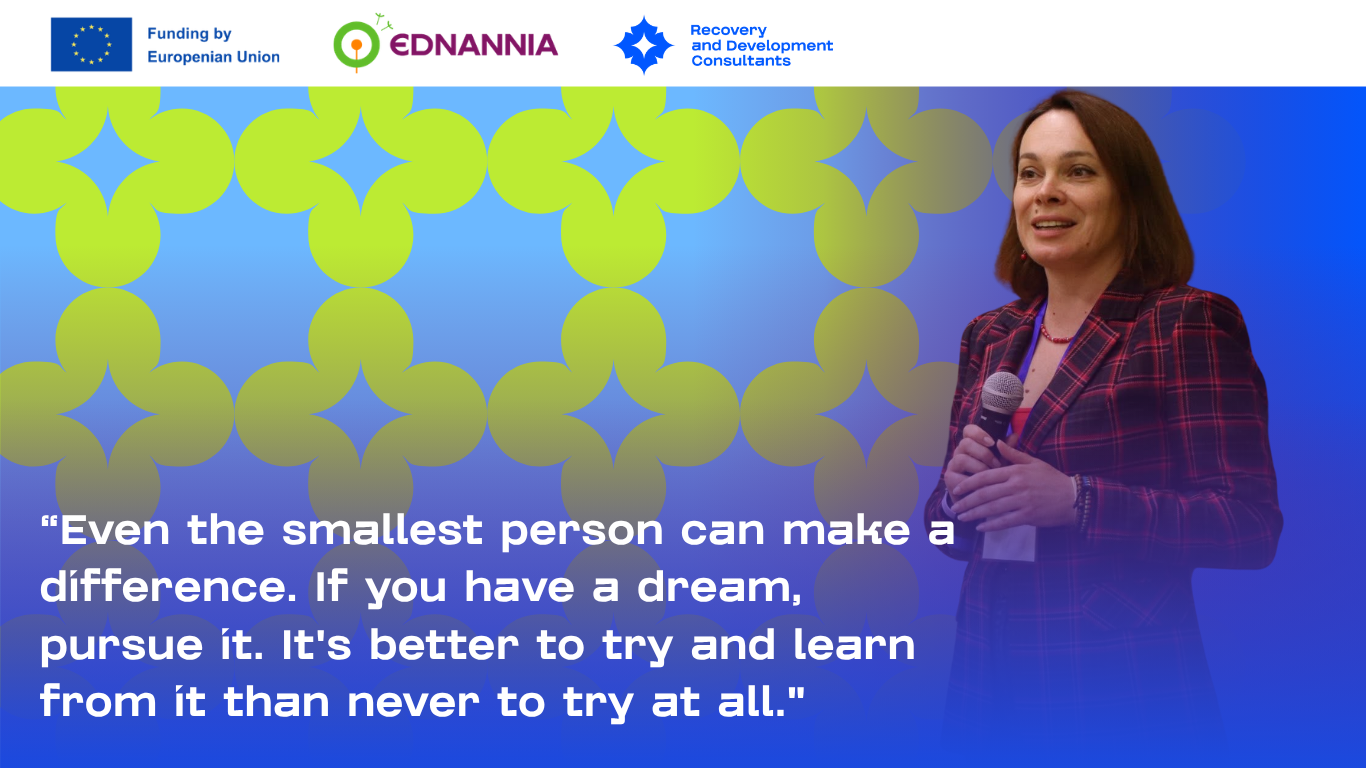
"Even the smallest person can change something. If you have a dream, go after it. It's better to try and draw conclusions than not to try at all," she says.
According to her, participation in the program provides knowledge, confidence, and new opportunities — and most importantly, an understanding of how to keep developing and where to seek new knowledge, since it's constantly changing.
The programme is implemented within the framework of the EU Unity4Community project, funded by the European Union.
This publication was produced with the financial support of the European Union. Its contents are the sole responsibility of ISAR Ednannia and do not necessarily reflect the views of the European Union.