Home
Home
ISAR Ednannia is the partner of the official Pre-Conference to URC2024
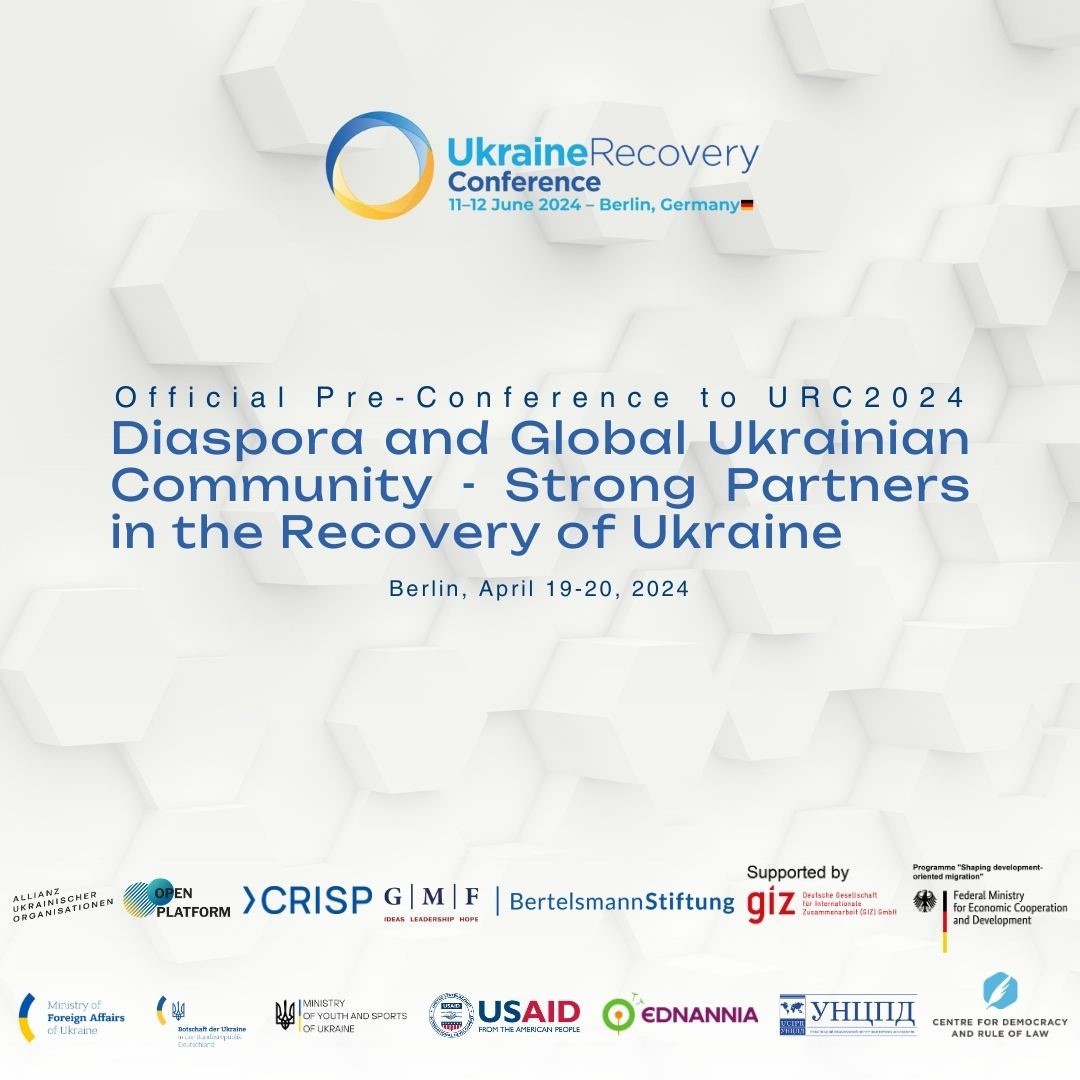
ISAR Ednannia has become a partner of the official Pre-Conference to URC2024 'Diaspora and Global Ukrainian Community - Strong Partners in the Recovery of Ukraine’, which will be held on April 19-20, 2024, in Berlin, on the eve of URC2024.
The aim of the event, initiated by the Alliance of Ukrainian Organizations, Open Platform e.V., CRISP e.V., and other organizations, is to highlight the importance of cooperation between the Ukrainian civil society, German governmental structures, Ukrainian diaspora, and the global Ukrainian community, both in the context of post-war recovery of Ukraine and for Ukraine's future accession to the European Union.
The conference will be attended by approximately 120 representatives of diaspora and Ukrainian NGOs, as well as delegates from the Embassy of Ukraine in Germany, the Ministry of Foreign Affairs of Ukraine, the Ministry of Youth and Sports, the Ministry of Foreign Affairs of Germany, and the Federal Ministry for Economic Cooperation and Development of Germany.
At the event, ISAR Ednannia will be Lesia Ogryzko, Deputy Chief of Party at USAID project “Ukraine Civil Society Sectoral Support Activity”.
ISAR Ednannia is an organization that has been developing the Ukrainian civil society for 25 years. We systematically strengthen initiatives for democracy building in Ukraine and annually allocate from 200 to 500 grants for the implementation of socially beneficial projects throughout Ukraine.
This collaboration is made possible by the generous support of the American people through the United States Agency for International Development (USAID) within the Ukraine Civil Society Sectoral Support Activity implemented by ISAR Ednannia in partnership with the Ukrainian Center of Independent Political Research (UCIPR) and Centre for Democracy and Rule of Law (CEDEM). The contents are the responsibility of ISAR Ednannia and do not necessarily reflect the views of USAID or the United States Government.
Ministry of Veterans Affairs of Ukraine, Ukrainian Veterans Foundation and ISAR Ednannia have launched the implementation of veteran grants under the "Varto: Edannnia" project
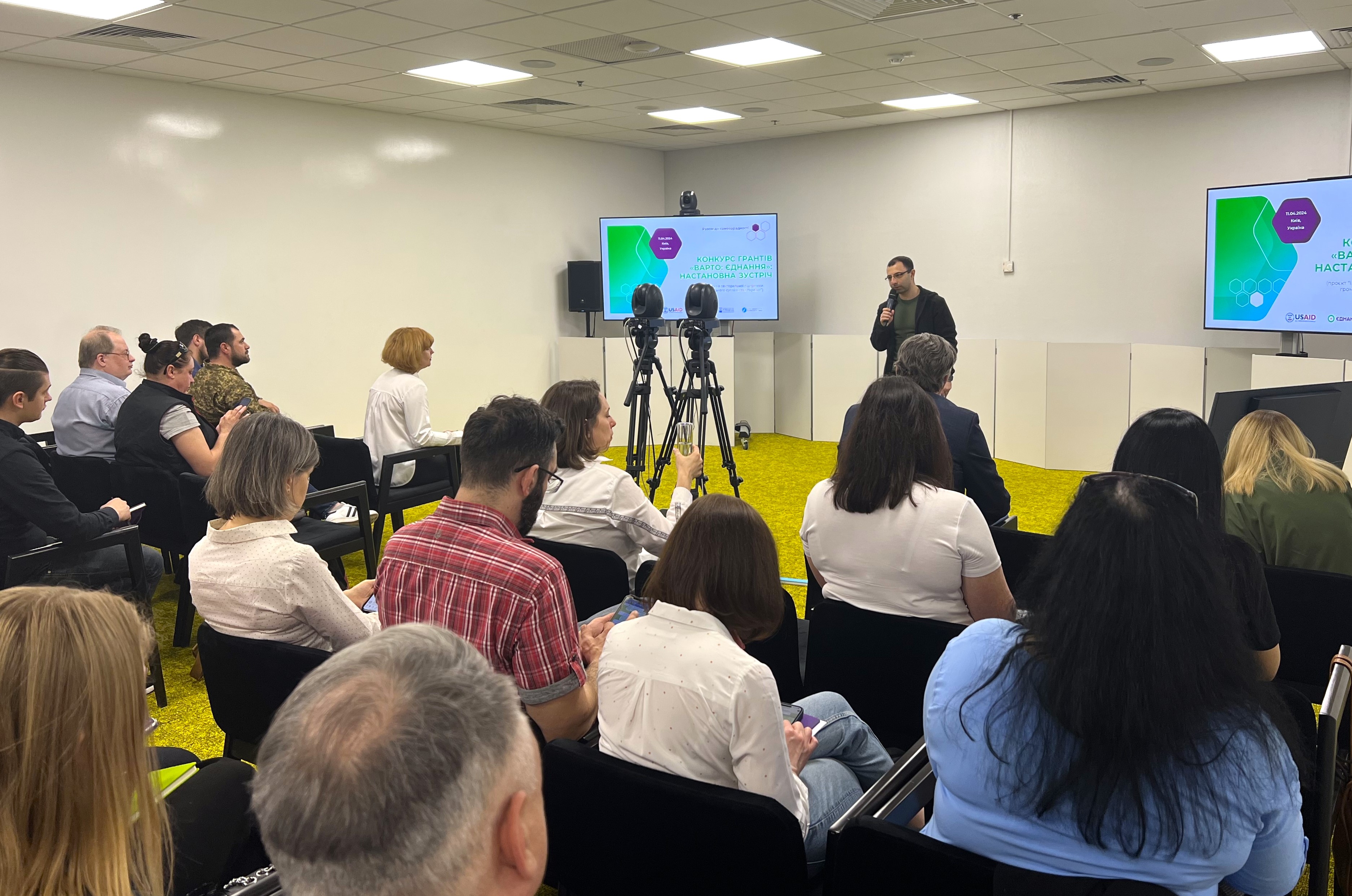
On April 11, 2024, the Ministry of Veterans Affairs of Ukraine, Ukrainian Veterans Fund (UVF), and ISAR Ednannia started the implementation of veteran grants under the "Varto: Ednannia" project.
The main goal of this grant competition is the reintegration and support of veterans and their families through the services of civic organizations, which will enhance their capacities and the quality of services toward of protection of rights and freedoms, satisfaction of social, economic, cultural, and other interests of veterans and their family members.
“Veterans policy is recognized by the state as one of the top priorities. The scope of tasks requires daily attention and involvement of civil society organizations (charitable and non-government organizations). This cooperation is an effective tool for implementing state policy aimed at reintegrating veterans into civilian life. Civil society institutions assist us in this through the legal support and counseling for veterans and their families in addressing their urgent needs. I am very appreciate to ISAR Ednannia for the grant’s support of such organizations; this collaboration makes a significant contribution to the success of our joint project. We are open and ready for productive work,” said Farhad Farhadov, Deputy Minister of Veterans Affairs of Ukraine.
The cooperation between ISAR Ednannia, the Ukrainian Veterans Fund, and the Ministry of Veterans Affairs foreseen co-financing projects of civil institutions that support veterans and their families, with a total amount of up to 2.5 million UAH within the framework of the new "Varto: Ednannia" competition. The UVF and the Ministry of Veterans Affairs select projects from civil institutions and commit to funding their implementation. Meanwhile, ISAR Ednannia, within the framework of the USAID project the “Ukraine Civil Society Sectoral Support Activity” finances institutional development and covers the administrative costs of the civil organization envisaged during the implementation of the selected project.
"ISAR Ednannia provides financial assistance for veterans' projects since the 1990s, especially from 2014. This involves collaboration with hubs, veteran businesses, and other organizations dealing with veteran issues. Now, in the third year of Russia's full-scale aggression against Ukraine, we are talking about over 4 million veterans and their family members. We estimate civil society organizations, which now approximately 130,000 in the country, as competent actors for state and private business which can jointly address veteran issues. Like an NGO, which connects the needs of CSOs with donors, we will be a reliable partner in this initiative," added Volodymyr Sheyhus, Executive Director of ISAR Ednannia.
As part of the "Worth: Unity" project, veterans and their families will get the following assistance:
- Mentorship support and consultancy for veteran entrepreneurship from start to development.
- Social support for veterans, their family members, and families of the deceased.
- Social support for children of veterans and children of the deceased.
- Support in the reintegration of veterans and their families into active social life.
The "Varto: Ednannia" grant competetionis made possible by the generous support of the American people through the United States Agency for International Development (USAID) within the Ukraine Civil Society Sectoral Support Activity implemented by ISAR Ednannia in partnership with the Ukrainian Center of Independent Political Research (UCIPR) and Centre for Democracy and Rule of Law (CEDEM) and the project is funded by the state budget through the Ukrainian Veterans Fund of the Ministry of Veterans Affairs of Ukraine.
195 representatives of the media participated in the educational course for regional journalists organized by ISAR Ednannia
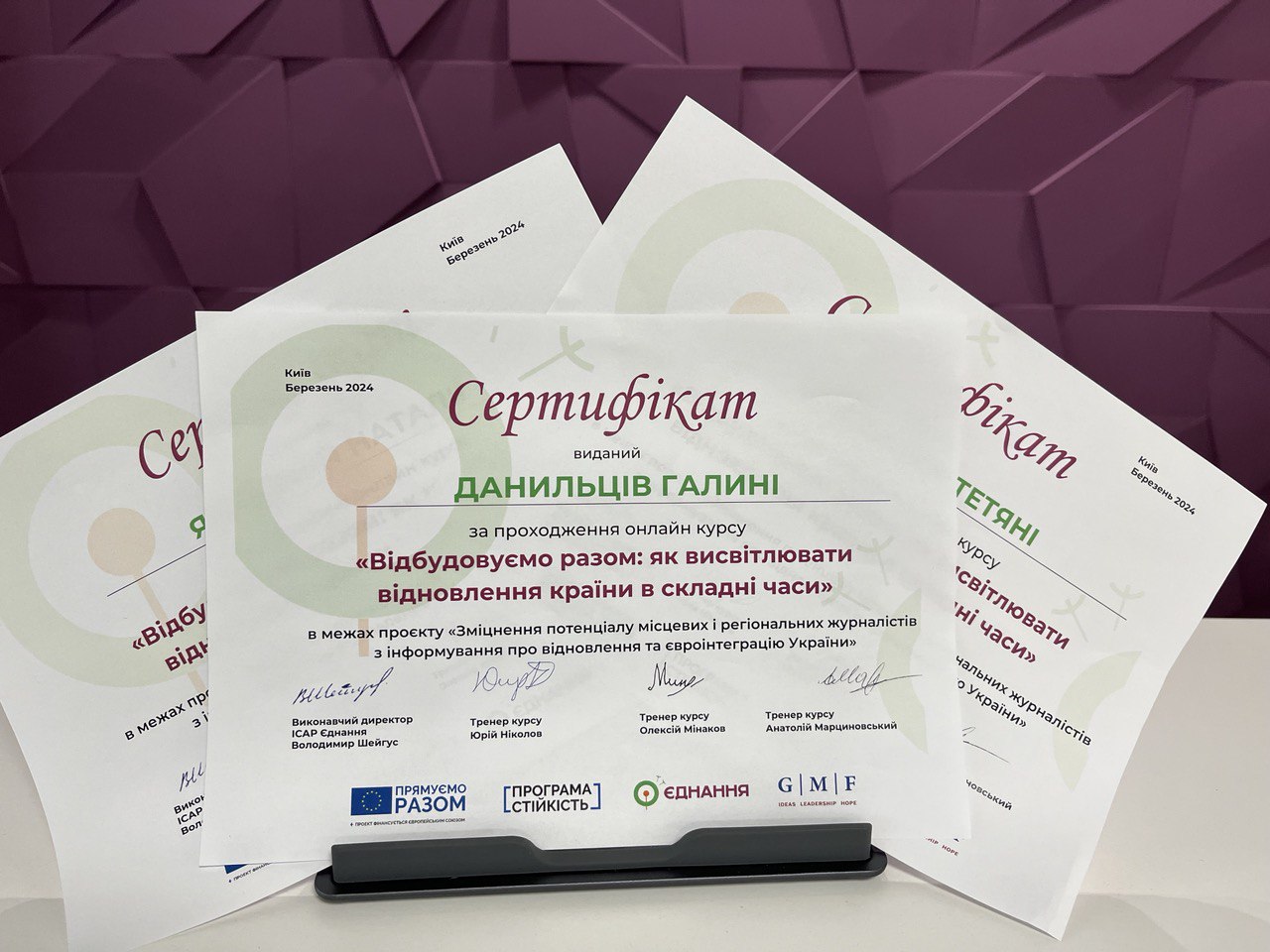
The educational mini-course "Rebuilding Together: How to Cover the Country's Recovery in Challenging Times," conducted by ISAR Ednannia for journalists from regional media and local publications, has concluded. A total of 195 journalists from various regions of Ukraine participated in the mini-course, with 67 representatives of regional media receiving certificates of completion.
The course consisted of the series of online training sessions on communicating with society about Ukraine's recovery and European integration, utilizing modern tools for gathering, systematizing, and analyzing information. Qualified media trainers instructed journalists on monitoring expenditures for Ukraine's reconstruction, finding information on procurement, and identifying corruption, as well as improving written texts using artificial intelligence and exploring topics on recovery and European integration in the genre of solution-oriented journalism.
"This is the important project for us in supporting media representatives because there are many questions about understanding recovery: are we only rebuilding infrastructure, or do we have broader initiatives - about human capital, about how to keep people in Ukraine so they stay in their homeland and help with the recovery. This topic permeates all spheres of our lives, and now we need to talk from the perspective of Ukraine's future EU membership. The role of journalists, especially regional ones, in this is extremely important because no one knows better than journalists how regions live, whether people are involved in the recovery, and how the community sees it. Therefore, we will continue to support such projects," said Executive Director of ISAR Ednannia, Volodymyr Sheyhus, during the certificate award ceremony.
The educational mini-course "Rebuilding Together: How to Cover Country's Recovery in Challenging Times" was held as part of the project “Empowering local and regional journalists role in EU accession and Recovery of Ukraine”, is implemented by ISAR Ednannia with the financial support of the European Union and the German Marshall Fund of the United States (GMF). Its contents are the sole responsibility of ISAR Ednannia and do not necessarily reflect the views of the EU and GMF.
Volunteers and NGOs are part of the "elite league" in terms of public trust level – the research by the ISAR Ednannia of the "third sector"
Since the full-scale Russian invasion, trust in volunteer and civil society organizations (CSOs) from the side of Ukrainian society has been increased. Today, both volunteers and CSOs are among more trusted civic actors in Ukraine. However, the level of trust toward volunteers remains higher in comparison with CSOs.
This conclusion was made according to a recent research "Civil Society in Ukraine in the Context of War" (see also the Ukrainian version) initiated by ISAR Ednannia and conducted by the Kyiv International Institute of Sociology as part of the project "Ukraine Civil Society Sectoral Support Activity". This initiative was implemented by ISAR Ednannia in partnership with Ukrainian Center of Independent Political Research (UCIPR) and Centre for Democracy and Rule of Law (CEDEM). It was possible by generous support of the American people provided through the United States Agency for International Development (The content of the report does not necessarily reflect the views of ISAR Ednannia, the United States Agency for International Development, or the United States Government).
Throughout 2023, there was a slight reduction in credibility toward both entities: at the fall of 2023, 84% of people trusted volunteers (compared to 88% at the beginning of the year), and 61% trusted CSOs (compared to 66% at the beginning of the year). The study emphasizes relative deduction in trust for government authorities from December 2022 to December 2023, the decrease in trust in volunteers and CSOs is much smaller in scale. Additionally, approximately half of Ukrainians believe that CSOs are more effective in addressing social issues than government and businesses.
"ISAR Ednannia has been conducting a sociological check-up of Ukrainian civil and volunteer organizations for the fourth consecutive year, and for the second time after the full-scale Russian invasion," commented Volodymyr Sheyhus, Executive Director at ISAR Ednannia. "From the report, it is clear that CSOs have already adapted to the conditions of war, with 80% of them not only continuing their activities in Ukraine but also taking responsibility for new areas such as humanitarian response, veteran movements, and country recovery."
Also, the report "Civil Society in Ukraine in the Context of War" includes an analysis of other topics related to CSOs:
1) Activity areas of civil society organizations and volunteers: assistance to Ukrainian Forces and victims of Russian aggression became the main direction of activity for civil society with the onset of full-scale war. However, in 2023, the proportion of organizations for which support for the Army and victims of Russian invasion were the main areas of activity decreased by 5% (from 43% in 2022 to 38% in 2023). The number of institutions providing assistance to war-affected individuals decreased even more noticeably - by 11% (from 43% in 2022 to 32% in 2023). Additionally, about 10% of NGOs, CSOs, and volunteer initiatives engage in international advocacy. Changes in priority areas of activity occurred in nearly a quarter (23%) of CSOs over the past year, while 77% of organizations continued to work in their usual areas during the second year of the war.
Areas where increased involvement of CSOs has been observed over the past year include: (1) work with adolescents and youth (increase by 29%); (2) assistance to vulnerable populations and people with special needs (increase by 14%); and (3) healthcare (increase by 7%). The main directions of volunteer work are focused on assisting the Armed Forces of Ukraine (46%), providing volunteer assistance to victims of Russian aggression (26%), humanitarian aid to the population (20%), and assistance to people with disabilities (16%).
2) Quantitative indicators and dynamics of the sector: from 2021 to 2023, the number of charitable organizations (COs) increased the most - by 43%. The number of NGOs and homeowners' associations (HOAs) also increased by 6.1% and 5.4% respectively. In 2023, there was a significant number of registrations of new COs - almost 5,000 (for comparison: in 2022, there were over 6,000 new registrations). In 2023, the highest number of NGOs and COs were registered in Kyiv, Dnipropetrovsk, Lviv, Kharkiv, Kyiv and Odesa regions. Although the list of leading regions in 2023 remained almost the same as the previous year, changes in the pace of creating new organizations by region are interesting: the largest increase was demonstrated by the Kherson region.
The number of registered volunteers in Ukraine significantly increased after the start of the full-scale invasion, especially since October 2022: from 320 individuals in January 2022 to almost 7,000 by the end of 2023. However, much volunteer activity occurs outside of official registration, so the actual scale of volunteering in the country is much broader.
3) Characteristics of organizations based on the research results in 2023 and comparison with the results of 2022: approximately 6.3% of civil society organizations were forced to relocate from active combat zones, with the majority of relocations (4.9%) occurring in 2022. The relocation process slowed down in 2023.
Half of civil society organizations and volunteers (49%) have a local geographical scope of activity, operating in individual settlements, communities, or regions. 24% consider themselves as a national organization, 18% are regional organizations operating in several regions, and 10% are international NGOs. There is a significant distinction between CSOs and volunteer initiatives: CSOs are more focused on the local level, while volunteers operate on a national scale.
4) Target audiences of CSOs: according to CSOs and volunteers, in 2023, the groups of people most in need of assistance are those whose lives are most affected by the war: military personnel, war veterans and their families, residents of frontline and liberated regions, and internally displaced persons (IDPs). Over half of the respondents also mentioned people with disabilities. Large part of participants agree that the needs for assistance of almost all categories of individuals have increased rather than decreased over the past year. At the same time, nearly one in five respondents believes that IDPs and Ukrainians abroad have needed less assistance over the past year.
5) Cooperation between NGOs and volunteers with state authorities and local self-government: four out of ten NGOs and volunteer initiatives received invitations for cooperation from government agencies or local self-government (almost the same as in 2022). NGOs and volunteers are most likely to establish productive working relationships with local self-government and least likely with central government. 25% of surveyed NGOs and volunteers reported having established good communication with central government agencies, 39% with local executive authorities, and 46% with local councils.
6) Main challenges and needs of NGOs and volunteers in 2023: the key issues in the activities of NGOs relate to financial support (58%) and personnel issues - team burnout, excessive workload, and staff shortages (34%). The proportion of NGOs reporting these difficulties slightly increased in 2023 compared to 2022. However, the prevalence of problems with technical support (28%) remained unchanged, and issues related to office and communication facilities (26%), physical safety of the team and organization's property (21%), and work organization (20%) even decreased.
7) NGOs Plans for 2024: the four most mentioned directions at work for NGOs in 2024 are closely related to overcoming the consequences of war: reconstruction of infrastructure and housing, rehabilitation and support for wounded soldiers, their families, and victims of combat actions, social and psychological assistance to a wide range of war-affected individuals. Strategic goals of NGOs for 2024 mentioned by representatives of the civil society sector and experts during in-depth interviews, they are also diverse: including strengthening the sustainability and institutional capacity of the NGOs themselves, as well as a wide range of tasks for the recovery, development, and strengthening of Ukraine in the conditions of war.
8) Access of NGOs to sources of funding: two-thirds of organizations indicated that the main sources of funding in 2023 remains donations, membership fees, or contributions. International grants possess the second place (22%), while incomes from their own economic activities are used by 18%. The proportion of organizations receiving funding from the government or local budget has slightly increased (in 2023 - 7.9%, compared to 5.6% in the previous year).
The sources of funding for NGOs and volunteer initiatives are mostly similar. However, volunteers more often get donations and contributions from the individuals, local businesses, and civic activists in comparison to NGOs. The respondents keep the opinion that international donors are a key source in funding for Ukrainian NGOs. In 2023, according to the experts’ findings, donors increased the volume of financial support, and the number of donors in Ukraine also increased. Representatives of NGOs believe that the volume of charitable contributions/donations from the citizens significantly decreased in 2023 in comparison with beginning of full-scale invasion.