Home
Home
Winter Starts Today: Preparing Ukraine’s Civil Society for Another Wartime Winter
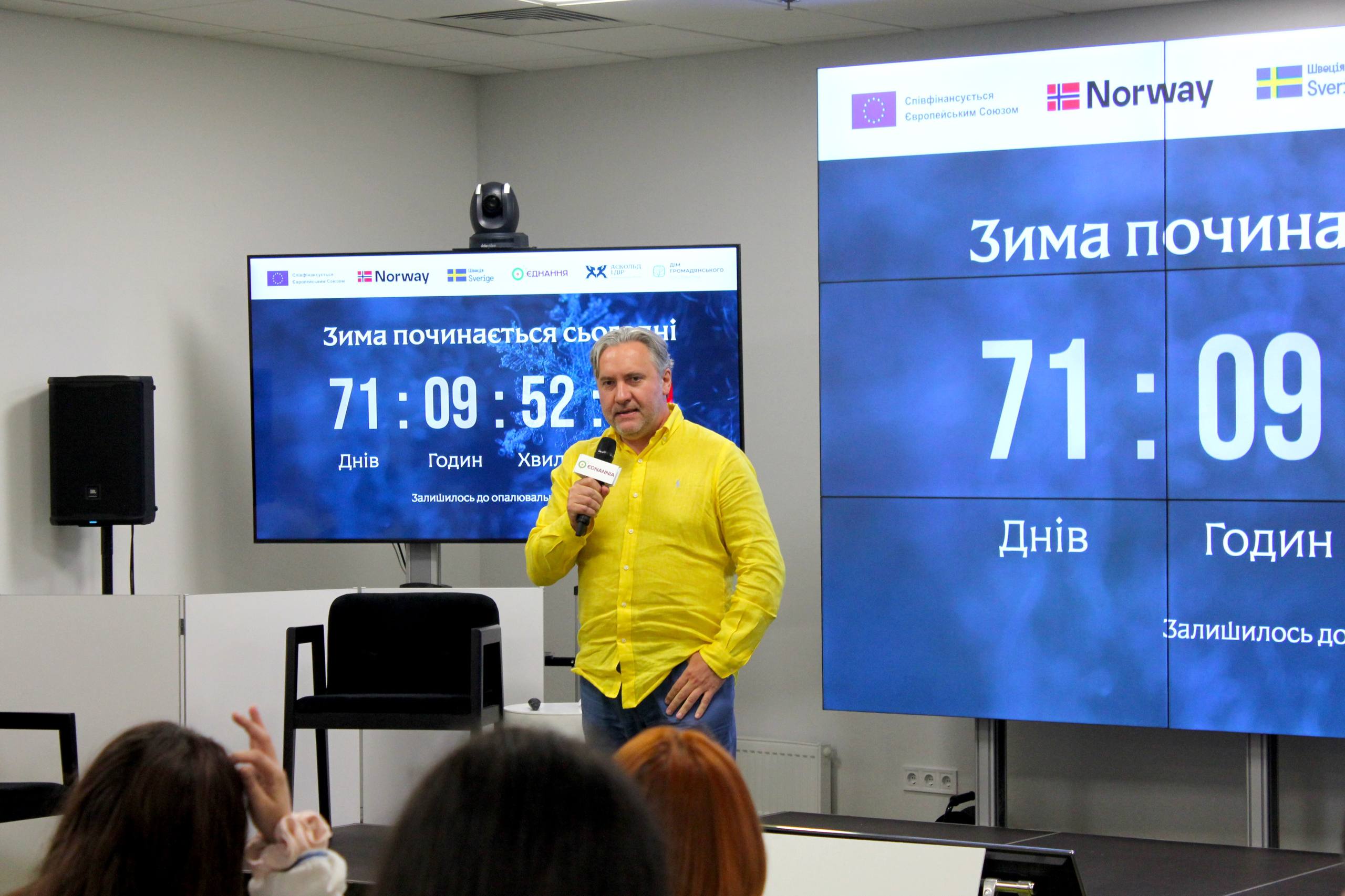
Winter is coming. Only 70 days left before the start of another heating season in Ukraine.
It could become one of the country’s most challenging winters since the start of the full-scale invasion. Continued attacks on energy and civilian infrastructure, combined with the growing pressure on communities, mean that preparation cannot wait.
❓One question guided us: What needs to be done now to ensure that civil society organizations can continue supporting people when winter arrives?
To explore practical answers, ISAR Ednannia organized and facilitated a closed practitioners’ meeting, “Winter Starts Today,” bringing together civil society organizations, donors, government institutions, and experts.
The discussion focused on one shared goal: strengthening the resilience of Ukraine’s civil society before the next crisis unfolds.
Here are some of the key takeaways:
🔹 Preparation cannot wait. Business continuity plans, backup power, reliable communications, and essential equipment should already be part of every organization’s planning.
🔹 Coordination is just as important as resources. Civil society, local authorities, and communities need to coordinate their efforts in advance to avoid duplication and respond more effectively to people’s needs.
🔹 Communities need clear emergency protocols. Everyone should understand their role and know how to act before a crisis unfolds.
🔹 Prepared communities are more resilient communities. People need practical guidance on how to cope with prolonged disruptions to electricity, heating, water supply, and communications.
🔹 Donors have an important role to play before a crisis begins. Investing in organizational resilience, energy resilience, and preparedness enables civil society organizations to continue delivering essential services throughout the winter.
🔹 Civil society organizations also need to invest in their own resilience. Organizations can only support communities if they are able to keep operating under difficult conditions.
Recognizing these challenges, ISAR Ednannia is preparing a new round of grant support through the Askold and Dir Fund, supported by Norad and Sida, to help Ukrainian civil society organizations strengthen their capacity for the months ahead.
After analyzing participants’ feedback and suggestions, we decided to launch a new grant competition called “Get Ready!”, inviting civil society organizations to join the competition and develop a winter preparedness plan.
Key findings and recommendations from the consultation meeting
"The Best Investment Is People": How the "iHELP" Foundation Brought Cinema to Frontline Communities and Learned to Write Grants

The Recovery and Development Consultants program is a training initiative of ISAR Ednannia, implemented with the support of the European Union. It trains specialists who help communities recover and develop, establish partnerships between authorities and citizens, launch local change projects and attract funding. Participants are people from NGOs, local governments and business initiatives who are already working at the local level and want to do it more systematically.
How It All Began
Anatoliy Dziubenko, co-founder of the "iHELP" charitable foundation, explains that in the first days of the full-scale invasion he decided to help a local volunteer initiative that was preparing and delivering food to shelters, kindergartens, and a maternity hospital.
Over time, the team realized they needed to organize and establish a charitable foundation so that aid wouldn't be provided haphazardly. That's how the "iHELP" Foundation came into being on April 1, 2022.
"At first we worked in Kyiv region, but after its de-occupation we redirected our efforts eastward — to Bakhmut, Avdiivka, and Lysychansk. Many of the foundation's staff are originally from Kherson region. I myself lived between two cities — Kyiv and Kherson. So after Kherson's de-occupation, we headed there with a large humanitarian convoy — a truck and vans loaded with food," Anatoliy says.
For the Children of Kherson Region: From Gifts to a Cinema
In 2022, the foundation launched the charitable campaign "For the Children of Kherson Region from the Children of Kyiv," which continues to this day.
"When we first arrived in Kherson region, we saw that after the occupation many children were very frightened. Some were even afraid to leave their yards. So we reached out to Kyiv educational institutions we cooperated with, and together we collected over 2,500 New Year's gifts and delivered them to children in Kherson region. Since then, this campaign has continued: we keep supporting the educational process, providing school supplies, and supporting children," Anatoliy says.
Another initiative of the foundation is the "Cinema World" (Kinosvit) mobile cinema for children, as the team decided to focus more on developing the educational process.
"We realized that many children from Kherson and Mykolaiv regions, especially from remote communities, had never in their lives been to a cinema. So thanks to benefactors, we purchased a popcorn machine, quality speakers, a cotton candy machine, a projector with a screen, and we try to recreate the atmosphere of a real cinema under these conditions. Screenings usually take place in shelters. At the start of each film, we tell the children about the country where it was made, so they learn something new."
Together with partners, the "iHELP" Foundation also launched the "Social Taxi" initiative, which helps people with disabilities from Kherson and Mykolaiv regions get to hospitals or government institutions to process necessary documents.
From Volunteering to Systematic Work
In August 2025, the "iHELP" Foundation joined ISAR Ednannia's "Recovery and Development Consultants" program.
Anatoliy explains that for a while the foundation operated on the team's own funds as well as donations. Later they realized that to work effectively they needed to scale their projects, find partners, and develop. So when ISAR Ednannia announced the competition for the "Recovery and Development Consultants" program, Anatoliy submitted an application.
"We understand that today all frontline communities have the opportunity to attract donors and partners to improve life in their communities. The problem is that we often lack understanding of exactly how to do this and what's needed for it," Anatoliy shares.
He also adds that his team strives to develop in the humanitarian sector as professionals and to work in accordance with international standards.
"This training became a new stage for us in understanding humanitarian sector standards. For me, first and foremost, it was important to understand how different organizations interact with one another. And also what exactly donors expect from us," Anatoliy adds.
Anatoliy shared that during the training, theory was combined with practice, which was very interesting. One stage of the program is a training-of-trainers, which he has already completed and is now preparing to conduct his own training.
Life After the Training
Anatoliy says the "Recovery and Development Consultants" program helped his organization better prepare to attract resources and understand how to work with international partners.
According to him, during the training he also learned how to work with grant applications, reporting, and official communication. After the program, the team applied for the "Social Taxi" project in order to implement it in Mykolaiv region as well, using the knowledge gained during the training.
"Later we wrote a grant application for the 'Cinema World' children's cinema and received 240,000 hryvnias for its implementation. We try to create a real cinema atmosphere for children — with a big screen, good sound, and a projector. When we launched the project, we hadn't seen anything like it in the civil society sector. And now other organizations have started adopting such initiatives. That's great, because our main goal is for as many children and young people as possible to get acquainted with the art of cinema," Anatoliy says.
He adds that the team is now working to make their projects sustainable, so they can continue operating even without the foundation's involvement. In particular, they are analyzing the effectiveness of "Social Taxi," engaging local business in its development, seeking international partners, and have already submitted a funding application to the Canadian government.
"Don't Doubt Your Actions"
Anatoliy advises other organizations still considering whether to participate in the "Recovery and Development Consultants" program to fill out an application:
"Don't doubt your actions. If you have a goal and a mission, ask yourself: does this program bring you closer to achieving your organizational goals? If so — don't hesitate, apply. This program is, first and foremost, experience, opportunities, and new connections. And the best capital there can be is people."
November 26, 2026, the XV Civil Society Forum will take place

Save the date for the XV Civil Society Forum — 26.11.2026!
On November 26, 2026, the XV Civil Society Forum will take place — the key event for those shaping change in Ukraine.
For the fifteenth time, the Forum will bring together those who are changing and developing the country: civil society organizations, charitable foundations, volunteers, activists, government institutions, international partners, businesses, and everyone who believes that a strong civil society is the foundation of a strong and resilient state.
Click "Going" on the event on our Facebook page so you don't miss any announcements about the XV Civil Society Forum: https://www.facebook.com/share/18uNmfvR2M/
Year after year, the Forum grows bigger, stronger, and more ambitious. We keep raising the bar — and that's why we're looking for bold ideas and partnership proposals that inspire, surprise, and leave new meaning behind.
If you can suggest:
a topic that deserves to be part of the Forum's main discussion;
a format that will surprise our loyal, longtime participants;
a speaker whose voice matters especially today;
or a partnership idea —
tell us about it.
Open Call for Proposals!
https://forms.gle/eVTNdWdf6Z8yx8468
Please note: this form is not registration for the Forum.
It is designed to collect proposals for partnerships, sponsorship, speakers, workshops, interactive formats, and other contributions within the XV Civil Society Forum.
We will carefully review every proposal and will be sure to get in touch if it fits this year's Forum concept.
Join us in shaping the XV Civil Society Forum. The best ideas are born together.
“You will not know unless you try” A specialist of the youth center from Kamyanske helps youth to participate in the community life

The Recovery and Development Consultants program is a training initiative of ISAR Ednannia, implemented with the support of the European Union. It trains specialists who help communities recover and develop, establish partnerships between authorities and citizens, launch local change projects and attract funding. Participants are people from NGOs, local governments and business initiatives who are already working at the local level and want to do it more systematically.
Olha Vinnichenko has been working at the municipal institution “Center for Youth Initiatives” of the Kamyanske City Council for 5 years. Until recently, this was the only youth center in the Kamyanske district.
Kamyanske is a city in Dnipropetrovsk oblast. Its broader district consists of 12 communities and they still have only two youth centers. In August of 2022 together with her colleagues Olha established a civil society organization “Space for Initiatives”. The main priorities of this NGO are: work with youth, conducting informal educational events and integration of the IDP youth to the community.
“Back in 2022 we did a lot of things, but now we are returning to our main focus – youth, informal education, integration of IDPs. However, the sphere of our activities is much broader than it seems”, says Olha.
Youth center and NGO cooperate closely as partners. Over three years they have opened two veteran spaces, Center of resilience and also implemented the project Youth Media Lab.
She was not accepted into the program on the first attempt
Olha applied to the Recovery and Development Consultants program together with a colleague. Initially, only the colleague was selected to participate, but later she was unable to join the training. Then Olha wrote to the organizers on her own and was given the opportunity to join the program.
“Before participating in the program, me and my colleagues already implemented different projects related to the issue of recovery. We also participated in the program "VidNOVA:UA" not only in Kamyanske but also in the Zhytomyr region. Over the years I worked there as an educational manager, and also a manager of youth exchange. We also implemented this program in Kamyanske. Last year we implemented another project that we authored, related to the involvement of youth to the processes of recovery and decision making. Within this project we conducted training for trainers and ideathon. So this topic was not new for us”.
Olha also adds that recovery is a broad notion.
“Recovery is not only about material reconstruction of the buildings. The notion is much broader and relates to the social, cultural recovery, restoration of the social ties. It was important for me to understand how ISAR Ednannia together with European partners see this process in a broader sense”.
“Now I approach organization of different events in a new light”
Olha participated in the educational program twice: first she finished a basic course for consultants, and then - a training for trainers.
“First I was bewildered by how modules and sessions were organized, but then I adapted. Discussions were so active that sometimes it was difficult to stop them when time was up. The team that conducted the training is just incredible. It was also a very friendly and open group, with whom we cooperated. Everyone was really involved and interested”.
Olha found training for trainers to be most enlightening, since it helped her to change her understanding of how the educational processes should be organized.
“I really learned a lot of things about organization and conduct of educational processes. We were provided with the feedback even concerning the minor details. For instance, what colour of markers is preferable to use over the others. Or the colour of the paper. Some thought: why do we need to go into such detail? But then you understand that this really influences perception and learning. Now I approach the organization of different events in a new light.”
Life after the training
After training Olha and her team prepared 2 ideathons for teenagers – events, where youth worked on creating their own ideas about the development of the community,
“After the training my understanding and approach towards organizing everything has changed. Now I analyze more using the perspective we were told about: how the logic of the process should be developed, how we move from one stage to the next one. Logical beginning, a bit of theory, practice and obligatory reflection. So that the participants understand why they are doing all of this. ”
Olha recounts how she consulted several educational institutions that applied for the specialized competition. Among other things she helped to prepare an application for refurbishment of the school dining halls and worked on the project budget.
”Here I needed the knowledge of project management that I gained during the training”, notes Olha.
Also, according to Olha, a meeting with the head of the Kamyanske regional council was held, where the development of the youth policy in the community was discussed.
“We discussed the strategic issues and ways of scaling our ideas,” adds Olha.
“Just apply”
To all those organizations that are afraid to apply for the Recovery and Development Consultants program, Olha suggest:
“You have to try despite your fear. Sometimes it may seem that your experience or knowledge is not sufficient but some of the participants were from very different communities, of different ages, with different experiences. Unless you try you will not know if you meet the criteria”.
The programme is implemented within the framework of the EU Unity4Community project, funded by the European Union.
This publication was produced with the financial support of the European Union. Its contents are the sole responsibility of ISAR Ednannia and do not necessarily reflect the views of the European Union.