Home
Home
Practice instead of theory: how training helped develop a community during wartime

The Recovery and Development Consultants program is a training initiative of ISAR Ednannia, implemented with the support of the European Union. It trains specialists who help communities recover and develop, establish partnerships between authorities and citizens, launch local change projects and attract funding. Participants are people from NGOs, local governments and business initiatives who are already working at the local level and want to do it more systematically.
How it all began
Myroslava Zhylina is the program director of the Podilska Hromada Community Foundation in Vinnytsia. Myroslava is from the Donetsk region: when Russia’s invasion of Eastern Ukraine began in 2014, her husband volunteered to fight in the army. In 2015, after he was wounded, the family moved to Vinnytsia. Myroslava says that before moving, she was not involved in the civil society sector. However, once she found herself in a new place and needed to adapt to society, she began attending various events supporting internally displaced persons.
“In the beginning I just visited events, then I began volunteering, then started working in one organization. And starting from 2021 I work in the Podilska Hromada Community Foundation.”
A foundation that is 18 years old
"Podilska Hromada" is not a classic civil society organization or a common charitable foundation. It is a community foundation whose main task is the development of the community itself.
"Our task is to develop the Vinnytsia community. To do this, we strengthen the culture of philanthropy and establish interaction between business, government, and the public. We try to solve the current problems of the community, as defined by the community itself. Almost every year we conduct a survey to understand these needs, and based on the results obtained, we plan our work and support," explains Myroslava.
The organization has existed since 2008. On May 23, it turned 18 years old. The foundation employs 9 people, as well as a supervisory board of 11 members and a representative council. Since 2022, within the framework of the Vinnytsia humanitarian hub, the foundation has been providing support throughout Ukraine, primarily to frontline territories, de-occupied communities, and the military.
Among the organization’s strategic areas of work are the development of the Vinnytsia community, strengthening the culture of philanthropy, increasing organizational capacity, and ensuring the resilience of the community in the face of a full-scale invasion.
One of the current projects of the fund is “Community on Security Guard”, implemented by ISAR Ednannia with the support of the European Union. Within its framework, fire hydrants are installed in the Vinnytsia community, trainings are held in emergency medical help, public first aid kits are equipped, and security packages are handed over to condominiums.
“This support is really important for us, because currently people really need community security to become stronger”, says Myroslava.
Trainings: practice instead of lectures
Myroslava has participated in the Recovery and Development Consultants program twice: first she completed the training for trainers, and later she became a participant in the second wave of the program for consultants.
“It seems to me that the goal of this training is to form a community of consultants who are partners of the community in recovery and development. This is exactly our goal as a community foundation,” she explains her decision.
She also adds that her particularly noticeable gap was in the knowledge of the legislative processes and the work of local government.
“Before this I did not really know legislative initiatives that well. So for me this was a very useful specialised training”.
Myroslava says that the training process was well planned and practically oriented. During the five-day training for trainers, she received many useful tools and techniques that helped her deepen her knowledge and skills.
“I was very impressed by the special approach of the team of trainers to the training, the availability of handouts and instructions. They simply give you ready-made clear templates and algorithms, which you can then use in your work,” she says.
She noted that the "Recovery and Development Consultants" program was thoughtfully structured — progressing from ethical principles through to community partnership and facilitation.
Myroslava notes that the Recovery and Development Consultants program was logically structured: from ethical principles to community partnership and facilitation.
New topics that she learned through the program included local policy development, the work of parliament, and mechanisms for involving the public in decision-making.
The next step in Myroslava’s training is to conduct training in her own or a partner community. On June 13, she and her colleague are planning to conduct such a training in Boyarka, in the Kyiv region.
Life after training
Myroslava immediately began to implement the knowledge she gained during the training into practice. The foundation is currently administering the project “Community in Action: Participation Tools for Recovery”. And the tools for engaging the public that were discussed in detail during the trainings became the basis for this current project.
“Since we paid a lot of attention to public engagement and participation tools, this is extremely relevant for me now,” she says.
After the training, the foundation’s team has already conducted trainings on fundraising, grant writing, and project management for other organizations.
“I started feeling much more confident because we studied very well all kinds of training tools,” says Myroslava.
The foundation constantly receives many requests, from humanitarian aid to community development needs. According to Myroslava, this requires resources, but the knowledge gained during the training helps to find not only funding, but also partnerships and other support opportunities.
The organization continues to develop the Vinnytsia community, supports rehabilitation institutions, advises civil society organizations and shares experience with newly created initiatives.
As one of the oldest civil society organizations in the region, the foundation often receives requests for mentoring and consulting. However, due to the large volume of current work and humanitarian projects, sometimes there is not enough time and resources to systematically engage in these activities.
“I want to work more with business, develop corporate social responsibility and share my experience,” says Myroslava.
She adds that the training has influenced not only individual projects, but also the approaches of the organization as a whole. The team is already using the knowledge gained when developing new initiatives in the areas of European integration, strategic communications and cooperation between local governments and civil society organizations.
The program has also helped the foundation to strengthen its expertise in community renewal, involving residents in decision-making and developing partnerships between the government, business and the civil society sector. The tools for analyzing community needs, facilitating dialogue and finding joint solutions to solve local challenges have become particularly useful.
According to Myroslava, thanks to this, the foundation is gradually developing: it is no longer just providing assistance or grants, but is also becoming an organization that helps communities better plan development, unite people and resources for change.
“It’s not that difficult”
For those who hesitate about applying for the program, Myroslava advises to simply take the first step.
“If you start filling out the application, you will see that everything is not so difficult, but on the contrary - interesting and motivating. In addition to knowledge and skills, you also gain this extraordinary community that will then surround you. Simply extraordinary people who do the possible, and sometimes the impossible, for the development of their communities,” she concludes.
The programme is implemented within the framework of the EU Unity4Community project, funded by the European Union.
This publication was produced with the financial support of the European Union. Its contents are the sole responsibility of ISAR Ednannia and do not necessarily reflect the views of the European Union.
“Be afraid, but do it.” How an activist from the frontline Kherson region teaches communities

The Recovery and Development Consultants program is a training initiative of ISAR Ednannia, implemented with the support of the European Union. It trains specialists who help communities recover and develop, establish partnerships between authorities and citizens, launch local change projects and attract funding. Participants are people from NGOs, local governments and business initiatives who are already working at the local level and want to do it more systematically.
Danylo Shchogol grew up in the village of Dar'ivka in the Kherson region, a community that was under Russian occupation in 2022. Together with like-minded people, in 2017, Danylo created the initiative group "Dar’ivska Hromada", which on October 20, 2019 became an official civil society organization working in the community uniting 15 villages.
"We realized that we need to provide a legal basis for our activities. When you want to work with larger partners and donors, raise funds, and participate in open competitions, an initiative group is no longer enough. You need a civil society organization," Danylo explains. He also adds that the goal of their NGO "Dar’ivska Hromada" is to promote the comprehensive development of the community, strengthen its capacity, and increase the level of public participation.
After the de-occupation of the Kherson region, the organization focused on humanitarian aid - they helped with food, hygiene products, and delivered aid in a targeted manner, paying special attention to the most vulnerable categories of the population. And thanks to French partners, they brought medical equipment to the local hospital.
Currently, the NGO "Dar’ivska Hromada" is not as active as before the full-scale invasion, as Dar’ivka is located near the contact line and is under constant shelling.
"It is difficult to talk about recovery and reconstruction in a community that is literally surviving. Currently, we almost do not engage in a humanitarian mission in the community, because it is less and less needed. Currently, in the Kherson region in general, and in Dar’ivka in particular, specialized organizations are working to evacuate the population and provide targeted assistance," says Danylo.
Therefore, Danylo is now focused on coaching and helping other communities organize and develop.
"I really wanted to participate in this program"
Danylo says that when he saw the recruitment for the training of trainers of the "Recovery and Development Consultants" program, he decided to submit his application.
Danylo has been training communities and civil society organizations for three years and works with various organizations: the Charitable Foundation "Rokada", the NGO "Southern Development Strategy" and the NGO "Educate for Ukraine". The trainings are mainly aimed at those people who work directly in the social or educational sphere: social workers, educators, veteran support specialists and those who work with vulnerable groups of the population.
“Before the program, I lacked a holistic and systemic vision. University education in social work is actually of a good quality, but it does not always keep up with modern demands and challenges. In particular, we do little research on the issue of comprehensive community restoration and their resilience. And this is extremely important, because a social worker in a community must know how to restore trust there, how to create a barrier-free space, and how to integrate all community residents into decision-making processes. It was important for me to understand how ISAR together with its European partners see this process – not only in terms of infrastructure or architectural issues, but in a broader sense,” he says.
The submission process took three days – Danylo was putting together a portfolio so as not to lose or forget anything.
“I really wanted to get into this program,” he says.
"At first it was a little scary, because I was the youngest participant. But the trainers did a fantastic job and by the third day of training everyone had started feeling as if we belonged to one group. We still communicate and call each other, help each other, and share achievements. This is greatly facilitated by both our team of trainers and ISAR Ednannia."
The training combined lectures with practical exercises and analysis of real community cases.
Life after training
After the training, Danylo and his colleague conducted a pilot training for the community of the city of Ukrainka. According to him, he was a little nervous before his first work with the community, but the preparation turned out to be of high quality.
"The materials we received as trainers are very high quality. After studying them, you just go and work with the community," he says.
Danylo shared his knowledge with students of the Faculty of Psychology of Taras Shevchenko National University of Kyiv, for whom he conducted classes as an assistant. He also uses his newly acquired experience developments during trainings for communities in different regions of Ukraine.
At the same time, Danylo emphasizes: the role of a trainer is not to offer ready-made solutions to the community.
"It is important to understand that a coach is not some sort of super expert who decides everything for the community. We are mediators. We can help people self-organize, highlight problem areas, create a platform for dialogue, and update their experience. Because only the residents of the community decide what it should look like in the future, in partnership with local governments, business, civil society, and the media. You definitely don't have to be a magic wand, because you really aren't it," he says.
The training also influenced his own vision of recovery processes. Danylo says that after the program he better understood how community development should take place and what to focus on when working with people.
"In my work and trainings, I began to use new tools and place different emphasis. It's not just about infrastructure restoration, but also about restoring trust as the main capital of the community. A lot of people don't realize that many problems arise precisely because of its lack," adds Danylo.
“Do not belittle your achievements"
Before applying for participation in the Recovery and Development Consultants program, Danylo Shchogol advises you to carefully read all the requirements, soberly assess your capabilities, and in no case belittle your achievements.
"I advise you not to be afraid to apply. Once I was not selected for my first educational program - it was a real tragedy. But I did not give up. And I applied for three others. There are a lot of opportunities now. So everyone who is afraid - be afraid, but do it."
The programme is implemented within the framework of the EU Unity4Community project, funded by the European Union.
ISAR Ednannia at URC 2026: Partnerships, Experience, and Solutions for Ukraine's Recovery and European Future
Ukraine Recovery Conference 2026 in Gdańsk brought together governments, international organisations, civil society, businesses, and development partners to discuss Ukraine's recovery and its path towards European Union membership.
A strong message echoed throughout the conference: Ukraine's recovery cannot succeed without a strong and active civil society. Across the country, civil society organisations are supporting communities affected by the war, driving reforms, strengthening local leadership, and building partnerships that bring together government, communities, and international partners.
This vision is reflected in the Gdańsk Common Message, developed by Ukrainian and international civil society organisations ahead of URC 2026. The Message calls for civil society to be recognised as a full partner in Ukraine's recovery, with a meaningful role in shaping policies and decision-making at every stage of the process.
Read and endorse the Gdańsk Common Message here: https://democracyendowment.eu/assets/Gdansk-Common-Message.pdf
These are the principles that guide ISAR Ednannia's work. At Ukraine Recovery Conference 2026, we contributed to this conversation as an organiser, partner, and participant through a series of official events.
ISAR Ednannia at URC 2026: Ukrainian Civil Society's Experience in Community Recovery
As part of the "Resilience Through Partnership: Communities Acting Together" workshop, organised by the National Project "Shoulder to Shoulder: Cohesive Communities," ISAR Ednannia's Executive Director, Volodymyr Sheihus, presented practical examples of how ISAR Ednannia and Ukrainian civil society are supporting local initiatives, strengthening communities, and contributing to recovery during the full-scale war.
During the international panel discussion, he shared how, for more than 30 years, ISAR Ednannia has been investing in community development, strengthening local civil society organisations, and building both individual and organisational capacity. Today, this experience helps communities not only respond to the challenges of war but also build a strong foundation for long-term recovery.
Read more in our full article.
Two Official URC 2026 Side Events
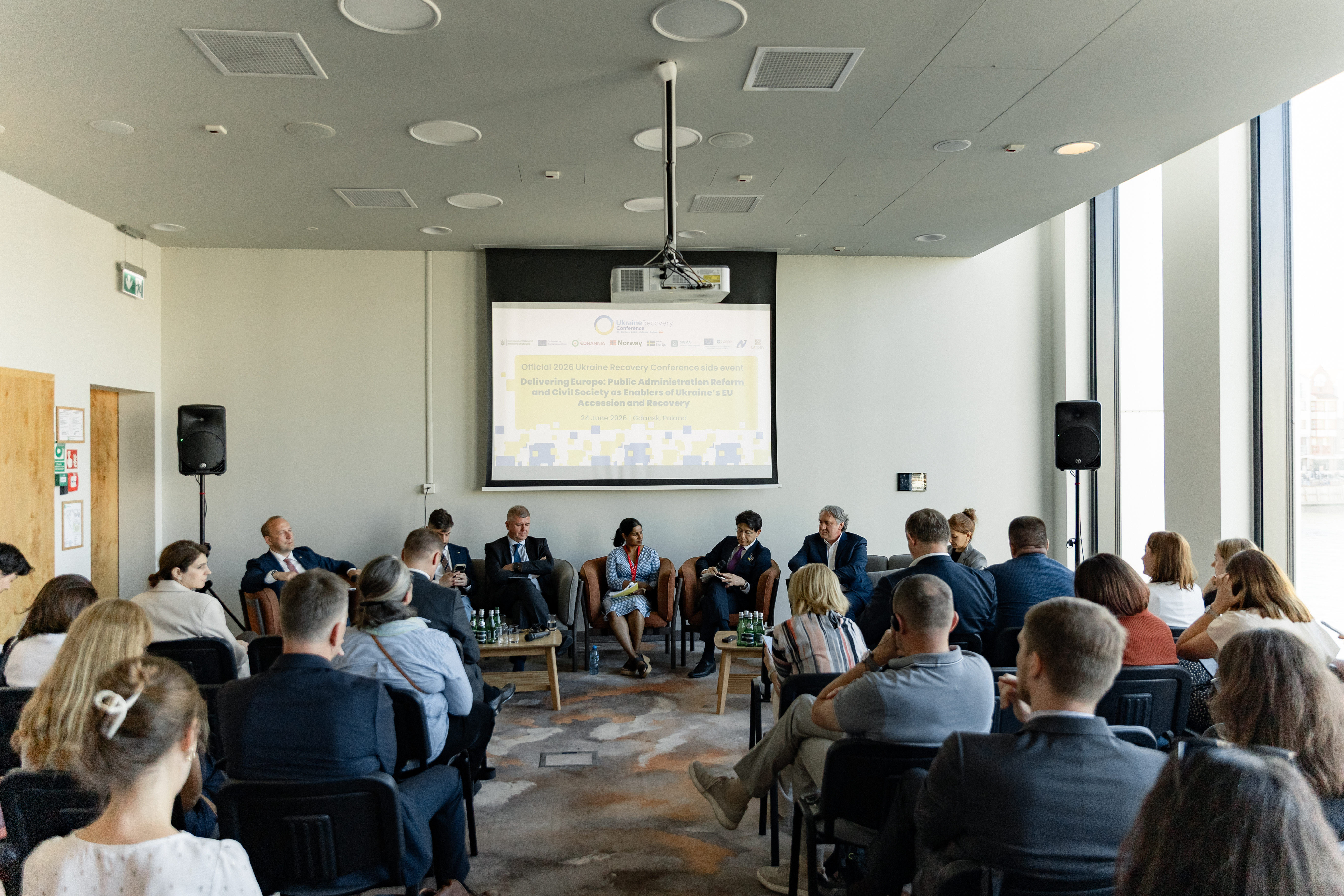
Delivering Europe: Public Administration Reform and Civil Society as Enablers of Ukraine's EU Accession and Recovery
Together with government representatives, civil society organizations, and international partners, we explored how public service culture, human capital, partnership, and trust can strengthen public administration and support Ukraine's path towards EU membership and recovery.
A key focus of the discussion was the role of civil society as a trusted partner in advancing public administration reform and Ukraine's European integration.
Read the key takeaways in our full article.
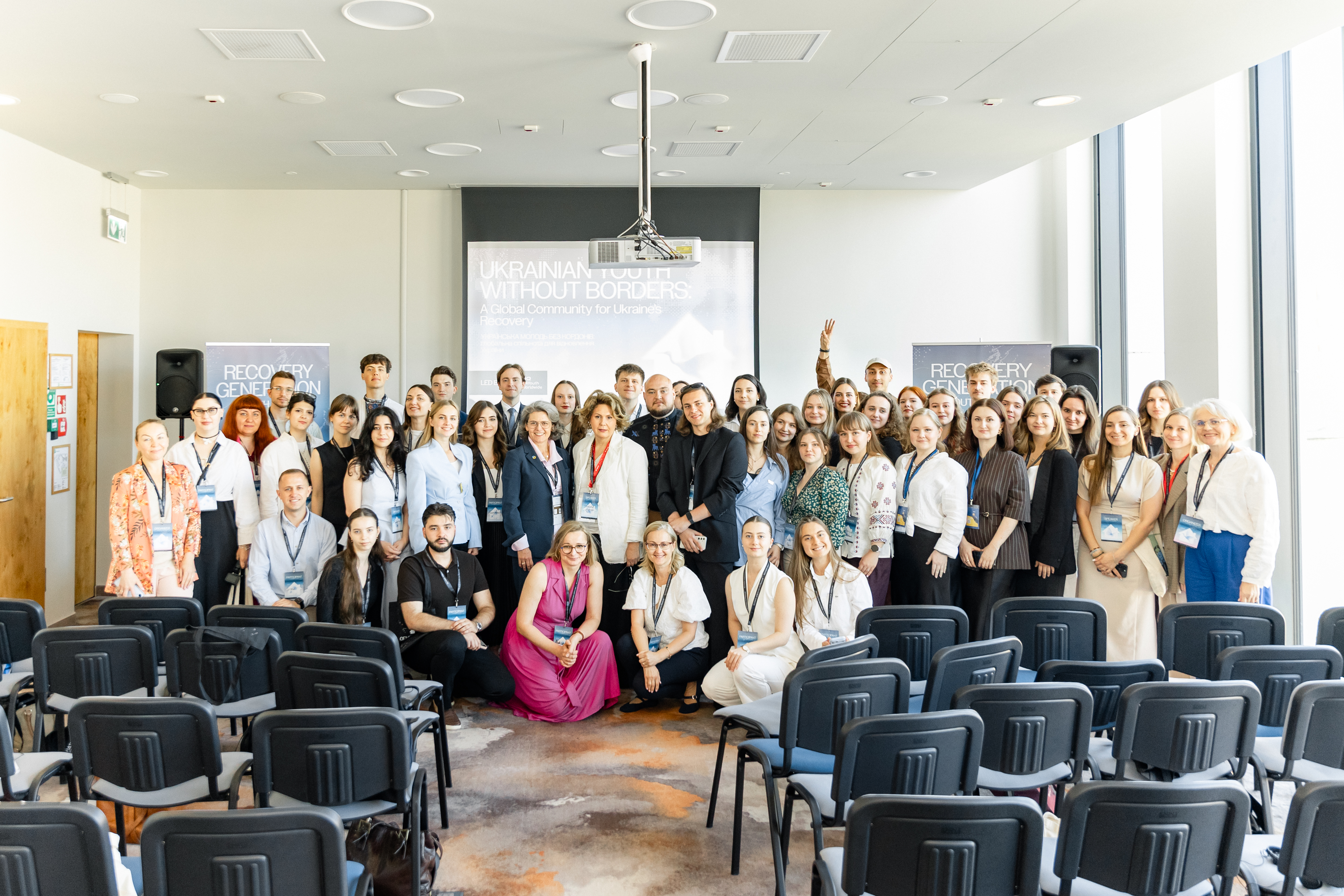
Recovery Generation Youth House
Together with the Ministry of Youth and Sports of Ukraine, ISAR Ednannia co-organized Recovery Generation Youth House — a side event dedicated to the role of young people in Ukraine's recovery.
The discussions focused on youth participation in decision-making, community development, and creating opportunities that enable young people to realize their potential.
Learn more in our full article.
ISAR Ednannia Grantees at URC 2026
URC Podcast
With the support of the Askold and Dir Fund, implemented by ISAR Ednannia and , funded by Norway and Sweden, URC Podcast was launched during Ukraine Recovery Conference 2026. The series of strategic interviews and public conversations is produced by the Kateryna Osadcha Foundation in partnership with the Ministry of Economy of Ukraine.
The initiative aims to strengthen international advocacy for Ukrainian youth as an essential part of the country's recovery. Discussions focused on human capital development, career guidance, employment, encouraging young Ukrainians to return home, and creating new opportunities for professional growth in Ukraine.
Guests of the URC Podcast included representatives of the Ukrainian government, international institutions, businesses, and the expert community, who discussed key challenges and solutions for Ukraine's future.
Watch the interviews here.
Recovery Talks: An Evening Where Partnerships Begin
Our grantee, Recovery Window NGO, organized Recovery Talks: An Evening Where Partnerships Begin as part of URC 2026.
The event created a space for networking between international partners, donors, civil society organisations, media representatives, and practitioners working on Ukraine's recovery. Its format encouraged meaningful conversations, new connections, and partnerships that can grow into future recovery initiatives.
High-Level Roundtable on Ukrainian Media and Information Resilience
As part of the official URC 2026 programme, Recovery Window NGO also organized the High-Level Roundtable on Ukrainian Media and Information Resilience, dedicated to the role of independent media in Ukraine's recovery and European integration.
Participants explored how independent journalism, access to information, open data, and the safety of journalists contribute to accountability, public trust, and information resilience. The discussion also highlighted the importance of supporting local media and strengthening Ukraine's media sector as a key pillar of democratic recovery.
Building Partnerships for the Future
For ISAR Ednannia, URC 2026 was an opportunity to showcase the experience of Ukrainian civil society on the international stage, strengthen existing partnerships, and build new ones.
Throughout the conference, our team met with international donors, government partners, civil society organisations, and international institutions. These conversations laid the foundation for new partnerships, joint initiatives, and future collaboration to support Ukraine's recovery.
The conference also provided a valuable opportunity to demonstrate the practical role of civil society in Ukraine's recovery as a trusted partner of government, local communities, and the international community.
It is through partnerships like these that we can build a more resilient Ukraine and advance its European future.
Showcasing Ukrainian civil society’s experience in supporting community recovery at URC 2026
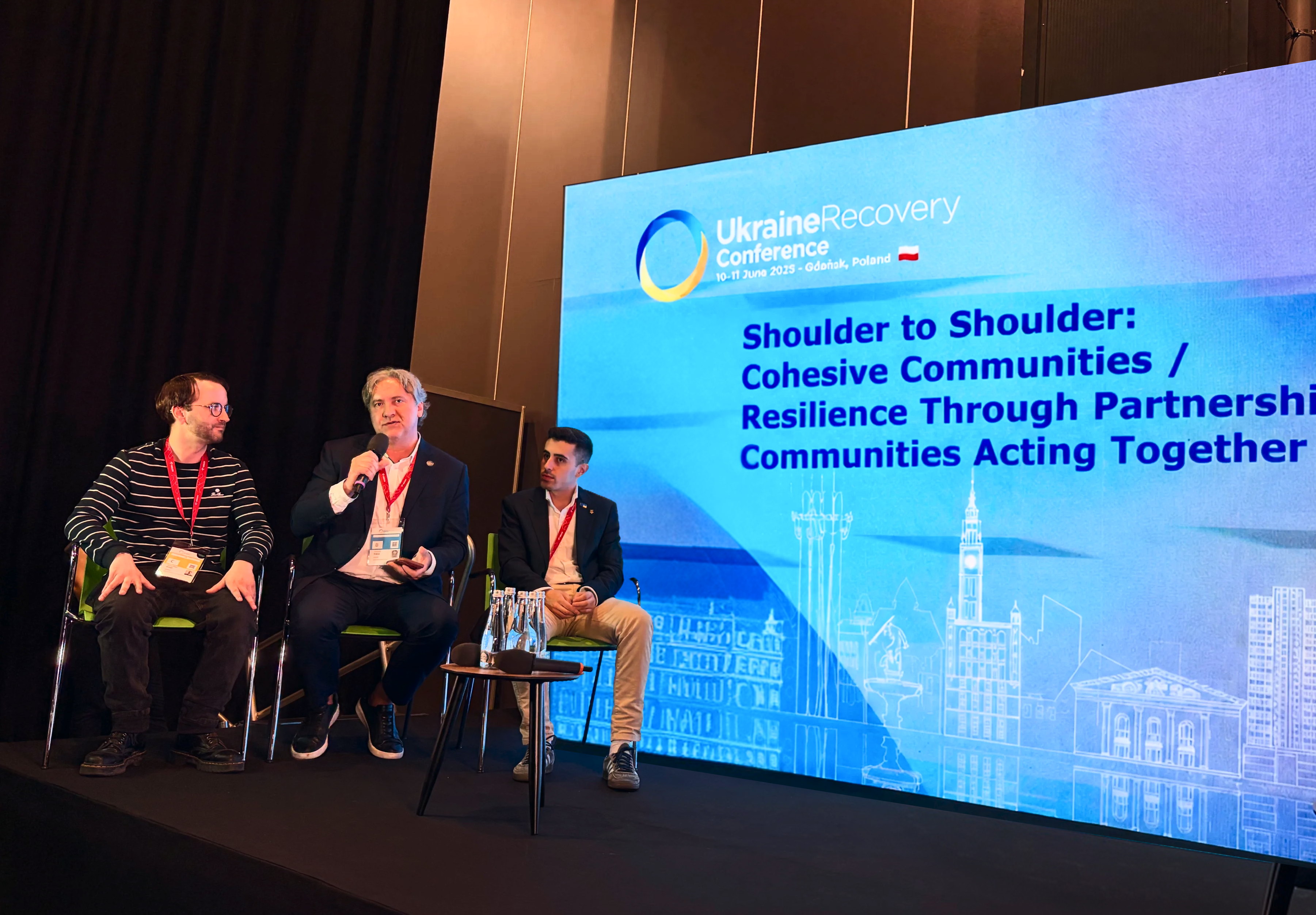
At the workshop “Resilience Through Partnership: Communities Acting Together,” organized by the National Project “Shoulder to Shoulder: Cohesive Communities,” ISAR Ednannia Executive Director Volodymyr Sheihus presented the practical experience of ISAR Ednannia and Ukrainian civil society in supporting local initiatives, strengthening community capacity, and advancing recovery efforts during russia’s full-scale invasion of Ukraine.
During the international panel discussion, he highlighted that for more than 30 years, ISAR Ednannia has invested in community development, strengthened local civil society organizations, and built both individual and organizational capacity.
Today, this long-standing experience enables communities not only to respond to the challenges of war, but also to lay the foundations for sustainable recovery.
Among the initiatives already making a difference at the local level:
▫️ Recovery and Development Consultants — a growing community of professionals helping local authorities design high-quality projects, access funding opportunities, and deliver sustainable recovery initiatives.
▫️ Support for local initiatives — from emergency humanitarian response to long-term programmes that strengthen community resilience and support recovery.
▫️ Unity Points — a new initiative that will soon begin rolling out across Ukraine, creating collaborative spaces where civil society organizations, local authorities, and active citizens can work together to strengthen communities and implement local initiatives.
💬 “We encourage public institutions, civil society organizations, and the private sector to come together at the local level to improve people’s lives, rethink community recovery, strengthen communities, and move forward together on Ukraine’s path to the European Union,” Volodymyr Sheihus emphasized.