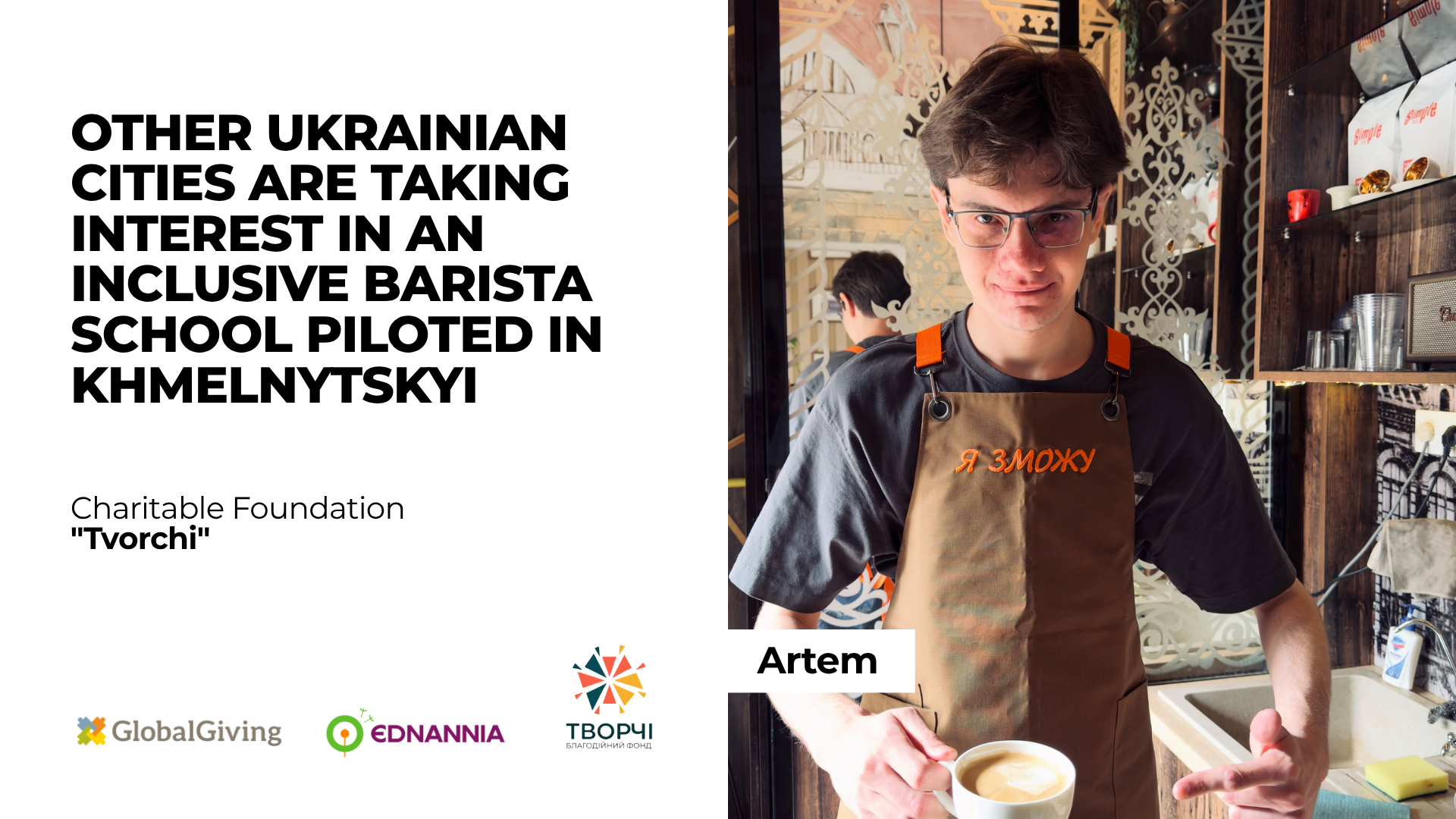
It has always been hard for people with disabilities to get a profession and then actually earn a living from it. Unfortunately, this situation is still common in Ukraine today. As a result, young people are pushed to the margins of the labor market, and communities lose people who, given the right conditions, could be active and self-sufficient. But in spring 2026, a community initiative appeared in Khmelnytskyi that shows how the needs of these young people can be combined with... the coffee business, creating a win for everyone.
The thing is, at most cafés, staff don't stay long: young men and women are happy to work as baristas while they're studying, and then they move on. So café owners are constantly stuck searching for and training new people. At the same time, young people with disabilities dream of stable, long-term work — but who's going to teach them the barista profession, and how?
Charitable Foundation "Tvorchi" from Khmelnytskyi decided they were the ones who could build an inclusive barista school. According to foundation co-founders Andriy Shcherbytskyi and Ilona Bilyk, they put the idea on paper under the name "I Can!", submitted an application to the "Sparks of Communities" grant competition by ISAR Ednannia and GlobalGiving, and ended up among the winners. The project launched on April 1, 2026: 12 residents of Khmelnytskyi with disabilities, aged 16 to 25, began their path toward becoming baristas.
Overall, the training consisted of three parts. First came the theoretical classes: the history of coffee, service standards, hygiene, financial literacy. Then practice began: participants learned to make coffee on professional equipment, froth milk, calculate the right proportions, and even create simple latte art. There were also field trips to a coffee production facility and a bakery, to show the young people other paths in the field in case barista work didn't turn out to be right for them.
The project came together thanks to the support of several partners — the "Hesed Besht" Charitable Foundation, the NGO "Podilskyi Prostir," and Mykhailo Kvoka's café chain, which provided space for hands-on practice, its best baristas as instructors, and later committed to hiring at least a third of the graduates.
Special attention was given to psychological support for participants and their parents. 49 hours of sessions with a psychologist helped parents build strong confidence in their children and their ability to be independent. Oksana, the mother of one of the project participants, says that for parents of children with disabilities, it's a big dream for their child to have a profession, to be steadily engaged in something, and to earn a living.
Even before it wrapped up, the "I Can" project had already drawn interest from other Ukrainian cities, including Kyiv, Lviv, Zhytomyr, and Vinnytsia. This shows that the model works, and that when communities, businesses, and donors join forces, inclusion stops being an "empty" word and becomes a working process. The "Tvorchi" Charitable Foundation has built a viable business model that proves the sincerity and diligence of employees with disabilities is a powerful asset for modern service.
The grant competition “Community Sparks: ISAR Ednannia and GlobalGiving Partnership for Resilience” is implemented by ISAR Ednannia with funding from the GlobalGiving platform.