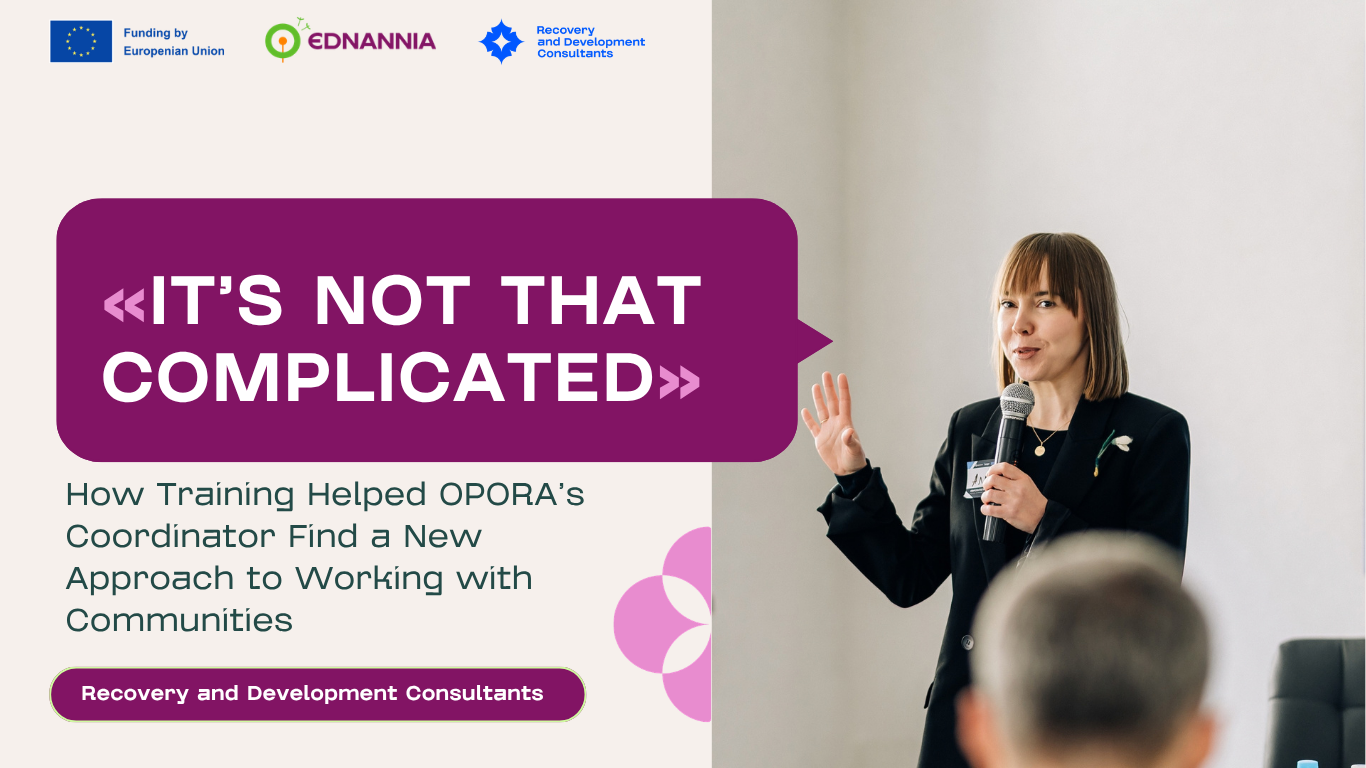
The “Recovery and Development Consultants” programme is a training initiative by ISAR Ednannia, implemented with the support of the European Union. It prepares professionals who help communities recover and develop, build partnerships between local authorities and residents, launch local change initiatives, and attract funding. Participants include people from NGOs, local governments and business initiatives who are already working at the local level and want to make their work more systematic.
From Investigative Journalism to the Civil Society Sector
Alla Maksymchuk is a Project and Communications Coordinator at the Civil Network OPORA in Rivne Region. She joined OPORA almost four years ago, after working as a journalist and conducting investigative reporting.
“At the beginning of the full-scale invasion, I realised that I was burned out: there were too many emotions and crises happening at once. I decided that something had to change, so I left journalism and joined OPORA,” she recalls.
Today, at the regional level, OPORA promotes participatory tools and develops local democracy, works to strengthen community cohesion, facilitates cooperation between local authorities and residents, supports advocacy campaigns, and helps develop documents related to public participation and communication.
“I really enjoy working with communities. There are incredible people and incredible ideas there. And when you work with them, support them and help newly established organisations take their first steps towards cooperation with local authorities, prepare grant applications and so on, it strengthens you as well. And then, when we ‘leave’ a community, that cooperation remains, and people continue creating change. It shows that our work matters.”
“It’s Not That Complicated”
Alla learned about the “Recovery and Development Consultants” programme while completing another project supported by ISAR Ednannia. Despite her busy schedule, she decided to apply.
“I decided that I should open myself up to something new. It was important for me to find out whether our goals, values and vision for the development and recovery of communities align with those of major partner organisations,” she explains.
Alla took part only in the training-of-trainers component. Even participants who did not complete the main training received all the necessary materials to understand the programme’s content and approaches.
According to Alla, the training involved a lot of practical work. Participants worked in teams, prepared parts of the training for their colleagues, and then discussed together what had worked and what could have been done better.
“So it was a very practical training. I had never attended anything like it before. I will take this experience and share it with the communities we work with,” she recalls.
Life After the Training
As part of the practical component of the training, Alla independently conducted an open training session in Rivne on participation tools and policy development.
“I wanted to see whether I could do all of this on my own. Because conducting a training session is actually not easy. It was a kind of test of myself, my abilities, goals and motivation,” she says.
Representatives of communities, young people and local residents who had seen the announcement on social media attended the training.
“Everyone wanted the same thing — to understand how citizens can participate in policymaking at the local level. It is an important topic, especially in the context of Ukraine’s accession to the European Union. Overall, it went quite well. We continue to work with some of the people who attended. It was a useful experience both for us and for them,” Alla says.
She also notes that the Consultants’ handbook, which she received during the training, has had the greatest impact on her work.
“I think this handbook is excellent. It contains all the information a community needs, as well as what someone working with communities in the context of recovery and European integration needs to know. So I am already using it,” she says.
The knowledge gained through the programme also came in handy when creating a video course on Ukraine’s accession to the EU. For one of the videos, she used materials from the programme’s handbook to talk about recovery and cohesion in Ukraine and the EU.
At present, OPORA is preparing new grant applications, including applications to ISAR Ednannia, and continues working with communities because this is where important changes take place.
“Ukraine is not made up of the capital alone. It consists of communities, most of them rural. And the people who live there, their experience — it is immense, invaluable and remarkable. That is why communities should always be given attention, and our projects are specifically focused on them. We do not simply come to a community, work with it and leave. We always leave something behind — a lasting impact and practices that people can continue to use and share. We always support them and help them develop,” Alla says.
“If You’re Not Motivated, There’s No Point in Going”
For those who are unsure whether to apply for the programme, Alla Maksymchuk advises them to listen to themselves:
“If you are not motivated, you feel tired, and you do not genuinely want to take part, I would advise you not to go. There is no need to do something just to tick a box because everyone else is doing it. You need to find something that truly speaks to you.”
But if the programme resonates with you, she says, there is no need to hesitate:
“If you see the programme and feel that you have the strength, energy and desire to help people and communities, support them, and you know that you have experience worth sharing — then you should go for it and give it a try.”
The programme is implemented within the framework of the EU Unity4Community project, funded by the European Union.
This publication was produced with the financial support of the European Union. Its contents are the sole responsibility of ISAR Ednannia and do not necessarily reflect the views of the European Union.
By Elia Serkozhaieva