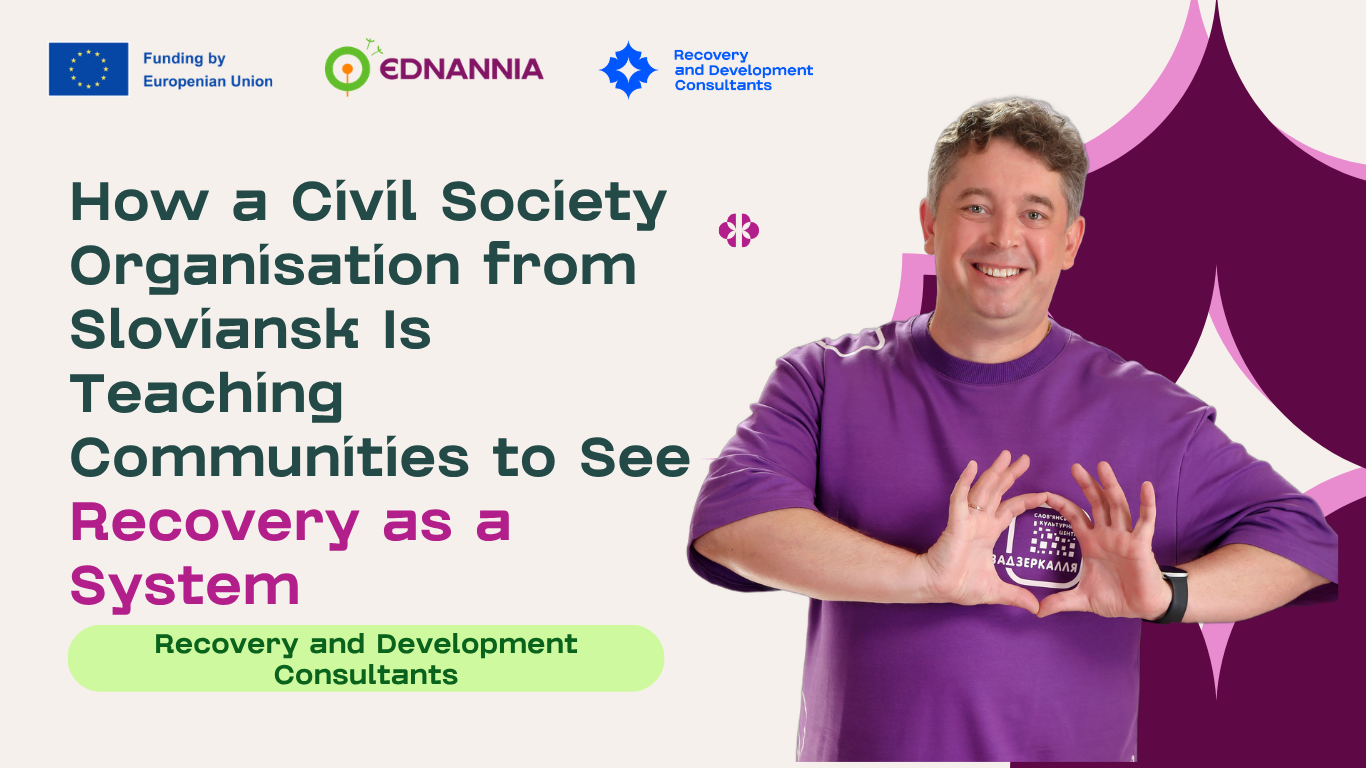
The Recovery and Development Consultants Programme is a training initiative by ISAR Ednannia, supported by the European Union. It prepares professionals who help communities recover and develop, build partnerships between local authorities and residents, launch local change initiatives, and attract funding. Participants include people from NGOs, local governments, and business initiatives who are already working at the local level and want to make their work more systematic.
Oleksandr Kashlakov has been working in the civil society sector since 1996, when he headed one of the children’s NGOs in Donetsk region. Today, he leads the Slavyansk Cultural Centre “Zadzerkallia”. Founded in 2005, the local organisation relocated to Kropyvnytskyi following Russia’s full-scale invasion.
Today, Zadzerkallia implements projects in culture, education, civic engagement, support for civil society organisations and local communities. The NGO also serves as an implementing partner for UN agencies, including UNDP, UNICEF, and others. The organisation gained its first experience working on recovery projects back in 2014 in Donetsk and Luhansk regions. Today, its work spans 21 regions of Ukraine.
“If we provide consulting, we need to know what we are talking about”
Oleksandr says he decided to apply for the Recovery and Development Consultants Programme because his organisation was developing rapidly and taking on increasingly complex and important issues for communities. One example was supporting communities as they introduced the preschool education reform, for which there were not enough ready-made tools.
“After 2022, we shifted from humanitarian response projects to recovery and development projects. Communities received new powers and responsibilities, but unfortunately, there were not enough tools to put them into practice. So we needed to strengthen our own expertise to better support communities in analysing problems, strategic planning, budgeting, and implementing recovery and development projects.”
The programme’s very name became a guiding principle for him:
“If we are already providing consulting on recovery and development, we need to have a solid understanding of what we are talking about ourselves. So I joined the programme to fill these gaps in my own expertise and to see our work with communities as a system rather than as something emotional, volunteer-driven, or inspirational.”
Oleksandr was selected as a trainer and, during the second cohort, joined the programme as a consultant.
“It is very rare for reality to exceed expectations. I really got exactly what I came for,” he says.
Training that doesn’t feel like five days
The five-day training format surprised Oleksandr with its intensity: he says the days seemed to fly by. But what impressed him most was the programme’s methodological rigour:
“The programme stands out for the exceptionally high quality of its materials — the methodological support, presentations, and handouts. And it is very encouraging to see how carefully and rigorously the organisers ensure that the methodology is followed. In reality, not all trainers have a pedagogical background or strong public-speaking skills. Following this system gives us the confidence that we can deliver the material to communities in a safe and respectful way.”
With 25 years of experience in teaching and training, Oleksandr says the programme stood out for its well-organised learning process:
“This is one of the few times in my practice when I have been 100% satisfied with how the process was organised — technically, methodologically, and organisationally.”
Life after the training
After completing the programme, Oleksandr says that what changed was not so much what he does, but how he looks at his work. He says he has become more attentive and critical when assessing the information he works with every day, even when dealing with what may seem like purely digital research.
Oleksandr is already applying this approach in real-life projects. In particular, as part of a pilot supporting the implementation of the preschool education reform, his team is working with three very different communities: the small rural Mostivska community in Mykolaiv region, the medium-sized Starokostiantyniv community in Khmelnytskyi region, and the large Brovary community in Kyiv region.
“This differentiated yet systematic approach that the programme provided helps us find common ground and consensus-based solutions in different communities. I realise that we have been working with communities like these for many years, but the programme has changed the way I approach my work in practice. What I did in the same community a year or two ago, I would do differently today,” he says.
Oleksandr also applies the knowledge gained through the programme to his academic work and to youth policy initiatives in several regions of Ukraine.
“I drew a lot of inspiration for certain hypotheses in my academic research from the programme’s practical exercises. The programme is like artificial intelligence: if a person is motivated and knows how to use it, it multiplies their capabilities, expertise, knowledge, and confidence,” he explains.
He also shares the materials and approaches he gained through the programme with his organisation’s team so that his colleagues can benefit from the tools as well.
At the same time, Oleksandr’s organisation is expanding its cooperation with local authorities and new partners, including the Investment Department of Rivne region, which has already invited him several times to speak as an expert at its events.
“We plan to move forward in one of the organisation’s areas of work — supporting local communities and civil society organisations on this journey,” he says.
Advice for those who are hesitating
Oleksandr advises anyone considering whether to apply for the programme to look at whether it aligns with their values and aspirations. He says the community the programme creates is particularly valuable:
“In a time of total uncertainty, having a community of people united by the same values, with whom you can speak the same language, is a great gift.”
And he concludes: “Every community and every civil society organisation should have a graduate of this programme.”
The programme is implemented within the framework of the EU Unity4Community project, funded by the European Union.
This publication was produced with the financial support of the European Union. Its contents are the sole responsibility of ISAR Ednannia and do not necessarily reflect the views of the European Union.
By Elia Serkozhaieva