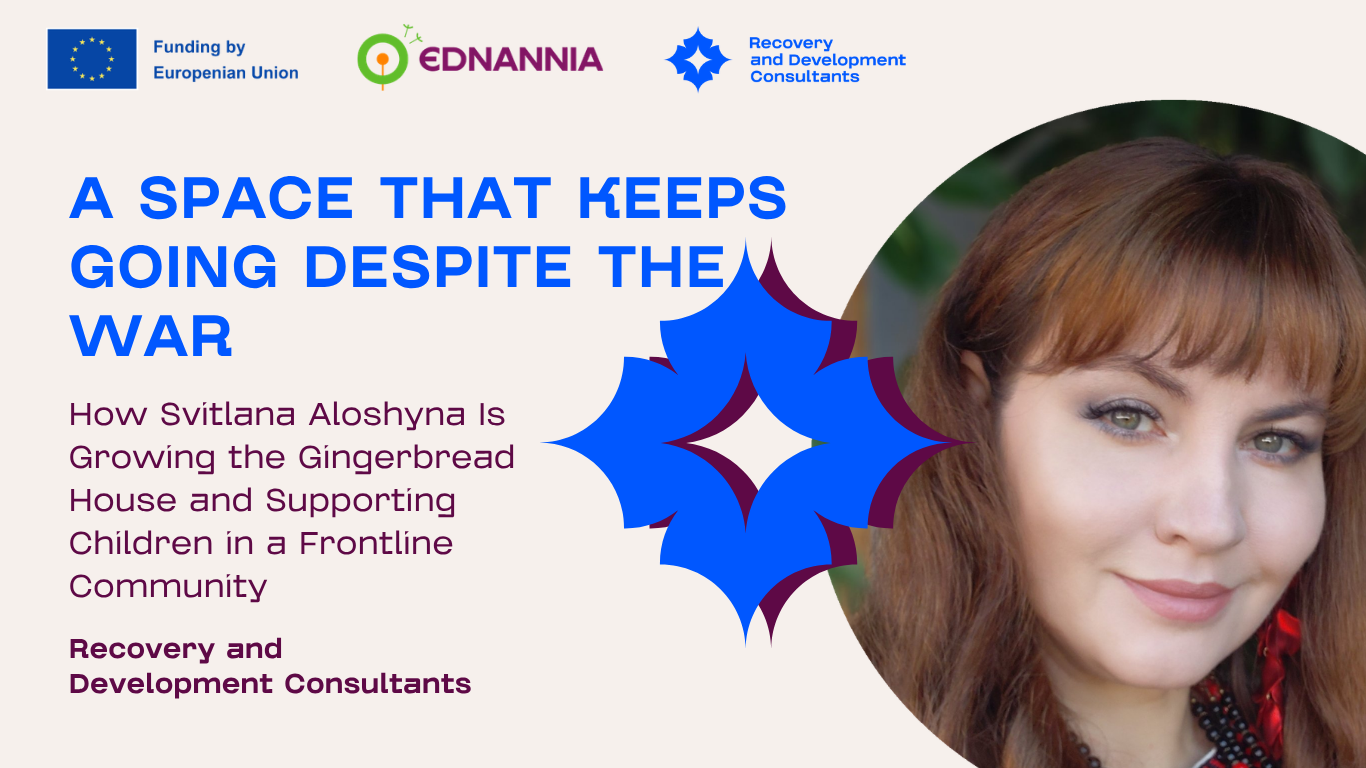
The Recovery and Development Consultants Programme is a training initiative by ISAR Ednannia, supported by the European Union. It prepares professionals who help communities recover and develop, build partnerships between local authorities and residents, launch local change initiatives, and attract funding. Participants include people from NGOs, local government, and business initiatives who are already working at the local level and want to make their work more systematic.
The Novopokrovska community in Kharkiv region lies between Kharkiv and Chuhuiv. Shelling is part of everyday life here.
“If it’s not a direct hit, it’s a downed drone that falls and explodes. This happens every day,” says Svitlana Aloshyna, head of the NGO Smak Zhyttia (“Taste of Life”).
Around 26,000 people live in the community, including more than 12,000 internally displaced people. This year, for the first time in seven years, the community introduced a blended learning format. To make this possible, a learning space was set up inside the shelter of the local cultural centre, where the Gingerbread House, a space founded by Svitlana, has been operating for several years. Despite the war, activities for children and young people continue there.
“We understood that children needed not only a safe place to learn, but also somewhere they could socialise, create, and grow,” Svitlana explains.
From economics to a creative space for children
Svitlana Aloshyna entered the civil society sector in 2017. A year later, she and her sister, Iryna Voronova, officially registered the NGO Smak Zhyttia. Before that, Svitlana had worked as head of the economics department at the Chuhuiv District Administration and lived in Chuhuiv, although she was originally from Novopokrovka.
One day, while reviewing reports from her home settlement, she came across a statistic: 99% of children were reportedly enrolled in extracurricular activities. Svitlana decided to check this figure for herself and visited the local cultural centre on a weekend. But the doors were locked, and no children were attending any activities.
She then reached an agreement with the centre’s director to run sessions herself every Saturday. Seven or eight children came at first, but their numbers gradually grew.
“At first, I thought it would be a small initiative for a few children. But they started bringing their friends, and every week there were more and more of us,” Svitlana recalls.
The children drew, did arts and crafts, baked gingerbread, and decorated it. Eventually, so many children joined that Svitlana was running four sessions back-to-back. As the initiative grew far beyond an ordinary extracurricular club, the team decided to officially register an NGO. The first project received support from the Kharkiv Regional Council, and the space was named the Gingerbread House — a name it still carries today.
“The name has been with us since the very first sessions. The children made gingerbread houses, and this place became just as warm and welcoming for them,” Svitlana says.
Since then, the space has continued operating, even after Russia’s full-scale invasion began. The Gingerbread House gives children opportunities to try different activities and discover what truly interests them. Artists, chefs, authors, and robotics specialists have all been invited to lead sessions. Children have explored drawing, confectionery, handicrafts, and robotics.
After the full-scale invasion began, activities moved into the shelter of the same cultural centre. The NGO’s team renovated the space and held events there throughout the year. Children travel from different settlements across the community to attend Smak Zhyttia’s activities. Some are brought by their parents, while the local council helps arrange transport for registered participants.
The organisation also works beyond children’s activities. Its team has contributed to renovating outpatient clinics, repairing the cultural centre’s roof, and implementing other infrastructure projects. It also helps secure external funding when local budgets are insufficient.
“We already had the experience, but we needed new tools”
Svitlana joined the Recovery and Development Consultants Programme with extensive experience working in her community. At the same time, she wanted to organise her knowledge more systematically and learn from experienced trainers and facilitators.
“We often organise events ourselves. I’m practically a trainer in my community every day. I wanted to see how an experienced, effective trainer works,” she says.
Meeting the programme’s trainer, Alona Dolia, proved particularly valuable.
“When I met Alona Dolia in person, all my doubts disappeared. I wanted to absorb everything she shared like a sponge. And it really works,” Svitlana recalls.
It was also useful to experience the training from the participant’s perspective rather than as a trainer.
“When you’re on the other side of the table — not as a trainer, but as a participant — you can experience for yourself which games and exercises really engage people and which ones they resist,” she explains.
From training to community action
Taking part in the Recovery and Development Consultants Programme helped Svitlana’s team implement a project on European integration for young people. During the training, she gained practical advice on working with different audiences, facilitating group sessions, and responding to unexpected situations.
These skills proved useful from the very first day of the project. The team realised that a lecture-based format was not working for the young participants, so they redesigned the programme overnight.
“We added games, screened a film about Paddington and discussed European values, and organised a live conversation with people in Europe. That’s how we learned to adapt the programme quickly to participants’ needs and not be afraid to change the original plan.”
She also applies her facilitation skills in her day-to-day work, as Svitlana is now deputy head of the Novopokrovska settlement council.
“For me, running a meeting or a training session is now much the same. You need to prepare, draw up a plan, and keep track of the timing,” she says.
Svitlana once delivered a training session with a colleague right inside a shelter. Shelling caused the internet connection to go down, so the team had to adapt the programme on the spot and look for a mobile signal.
Another important outcome, she says, has been the connections she made with other programme participants.
“We still keep in touch in our group chat and follow each other on social media. And you feel happy when you see things working out for someone else. If one person can do it, others can too,” she says.
For those who are unsure whether to apply for the programme, Svitlana advises them not to let fear keep them from trying something new:
“If you feel afraid, that’s a sure sign you should go exactly where you’re most afraid to go. Where you feel no fear, you’re already completely at home. You need to step outside that comfort zone.”
The programme is implemented within the framework of the EU Unity4Community project, funded by the European Union.
This publication was produced with the financial support of the European Union. Its contents are the sole responsibility of ISAR Ednannia and do not necessarily reflect the views of the European Union.
By Elia Serkozhaieva