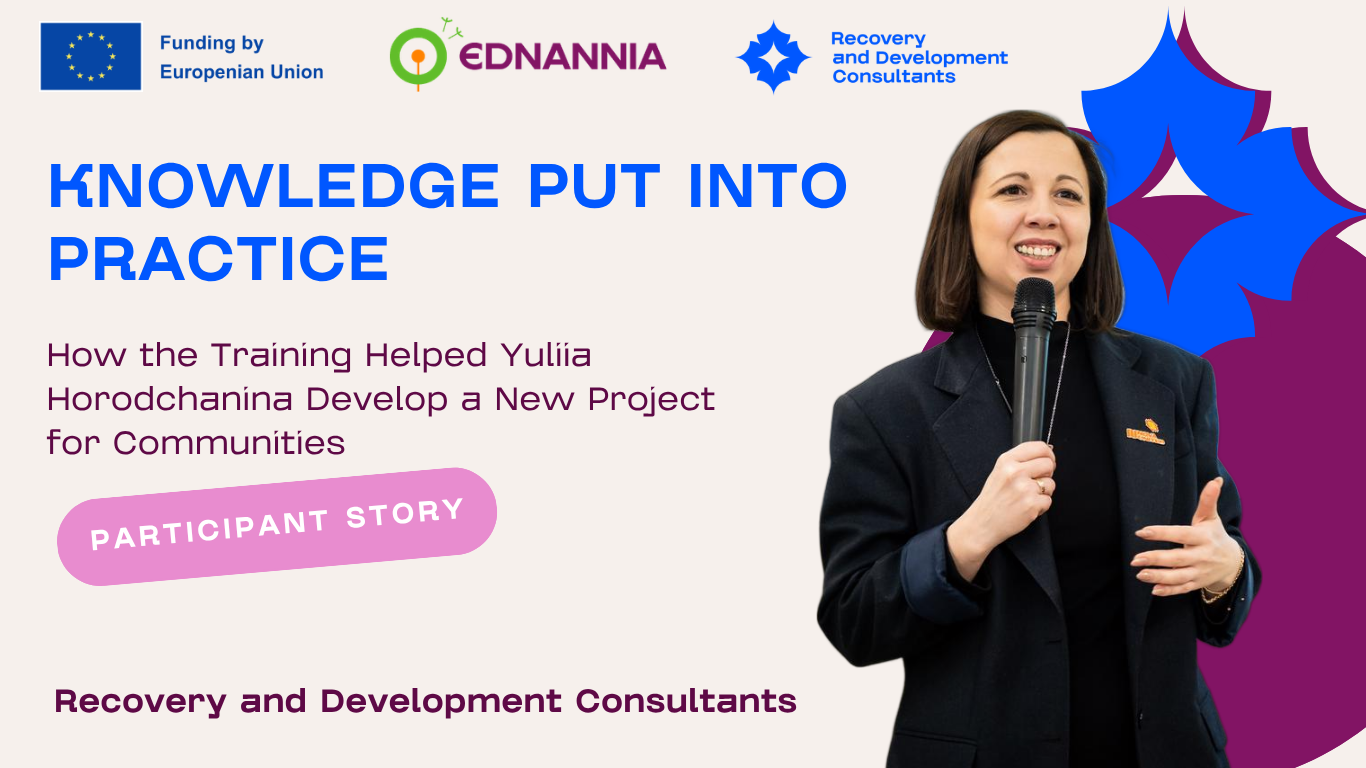
The Recovery and Development Consultants Programme is a training initiative by ISAR Ednannia, supported by the European Union. It equips professionals to help communities recover and develop, build partnerships between local authorities and residents, launch local change initiatives, and attract funding. Participants include people from NGOs, local government, and business initiatives who are already working at the local level and want to make their work more systematic.
How It All Began
Yuliia Horodchanina is originally from Poltava Region and now lives and works in the city of Poltava. She became involved in the civil society sector while still a student, initially as a participant and project manager. Her first job was at the Regional Youth Centre, a municipal institution established by the Poltava Regional Council.
In 2015, Yuliia joined the NGO Nova Poltava (now Nova United) as a project coordinator. Less than a year later, she became the organisation’s head. Today, she serves as its chair of the board.
The organisation’s activities now span three regions: Poltava, Sumy, and Kirovohrad.
Initially, the organisation focused on community self-organisation within the city and non-formal education. The team later shifted towards advocacy campaigns. After five to seven years of working in civil society, Yuliia became a member of the Poltava City Council to help implement more systematically the initiatives she had previously promoted through the civil society sector.
“Our team already had a direct tool for influencing decisions, so we continued working both in civil society and in local government,” she explains.
Today, the organisation focuses on three areas: education, including addressing learning gaps and promoting inclusion; youth engagement in communities; and, in partnership with ISAR Ednannia, helping communities prepare for the challenges of war, including by strengthening energy security and equipping shelters.
Yuliia describes the creation of a youth hub as her biggest and most meaningful project. The hub is an inclusive 540-square-metre space with its own shelter. It has become a centre for events and educational activities not only for Poltava but for the entire region. It also provides a free venue for events organised by communities in Kharkiv and Sumy regions.
“Our region is relatively safe, so being able to serve as a safe rear area is very meaningful to us. We want to create opportunities for young people to realise their potential and feel supported, so they choose to stay here and develop their communities. One of the easiest ways to start is through volunteering and civic engagement, which young people can learn about at the hub,” she says.
The community now hosts more than 53,000 internally displaced people, in addition to its approximately 300,000 residents. Over the past year, the security situation has deteriorated, with the number of attacks increasing almost fourfold. Air-raid alerts restrict educational activities and large gatherings. At the same time, the community is preparing for possible power outages during the winter.
Learning Through Practice, Not Lectures
Yuliia wanted to better understand how to help communities engage with residents — not only when planning budgets, but also when listening to people’s needs and attracting additional resources for development.
Before joining the Recovery and Development Consultants Programme, she already had experience as a trainer and had worked extensively in project management, social cohesion, and participatory tools. However, she believes there is always room to develop new skills, so she decided to take part in the training programme for trainers.
The learning environment itself was particularly important to Yuliia. Instead of conventional lectures, participants were constantly interacting with trainers and one another.
“It never felt like someone was simply delivering lectures. The format was highly productive and interactive: we learned from the trainers, learned from each other, and then immediately put the information into practice by taking on the role of trainers ourselves.”
This approach allowed participants to understand how to apply their new knowledge in practice while they were still in training.
“That was the most valuable part for me because we could immediately try out everything we were taught. As a result, we went into communities better prepared to deliver sessions. We could make mistakes and receive feedback during the training, rather than only once we were already working in the field. We could also ask the trainers for mentoring support whenever we needed it.”
Putting Learning into Practice
Yuliia delivered her pilot training session in the Kobeliaky community together with her colleague Larysa Vashchenko. The community had applied to participate and subsequently formed a mixed group of local government and civil society representatives. The session focused on participatory tools, partnership development, and engaging the public in decision-making.
Yuliia says the training strengthened not only her confidence as a trainer but also influenced the specific projects she has been developing and implementing since completing the programme.
Together with her colleagues, she developed a new project focused on gender-sensitive safety audits in communities. The key emphasis is on participation: different groups of people are involved in conducting the audits, and the findings are then used to engage residents in making concrete decisions about community safety.
Three communities in Poltava Region were selected for the project: Poltava, Myrhorod, and Shyshaky. The team is sharing the tools acquired during the training so that the communities can conduct the audits independently in practice.
“This project aligns very clearly with the tools we worked with during the training. The key is to involve different groups of people — first in conducting the audit itself, and then in developing concrete safety solutions for the community. That is why I am already applying what I learned in the new project and in our work with communities.”
The training has also influenced the way the organisation works internally.
“When we develop projects within the organisation, we now pay more attention to assessing needs and involving participants to make sure these aspects are taken into account.”
Yuliia continues to use the training materials in her work. One approach she has adopted is to pause after each exercise and give participants time to reflect on what they have learned and how they can apply it in practice, rather than simply moving on to the next topic.
“It is important to pause after a learning exercise and reflect on what has happened. Instead of drawing conclusions for the participants, give everyone the opportunity to think for themselves: why did we do this, what does it mean to them, and how can they apply it in their work? It may seem like a simple and obvious approach, but it only becomes part of your practice once you start using it.”
Don’t Miss the Opportunity
For those who are unsure whether to apply to the Recovery and Development Consultants Programme, Yuliia’s advice is simple: do not be afraid to try. In her view, an application is about more than experience and professional achievements. Motivation and a genuine desire to make a difference in one’s community matter just as much.
“Don’t be afraid — give it a try. If you don’t, you may regret missing an opportunity. It is also important to be honest about why you want to take part. I think you can often tell when reading applications whether people are truly passionate about what they do, whether the issue really matters to them, and whether they genuinely care. Even if someone has less experience but more motivation and a real desire to do something for their community, that can matter more than the credentials listed on their CV.”
The programme is implemented within the framework of the EU Unity4Community project, funded by the European Union.
This publication was produced with the financial support of the European Union. Its contents are the sole responsibility of ISAR Ednannia and do not necessarily reflect the views of the European Union.
By Elia Serkozhaieva