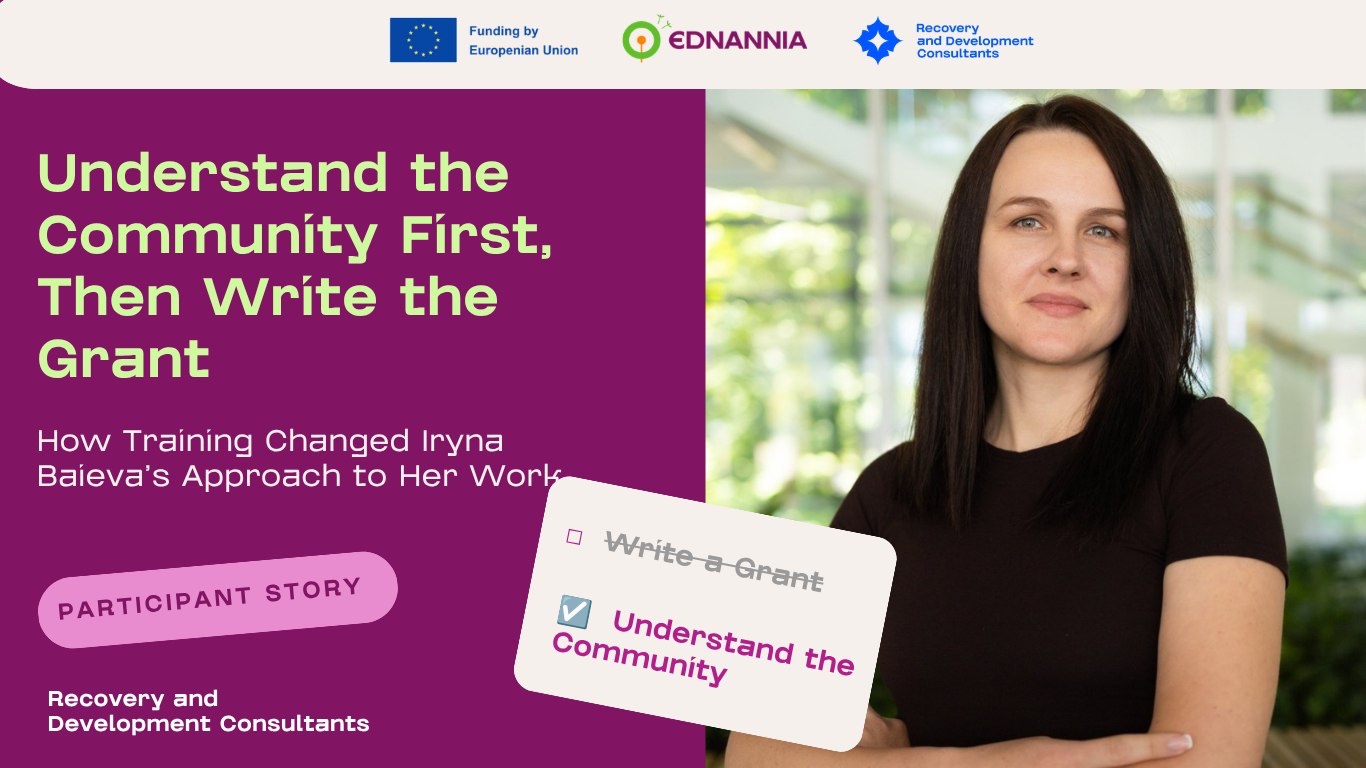
The Community Recovery and Development Consultants Programme is a training initiative by ISAR Ednannia, implemented with the support of the European Union. It prepares professionals to help communities recover and develop, build partnerships between local authorities and citizens, launch local change initiatives, and secure funding. Participants include people from NGOs, local self-government, and business initiatives who are already working at the local level and want to take a more systematic approach.
Training That Helps Communities Grow
Mykolaiv Oblast remains a region where communities must address recovery needs while planning for future development. Security risks, population outflow, staff shortages, and limited resources directly affect which solutions communities can implement today and what they need to plan for the future.
One of the organisations working to address these challenges is the South Centre for Adult Learning and Education, where Iryna Baieva works. The team helps communities develop and enables local residents to acquire new skills and find opportunities for employment and self-employment.
Iryna entered the civil society sector after working in local government. She comes from the Halytsynove community, where the organisation’s story began. Initially, the NGO was called the Sustainable Development Club “Southern Initiative” and focused on small-scale local projects. Over time, it shifted its focus towards adult education. In 2020, the team relocated to Mykolaiv to expand its activities. The organisation remains registered in the Halytsynove community and continues to work there, although its physical office is now located in Mykolaiv.
Today, the team delivers training programmes, retraining courses, short-term learning opportunities, and workshops. Its areas of focus include sewing, 3D modelling and printing, creative and craft practices, and entrepreneurship. The organisation operates three training studios: a sewing studio, a workshop dedicated to Tavria painting, and a 3D studio. It works with women, young people, veterans and their families, internally displaced people, and other community residents for whom new skills can open up opportunities for employment or starting a business.
Another key area of its work is community support, including needs assessments, work on strategic documents, entrepreneurship development, and identifying funding opportunities. The team also promotes Tavria painting and develops contemporary products inspired by this traditional art form.
“I Had Experience, but I Needed Practical Tools”
Before joining the Community Recovery and Development Consultants Programme, Iryna had already gained experience working with communities. She had organised meetings and events, worked with recovery planning groups, completed facilitation training, and taught project management and social entrepreneurship.
She decided to apply for the programme to refresh her knowledge and gain practical tools specifically tailored to community engagement.
“When working with communities, it is important to know more than just how to write a grant application. You need to understand the community itself: its needs, people, documents, priorities, and opportunities. Only then can you work out how to engage everyone, build effective cooperation, and turn an idea into something that will genuinely work,” Iryna explains.
One of the programme’s main advantages, she says, was its focus on practical information and the opportunity to look at familiar topics from different perspectives.
“You can spend months reading documents, methodologies, and legislation on your own, searching for information. Here, much of that material has already been collected and reviewed, and you are shown where to look for more. It helps you see the bigger picture and then choose the area you need and explore it in greater depth,” she says.
Putting Learning into Practice
One of the first practical outcomes of the training was a workshop Iryna delivered together with her colleague Viktor Sikalenko in the Bashtanka community. The participants included internally displaced people, veterans, and representatives of the youth council. They discussed cooperation between communities and residents, as well as tools for public engagement.
After completing the programme, Iryna began looking at community development strategies differently. She started examining the documents communities use when applying for grants more closely and assessing whether their actual activities align with the priorities set out in those strategies.
“Now, whenever we discuss a project idea, I immediately check whether that area is covered by the community’s strategy, what objectives have been defined, and whether the proposed activities align with them. A strategy should not be a document created just to tick a box; it should serve as the foundation for future decisions,” she explains.
She also immediately put her newly acquired facilitation skills into practice. Today, she supports several communities, including Snihurivka, Novyi Buh, and Berezanka, in developing programmes to support small and medium-sized businesses.
“A programme must reflect the actual situation in a community, including security risks, limited funding, and the needs of local businesses. If a community has few resources of its own, it needs to understand what other opportunities are available: partnerships, grant programmes, government support mechanisms, and investment. In other words, the document should help the community take action rather than simply sit on a shelf,” she says.
Iryna’s organisation also actively applies for new grants from ISAR Ednannia and other donors. Its areas of work include social entrepreneurship, such as a pottery workshop producing items decorated with Tavria painting, as well as adult education and initiatives that encourage entrepreneurial thinking among young people.
“The training also helped me realise that we need to assess communities ourselves before providing specific feedback. It’s not about simply making something look good; it’s about doing it with a genuine understanding of the context,” Iryna says.
She also notes that the programme encouraged her to explore the legal framework governing community development in greater depth.
“I started reading more laws, government resolutions, and methodological documents, and looking at how they are supposed to work in practice. Sometimes you read something and think everything is clear. Then you see how it is implemented locally, and even more questions arise. But that is exactly what I find interesting about this work now,” she explains.
For those still wondering whether to apply for the Community Recovery and Development Consultants Programme, Iryna offers the following advice:
“Apply, even if you feel you lack certain knowledge or practical experience. The programme is an opportunity not only to deepen your expertise but also to meet people who already have hands-on experience, their own case studies, and similar challenges. You can strengthen one another, share experiences, and find solutions together. That is incredibly valuable, because you learn not only from the trainers but also from the people who are on this journey alongside you.”
The programme is implemented within the framework of the EU Unity4Community project, funded by the European Union.
This publication was produced with the financial support of the European Union. Its contents are the sole responsibility of ISAR Ednannia and do not necessarily reflect the views of the European Union.
By Elia Serkozhaieva