Vykhvostiv is a small village in the Tupychiv community in Ukraine’s Chernihiv region, with a population of fewer than 1,000. As in other border areas of Ukraine, daily life here is shaped by the security situation. The local House of Culture operates with restrictions, leaving residents with far fewer opportunities to gather for community events, celebrations, and meetings.
In practice, the main gathering place, especially for children and young people, has become the youth space “STO — Dare to Create and Unite,” established in 2024. As local residents say, its doors are always open. Yet there was still no shared outdoor space where people of all generations could come together.
An Untapped Opportunity
Next to STO lay a plot of land that everyone seemed to avoid: an unattractive, neglected lot. In autumn 2025, when the idea emerged to transform it into a place for the community to relax and spend time together, a team with the knowledge and experience to make it happen stepped forward.
The project, “Unity Space in Vykhvostiv: Joint Planning, Development and Growth of a Community Park,” was undertaken by the Agency for Urban Initiatives, a Chernihiv-based NGO founded in 2017 through grassroots activism around urban infrastructure. Following Russia’s full-scale invasion of Ukraine, the organization shifted its focus towards systematic work with communities in Ukraine’s border regions.
The project received support through ISAR Ednannia’s GROW: Grassroots Recovery & Opportunities for Wellbeing grant competition, co-funded by the European Union and the Minderoo Foundation.
According to Mykola Sylenko, the project’s driving force and one of the main organizers of the space’s development, the site that now hosts the Unity Space was once nothing more than an abandoned lot.
“People didn’t come here, children didn’t play here, adults didn’t relax here, and no one organized anything. At most, the grass was cut a few times during the summer to keep the area looking reasonably tidy, and that was it,” he recalls.
The land officially belongs to the local gymnasium, but for years it had been used neither for educational activities nor for extracurricular programmes. It was simply overlooked. Yet the location was ideal: a main road runs alongside the site, the youth space STO borders it on one side, and a footpath used daily by residents on their way to work runs along another.
From the outset, the Agency for Urban Initiatives team established one guiding principle: the space should reflect the wishes of local residents, rather than decisions imposed from outside.
The process began in late March 2026 with a design session, where villagers, local authorities, educators, and young people came together to discuss what the future space should look like. Soon afterwards, representatives of the NGO and a local initiative group conducted their first on-site visit, walking around the territory and discussing its layout and potential uses.
Following a series of workshops, focus groups, and community meetings, practical work began. The first community clean-up took place in May. In total, at least six volunteer workdays were organized throughout the spring and summer, twice as many as originally planned.
The team levelled the ground, created flower beds, planted the first greenery, and installed a revolving gate to keep the space accessible to people while preventing local livestock from entering and damaging the young plants.
Common Ground
“There were hardly any outright sceptics among the local residents,” Mykola Sylenko notes. “I think this was connected to the community’s previous experience. In 2024, when we created the STO youth space with support from ISAR Ednannia, people were not entirely convinced that something like this could be established in a village or that anyone would actually need it. So, when we proposed creating the Unity Space this time, most people already understood that if we set out to do something, we would see it through.”
The project received support from across the community.
“Everywhere we turned, at every stage, we were met with support. Even when people couldn’t contribute their time or materials, they offered us at least a kind word,” Mykola explains. “The Tupychiv Village Council showed a genuine interest in developing the space and allocated funds to purchase flowers, ornamental plants, and trees. The head of the community and the village starosta also provided three benches and trees for landscaping. We approached the head of a local business, who helped us install an additional carousel.”
Alongside the physical transformation of the site, a Community Interest Club was launched, creating opportunities for residents to share their skills with one another.
The activities began with a traditional Easter egg decorating workshop led by staff from the Tupychiv House of Culture.
“That was the only workshop we held with the involvement of professional facilitators and a ready-made programme,” the space coordinator explains. “For all the others, we tried to build activities around the shared interests and unique skills of the villagers themselves.”
For example, a local young woman offered to lead a workshop on making bouquets from satin ribbons, bringing her own materials and teaching others how to use them. Activities were organized for the youngest residents, including plaster figurine painting and thread painting, as well as women-only gatherings featuring the creation of the traditional prypynda accessory using macramé techniques.
One of the most memorable workshops was devoted to making beeswax candles. A local beekeeper generously provided the raw materials free of charge.
“Before one of our Club meetings, a heavy downpour started, and we thought we would have to postpone the event because nobody would come,” Mykola recalls. “But as soon as the rain stopped, young people literally filled the space. That was a really good sign for me: people genuinely need this place.”
Bad weather repeatedly disrupted outdoor work, while air raid alerts forced the team to reschedule events. Yet not once did the organizers cancel an activity altogether.
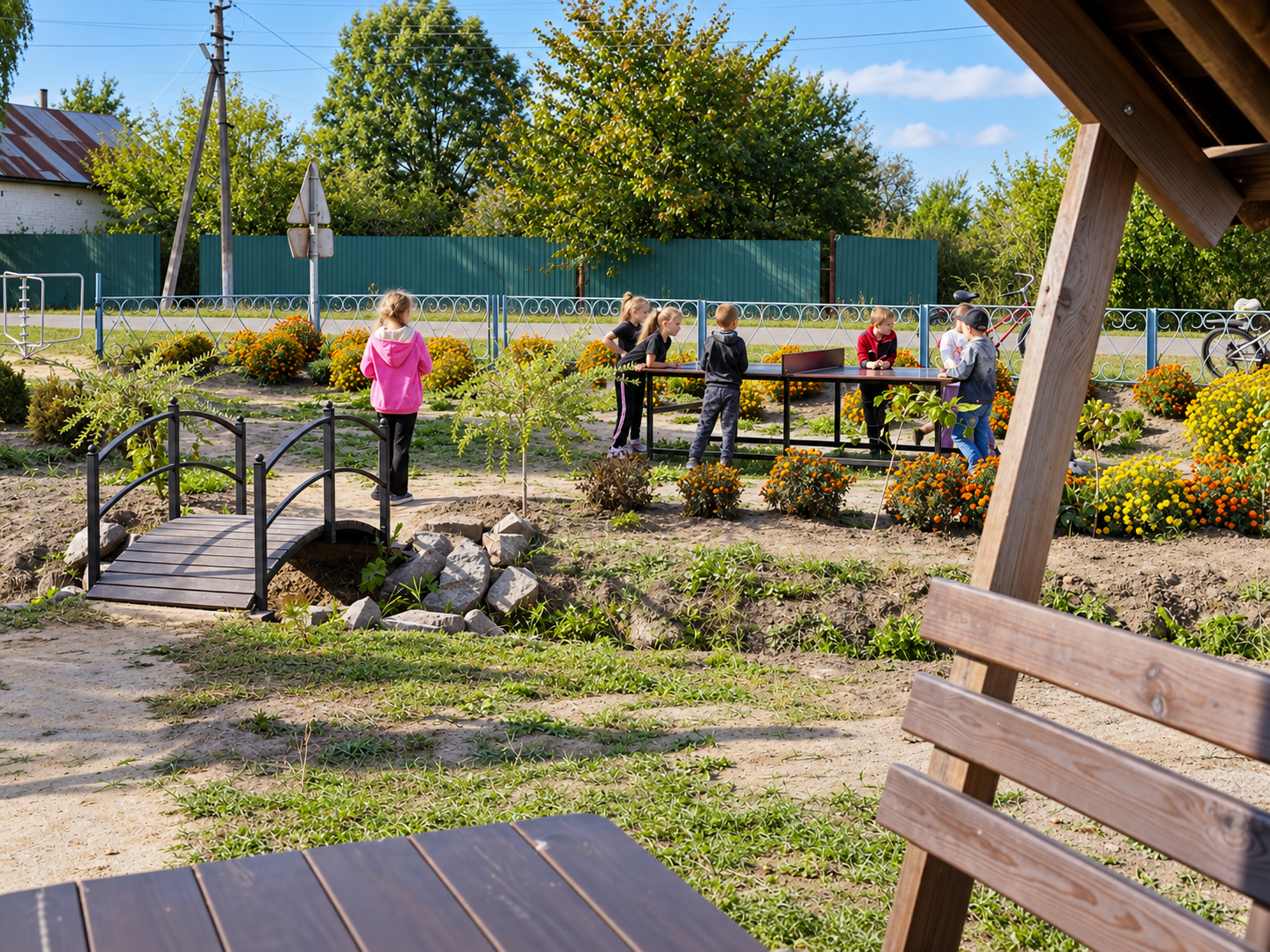
On 14 August 2026, the space officially opened. In just a few months, the former vacant lot had been transformed into a welcoming community area featuring a gazebo, benches, a swing, a children’s sandbox, a decorative bridge, and even an artificial fountain.
Now, children eagerly look forward to rainy days, hoping that a real little stream will appear beneath the bridge.
A Place to Call Their Own
Over six months, the team organized 15 events attended by more than 400 residents of Vykhvostiv — roughly half the village’s population.
However, for the Agency for Urban Initiatives, the number of participants is not the most important measure of success. What is truly remarkable is how quickly the space has become part of village life and how actively it is used today.
“There are lots of children here every day during every school break. Teachers have already held lessons in the gazebo and on the benches. At the end of the day, young mothers often stop by with their children after picking them up from kindergarten. The little ones especially love our sandbox. In the evenings, young couples enjoy sitting together on the swing. Even during heavy downpours, young people come here and take shelter in the gazebo. For me, that is probably the best proof that the space has become something people truly need,” Mykola Sylenko says.
Tetiana Romanova, the project manager, describes the project’s main achievement as follows:
“When people shape a space through their own ideas, opinions, and active participation, it truly becomes theirs. This is no longer a story about someone coming in and offering a ready-made solution or imposing a predetermined concept. It is a story of creating something together. Of course, this approach is much more challenging to implement, but that is precisely where its value lies.”
The project’s success has inspired the team to develop new plans. A river flows nearby, so they are already considering creating a small beach with a beach volleyball court.
The project has also brought a new photo spot featuring large wings. The next major idea is to create a mural on the wall of the local gymnasium in memory of the defenders who lost their lives protecting Ukraine.
“If I had to sum up what has changed in a single sentence, I would say that this used to be just a plot of land that everyone walked past,” Mykola Sylenko concludes. “Now it is a place people deliberately come to. And that is probably the greatest achievement for us: we have changed not only the territory itself, but also the way people relate to it. A place has emerged that belongs to everyone — children, young people, parents, teachers, and older residents of the village.”
This story was produced as part of the EU Unity4Community project, co-funded by the European Union and the Minderoo Foundation.