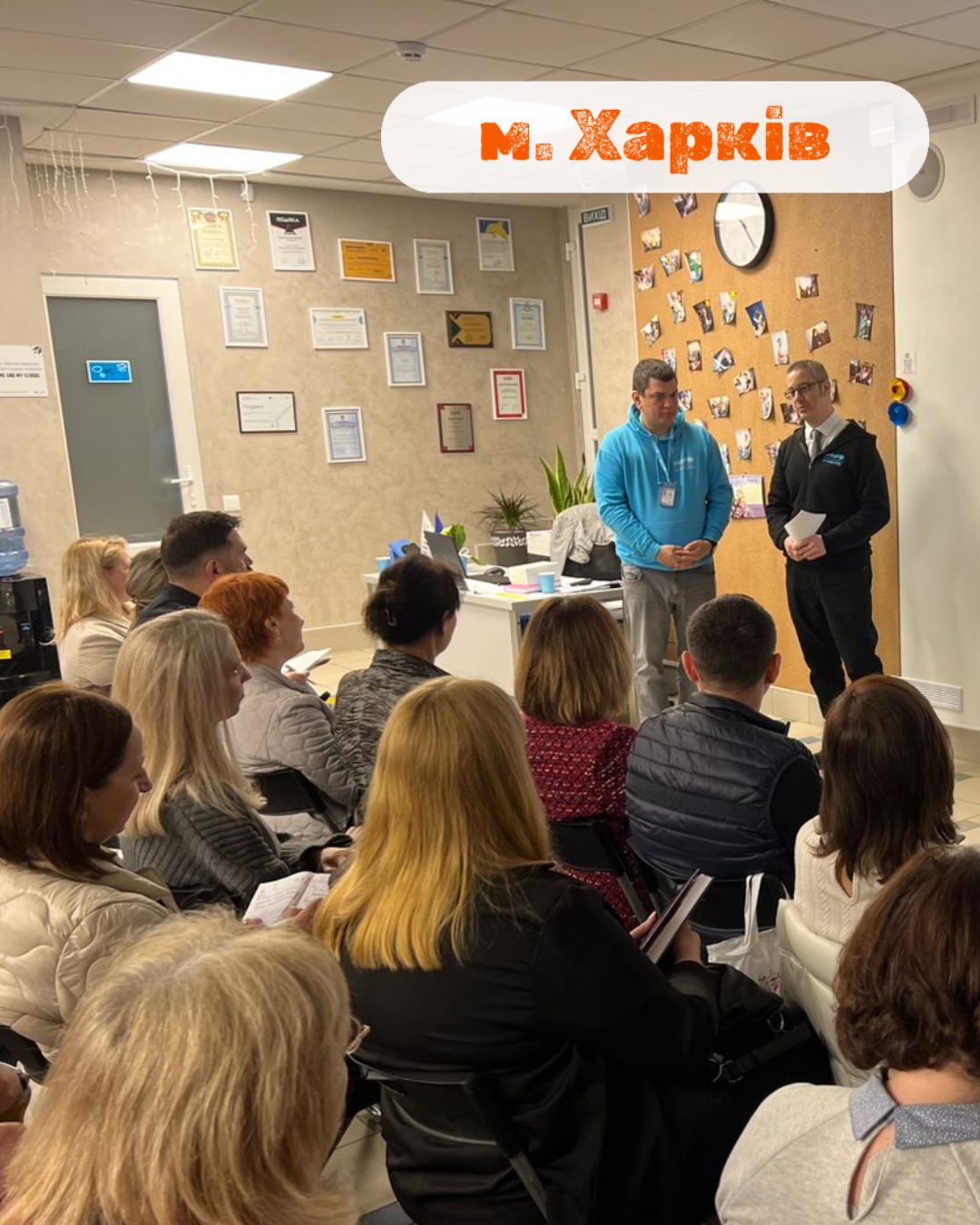
The Community Recovery and Development Consultants Programme is a training initiative by ISAR Ednannia, implemented with the support of the European Union. It prepares professionals to help communities recover and develop, build partnerships between local authorities and citizens, launch local change initiatives, and secure funding. Participants include people from civil society organisations, local self-government, and business initiatives who are already working at the local level and want to take a more systematic approach.
The Voznesensk community in Mykolaiv Oblast does not experience shelling as intense as communities closer to the frontline. However, the war is felt here every day: drones fly overhead, air defence systems operate, and strikes still occur. Energy infrastructure is most frequently targeted. Like many other communities, Voznesensk faces power outages and the ongoing consequences of the war.
The NGO Agency for Economic Development operates in the community, supporting other civil society organisations by helping them with registration, reviewing their policies and statutes, and providing guidance. The team also advises women on starting their own businesses, works with young people, and cooperates with local self-government bodies. With its mentorship, youth spaces have been established, and its representatives are regularly invited to participate in various working groups.
Olha Niukalova works at the NGO as a Programme Manager. She has been involved in the civil society sector for just over two years. Before that, she spent ten years working in local self-government: first as a lawyer and Head of the Legal Department, and during her final year as Head of the Administrative Services Centre.
Olha entered the civil society sector as a communications specialist after a decade in local government. She later became involved in analytical and monitoring work, as well as initiatives related to community development. It was during this period that she realised she wanted to deepen her professional knowledge and develop a more systematic approach to this work.
“I realised that I lacked professional knowledge in these areas. It wasn't just about knowing how to behave or approach things. As for training experience, I had none at all. I had never done anything like that before, so I was interested in trying something new in my professional life.”
Olha came across an announcement about the Community Recovery and Development Consultants Programme on Facebook and decided to apply. She was particularly interested in the focus on community recovery and development — an area she had already encountered in her work but wanted to explore in greater depth.
“In All My Experience, I Had Never Seen So Many Practical Exercises”
Olha had previously participated in various training programmes, but this one stood out for its extensive practical component and the amount of group work involved.
“The training was excellent. I had attended various events and training programmes before, but throughout my entire experience, I had never seen so many practical exercises or such active group collaboration. It gave us an opportunity to get to know the other participants better, find common ground, and establish potential partnerships.”
For Olha, this was important for reasons beyond the exercises themselves. Working together allowed participants to connect and find people with whom they could continue collaborating.
She also particularly appreciated the programme's learning materials.
“I have never been given learning materials like these before. Everything was explained in such detail, presented so clearly, and was so relevant to the current context. I had never encountered anything like this.”
Among the sessions, she particularly enjoyed the one focused on cooperation with local self-government bodies. This topic was especially relevant to Olha, given that she had spent ten years working within the local government system before entering the civil society sector.
“The session on the fundamentals of communication with local self-government bodies was really valuable. It covered how to build effective relationships not only with local authorities but also with businesses.”
Putting Learning into Practice
After completing the training, Olha began applying her new knowledge in practice. In May, together with Anatolii Dziubenko, she delivered a training session in Voznesensk on civic engagement tools and strategic planning. More recently, she facilitated a session for representatives of civil society organisations who had visited the community for an experience-sharing exchange. This time, the discussion focused on resilience and social cohesion.
The knowledge gained through the programme is now also being incorporated into the organisation's work. In particular, the team has started including short training sessions in grant proposals to share practical tools with other organisations.
“Previously, we didn't have this opportunity. Now, after completing the training, we do.”
Olha is already receiving invitations to facilitate sessions for other organisations. Topics include European integration and civic engagement tools — areas about which community residents do not always have an opportunity to learn directly from local authorities.
At the same time, practical experience has helped Olha realise that longer training sessions are not suitable for everyone. This is particularly true for people living in rural areas, who have jobs and household responsibilities.
“We noticed that people find it difficult to sit through sessions lasting three or four hours. They simply don't have the time. This is especially true for rural residents: people have their households and livestock to look after, so their time is limited. For them, a session lasting an hour and a half to two hours is much more comfortable.”
That is why the team plans to incorporate shorter sessions directly into its projects. Olha uses the programme's materials to prepare for them. Before one of her sessions, she reviewed the notes from the core module, while relying on shorter guidelines to deliver the actual training.
“The guidelines we received help us shorten training sessions. They outline the main and most important points that need to be communicated to the audience. The notes provide a broader understanding of the topic, while the guidelines are a practical tool that helps you focus on what matters most.”
Another outcome of the programme has been the professional connections Olha has established. She remains in touch with fellow participants and continues collaborating with organisations from neighbouring communities. Together with the Agency for Economic Development team, she is also awaiting a response to a grant application for the creation of a civic platform that would bring local civil society organisations together and help them support one another.
And for those who are still unsure whether to apply for the Community Recovery and Development Consultants Programme, Olha recommends following her own personal motto:
“Go where you're afraid to go. And honestly, when I think about it, I feel a little better. I don't know why it works that way, but it does. And once you get there, you realise it's not so scary after all. Don't let fear or doubts hold you back. You have to give it a try, because it could turn out to be an incredible opportunity.”
The programme is implemented within the framework of the EU Unity4Community project, funded by the European Union.
This publication was produced with the financial support of the European Union. Its contents are the sole responsibility of ISAR Ednannia and do not necessarily reflect the views of the European Union.
By Elia Serkozhaieva