98 minutes. That is the average duration of an air raid alert in Ukraine’s Chernihiv region. For an adult, this is about the length of two episodes of a favourite TV series. For a three-year-old child, it can feel like an eternity, especially when surrounded by damp concrete walls in a monotonous, enclosed space with nowhere else to go. The only way to stay safe is to remain in the shelter.
According to estimates by the Angels of Freedom International Charitable Foundation, made in late summer 2026, since the beginning of Russia’s full-scale invasion of Ukraine, children in Chernihiv and the surrounding region have spent more than 4,000 hours in shelters. That amounts to almost half a year. And the figure continues to grow as the war goes on.
In conditions of uncertainty and prolonged emergency, the only option is to adapt and improve the spaces where people have to spend their time. “If shelters are a reality we cannot change, then let’s at least make that reality a little more humane.” These were perhaps the thoughts behind the Angels of Freedom team’s decision to apply in autumn 2025 to ISAR Ednannia’s GROW: Grassroots Recovery & Opportunities for Wellbeing grant competition, co-funded by the European Union and the Minderoo Foundation.
The Foundation grew out of a volunteer movement launched in Chernihiv in April 2022. Its main mission is to create comfortable child-friendly spaces in shelters across Ukraine. Together with its donors, the organization has already helped restore underground shelters damaged by shelling and improve facilities in six schools and ten kindergartens in Chernihiv.
This time, the organization turned its attention to two kindergartens in the Ladan community, Pryluky district, Chernihiv region. The community had reached out for assistance because the shelters in the Chervona Shapochka and Barvinok kindergartens were little more than ordinary cellars: cold, empty, and completely lacking any sense of comfort. In short, they were no place for children.
The Little Things That Make a Big Difference
The project, “Spaces of Care: Safe and Comfortable Shelters for the Chervona Shapochka and Barvinok Kindergartens,” began in mid-February 2026. The idea was simple: purchase the necessary materials and furnish the shelters with modern, comfortable furniture, transforming them from merely usable spaces into places where children would actually feel at ease.
It is worth noting that the initial preparation of the premises — including finishing the walls, ceilings and floors, installing ventilation systems and setting up lighting — had already been completed with donor funding through other projects. Winning the GROW competition made it possible to bring the work to its logical conclusion.
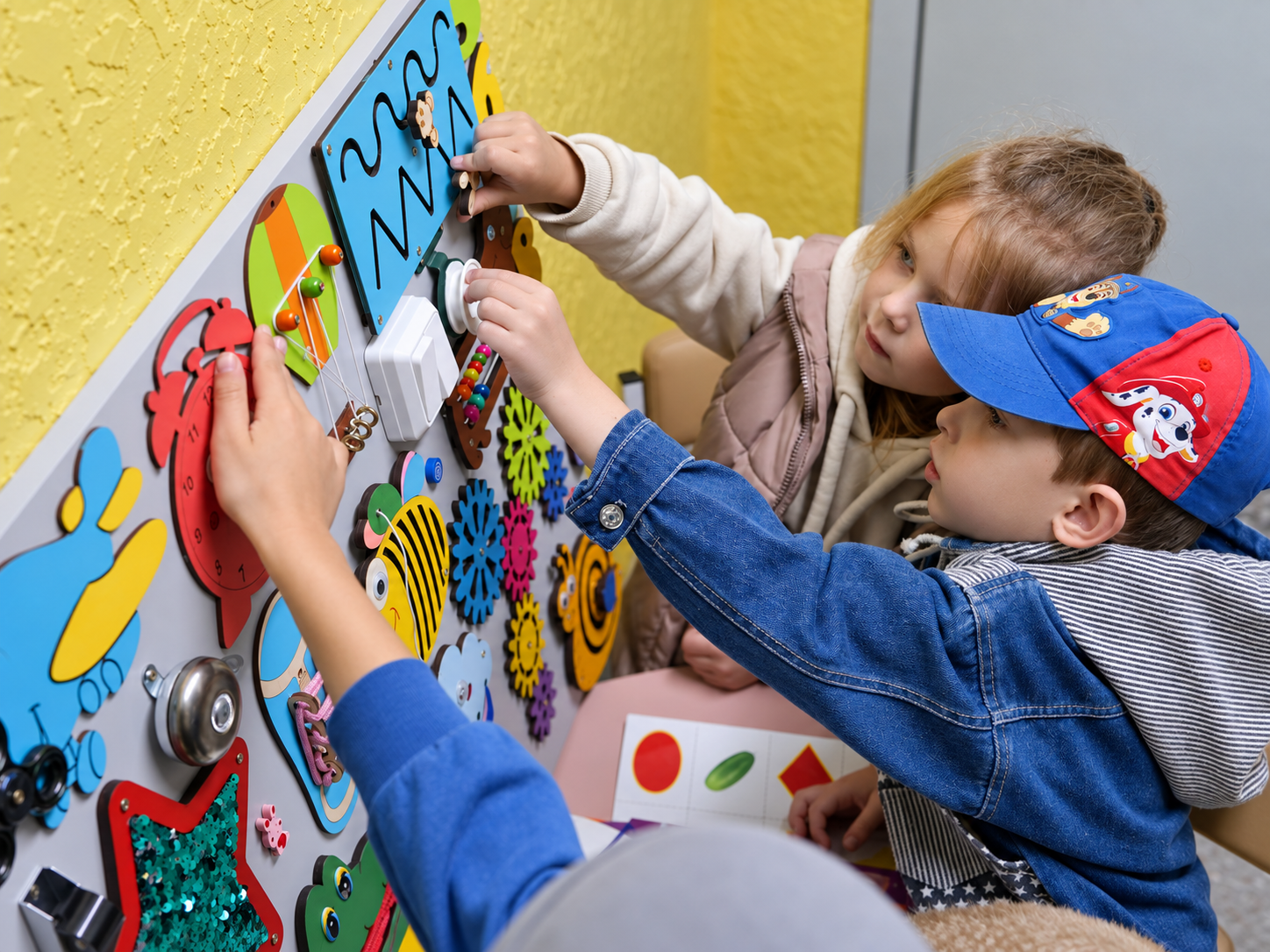
Where there had once been bare walls, there were now trapezoid-shaped tables, child-sized chairs in different heights, bean bags, upholstered benches, folding beds for daytime naps, activity boards, bookshelves, and rechargeable lamps for power outages — all the little things that make a significant difference.
“Our shelter is quite small, so it was important for us to make the most of every square metre. The folding beds turned out to be particularly convenient: we unfold them for nap time, then fold them away to free up space for games and activities. The trapezoid-shaped tables can also be rearranged in different ways each time — used as individual desks, grouped together for small-group work, or arranged in a circle for a shared activity.
“The youngest children have activity boards to keep them engaged during air raid alerts. And the frameless bean bags immediately became the children’s favourite spot: they rest on them, listen to stories, and look through books,” says Liubov Dzyhalo, head of the Barvinok kindergarten in Ladan.
“Our first-grade class is based at the Chervona Shapochka kindergarten, so we use its shelter during air raid alerts,” says Olha Shylo, a primary school teacher from Ladan. “Now, all the necessary conditions are in place for children to continue learning. We can write, read, and hold full lessons without having to wait for the all-clear.
“This is especially important for first-graders because a comfortable and familiar environment helps them feel calmer and avoid losing valuable learning time.”
An Unexpected Impact
According to representatives of Angels of Freedom, while implementing the project, they witnessed a shift in how the community viewed shelters: from purely technical facilities to fully fledged, safe, and comfortable spaces for children.
“The project became an important driver of stronger community self-organization. Parents, teachers, and concerned residents repeatedly took the initiative themselves. One particularly telling example was the joint volunteer workday after the furniture arrived for the shelters.
“Everyone took part, regardless of their age or position: people unloaded, assembled, carried, and arranged the furniture in the shelters together,” says Iryna Semenchuk, Director of the Angels of Freedom International Charitable Foundation.
Alina Chyzhevska, the mother of five-year-old Diana from Ladan, shares her impressions of the renovated kindergarten shelter:
“For parents, a shelter first and foremost means peace of mind. Previously, whenever an air raid alert began, I tried to pick up my child from kindergarten as quickly as possible. I was very worried about her spending several hours in a cold underground room.
“Now, during air raid alerts, I can continue working and taking care of my daily responsibilities because I know that my child is in a safe, warm, and comfortable environment where she can play, learn, or rest.”
Planting the Seeds for the Future
Interestingly, even before the project began, while the Angels of Freedom Foundation was looking for funding to improve the shelters in Ladan’s kindergartens, the community was already taking action. Local residents organized a charity fair themselves and raised more than UAH 60,000 for the necessary work.
When people in Ladan learned that ISAR Ednannia had supported the project and that the improvements at Barvinok and Chervona Shapochka would be funded by donors, something unexpected happened.
“One might have thought that the money raised could simply be kept for other community needs,” says Iryna. “But the residents of the Ladan community decided to donate the funds towards supporting the next educational institution where our Foundation plans to implement a shelter improvement project: the Barvinok kindergarten in the Bobrovytsia community, also in Chernihiv region. In effect, they provided the project with its initial funding.”
According to Iryna, it is precisely such acts that create a chain of solidarity, ensuring that support does not stop with a single project.
Moreover, thanks to careful budget management, the Angels of Freedom team managed to furnish not two, but three kindergartens. Another institution in Pryluky received support, even though it had not been included in the original project plans.
“For us, this story goes far beyond two or three kindergartens. Across Ukraine, there are many small underground premises in rural schools and kindergartens. Our Foundation alone currently has around 29 applications from educational institutions seeking similar assistance,” says Iryna Semenchuk.
“These shelters often struggle to attract support because only a relatively small number of children use them. Sometimes, people assume that nothing worthwhile can be done with an ordinary cellar. Of course, renovation cannot turn such a space into a fully fledged shelter capable of protecting against every type of weapon. But our experience shows that even a small, basic shelter can be transformed into a place where children have reasonably comfortable conditions during air raid alerts.”
“We cannot stop air raid alerts. But we can make sure that children do not have to be afraid,” reads the website of the Angels of Freedom International Charitable Foundation.
Thanks to the Foundation’s work, at least 100 children in Chernihiv region now experience those 98 minutes of air raid alerts differently — not in darkness and fear, but surrounded by books, soft chairs, and familiar toys.
This story was produced as part of the EU Unity4Community project, co-funded by the European Union and the Minderoo Foundation.