The Recovery and Development Consultants Programme is an educational initiative by ISAR Ednannia, implemented with the support of the European Union. It prepares professionals to help communities recover and develop, build partnerships between local authorities and citizens, launch local change initiatives, and secure funding. Participants include representatives of civil society organisations, local self-government bodies, and businesses who are already active at the local level and want to make their work more systematic.
From Civic Engagement to Training
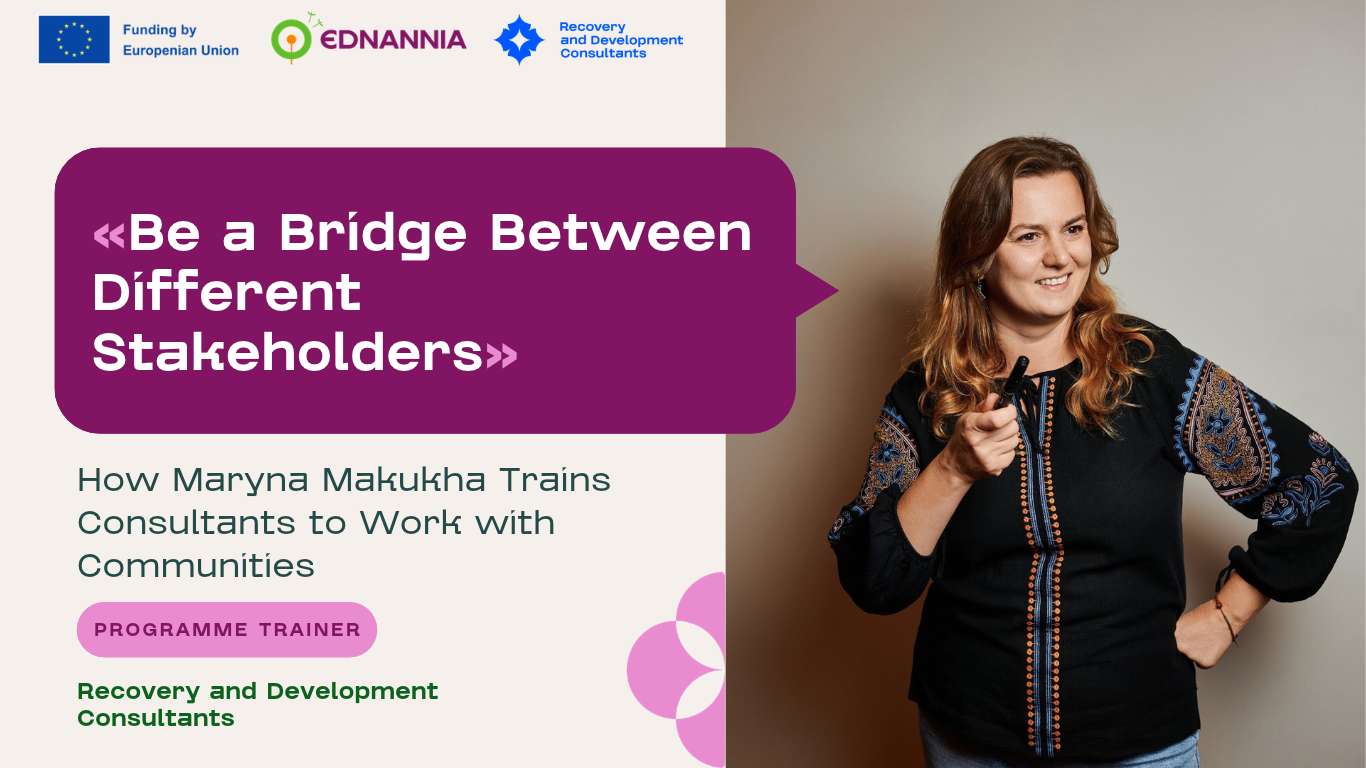
Maryna Makukha is a trainer, methodologist, facilitator, and communications specialist. Her journey into non-formal education began with civic engagement, which she became involved in as a university student during the Orange Revolution.
At the time, Maryna was studying at a university in Cherkasy. She realised that representing and defending citizens' interests was not solely the responsibility of the authorities — each and every one of us could play a role. She later joined a civil society organisation and subsequently became involved with the Civil Network OPORA.
Maryna started as a volunteer, then worked as a communications specialist, managed projects, and contributed to nationwide initiatives. Much of her work focused on electoral processes and advocacy.
Alongside her civic engagement, she taught at a university and defended her dissertation in the field of social communications. She later began receiving invitations to deliver training sessions on communications and election-related topics. Her teaching experience and background in developing educational courses helped her transition into adult non-formal education.
“I realised that non-formal education was also interesting. It has its advantages and disadvantages, but it is necessary and very important,” Maryna explains.
Gradually, training began to take up more and more of her time. Maryna enjoyed not only sharing knowledge but also engaging participants in discussions, practical exercises, and collaborative problem-solving. Eventually, she decided to focus on non-formal education.
Over time, Maryna expanded her work beyond delivering training sessions to developing educational courses and programmes and training other trainers.
How Communications Help Communities Recover
Within the Recovery and Development Consultants Programme, Maryna worked on the communications and advocacy modules. She also delivered sessions on project management, drawing on her own experience in the civil society sector.
Each member of the training team was primarily responsible for the topics in which they had the greatest expertise. At the same time, colleagues contributed to developing other training modules and continued expanding their knowledge.
According to Maryna, communications skills are essential for consultants because they will need to engage with a wide range of people and organisations: local authorities, civil society activists, community residents, and potential donors.
Each stakeholder may have their own needs, interests, and vision of what recovery should look like. For example, some may want to restore what existed before, while others may seek to create something new that reflects the changes their community has undergone.
A consultant's task is to help these stakeholders listen to one another, identify shared interests, and agree on the next steps.
“They need to be this bridge between local authorities, communities, the civil society sector, active citizens, and donors. They need to facilitate the flow of information, strengthen the process, and help resolve any misunderstandings that may arise,” Maryna explains.
This requires more than simply knowing how to communicate. Consultants need to understand whom they will be working with, what matters to each stakeholder, and how to convey their ideas effectively. They must also be able to substantiate their proposals and find ways to balance different interests when decisions are being made.
From General Statements to Concrete Actions
During the training, consultants worked with the trainers to identify the stakeholders they would need to engage with in their communities. Initially, participants often said they would work with everyone. However, they gradually realised that they might not have enough time and resources to reach all of them.
The trainers therefore helped participants identify priority target audiences, understand their needs and interests, and choose appropriate communication approaches.
Special attention was given to key messages — statements designed to explain to a particular audience what is expected of them and why they should get involved.
According to Maryna, when participants first tried to develop such messages, they often relied on general phrases such as “this is very important” or “we need to do this”. Such statements fail to explain what specific action is expected from people.
“Don't just say that something is very important and needs to be done. Be specific: attend a rally, sign a document, or vote at a council meeting,” the trainer explains.
Participants learned how to turn general calls to action into specific requests that take their audiences' interests into account. They worked in groups, analysed different scenarios, and developed messages tailored to particular audiences.
Participants began to recognise the value of these skills even before completing the programme. Some shared that they had already applied the new approaches the very next day during meetings with local authorities or business representatives.
For Maryna, such examples are particularly meaningful. They show that participants have not simply memorised the training material but have understood how to apply it in their everyday work.
Learning That Values Participants' Experience
Maryna believes that a trainer cannot be the only source of knowledge. Participants bring their own examples, share the challenges they face, and suggest solutions. Everyone has different experiences, and the same situation can unfold in different ways.
“I always say that it is not about one person being right and another being wrong. It is about different experiences. The same situation can lead to different outcomes,” Maryna says.
The trainer also learns from participants and gains a better understanding of the perspectives of different sectors. This helps her explain the civil society sector's position to local authorities and, in turn, help civil society activists better understand how local authorities operate.
When Learning Brings People Together
For Maryna, the outcome of a training programme is not just new knowledge, but also cooperation that continues long after the programme ends. Trainers stay in touch with graduates, share resources and opportunities, while participants meet at events and join forces on joint projects.
Maryna is particularly happy when graduates stay connected with one another without her involvement.
“It makes me happy when they communicate with one another, write in group chats, meet at events, and send each other photos. It means that I, as a trainer, together with my colleagues, have succeeded in creating an environment where they want to stay connected even after the training,” she says.
The consultants have different backgrounds and areas of expertise, which allows them to exchange knowledge, support one another, and join forces to work on projects. Maryna hopes that this network will continue to grow with each new cohort of participants.
Her Advice to Those Who Are Hesitating
For those who are unsure whether to apply for the programme because they fear the competition or feel they lack experience, Maryna advises not to put off the decision. She believes that taking the first step can open up new opportunities for learning and professional development.
“Let those who are unsure remain unsure. But those who want to take part should apply, and their doubts will disappear. Because we either keep doubting or take a step forward. If we really want something, we take that step. If we don't, we start looking for reasons why we shouldn't,” Maryna says.
The programme is implemented within the framework of the EU Unity4Community project, funded by the European Union.
This publication was produced with the financial support of the European Union. Its contents are the sole responsibility of ISAR Ednannia and do not necessarily reflect the views of the European Union.
By Elia Serkozhaieva