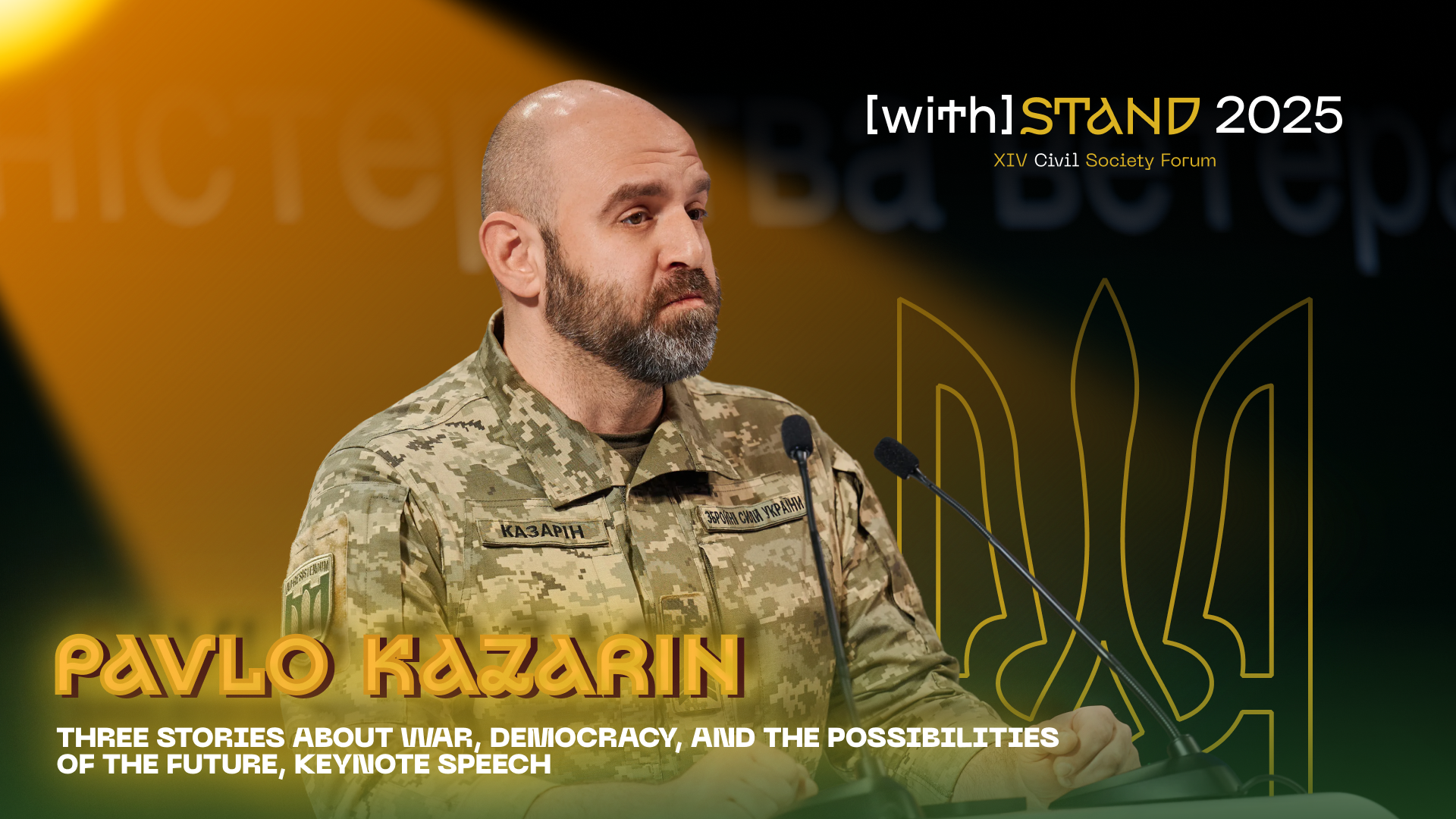
During the XIV Civil Society Forum, Pavlo Kazarin – a well-known journalist, writer, public intellectual, and now a senior sergeant in a strike UAV company of the Armed Forces of Ukraine – delivered a keynote speech in which he combined humanitarian insight, the reality of war, and reflections on the nature and future of Ukrainian democracy through the prism of his personal experience.
His address consists of three stories: about the power of citizens’ unity in contrast to authoritarianism, about Ukraine’s unique alliance between those who seek to save the nation and those who seek to save democracy, and about the shadow of the colonial past that still shapes our trust in the state. It is a speech about what makes us resilient, what threatens our future, and what will allow Ukraine to endure and win.
Recording of the speech (in Ukrainian):
Pavlo Kazarin’s Keynote Speech
Good afternoon, my name is Pavlo Kazarin, and I am a former journalist. A former journalist who hopes to get back to being a journalist again. But for now, I am the master sergeant of a strike UAV company of the 104th Brigade, and I will speak through the lens of my current experience.
In general, when we talk about civil society, we mean everything within a society that is neither the state nor state-controlled.
So I have three stories for you about how all of this works in wartime.
First Story
There is an opinion that democracies are effective in times of peace, while authoritarian structures are supposedly far more effective in times of war: that any authoritarian system may easily mobilize its citizens for any war; that propaganda turns citizens of authoritarian countries into fierce ‘passionaries’; that an invasion of a country accustomed to the role of a ‘besieged fortress’ will inevitably lead to a partisan movement, resistance, and all the other attributes of the Soviet cult of the“Great Patriotic War.
But then the Ukrainian army enters the Kursk oblast – and we see none of that. We see neither a partisan movement nor any grassroots resistance. And all of this sharply contrasts with what we witnessed in our own country in the first weeks after Russia’s invasion.
Do you remember how people in Kherson went to protest the Russian occupation? Do you remember how people in the Chernihiv oblast tried to stop Russian tanks with their own hands? We all remember the lines at military enlistment offices and the extraordinary surge of volunteer activity in the first weeks and months of the war.
We saw in our country everything that we did not see in the Kursk oblast when the Ukrainian army entered it. And I think this is a very vivid illustration of what does not work in authoritarian countries.
The nature of authoritarianism is that the government seeks first and foremost to preserve itself. And to do so, it destroys political opponents, then the media, and then civil society. An authoritarian government believes that any grassroots solidarity threatens the emergence of organizations that could challenge its power. Ultimately, any authoritarian country becomes a community of people who feel no solidarity with one another.
And it doesn’t matter what kind of organization you create. It could even be an ultra-loyal one like the Widows of the Heroes of the Special Military Operation Patriotic Association. If it is a grassroots initiative, it will still be considered a threat simply because the very existence of civil society contradicts the core idea of an authoritarian state.
And we should understand: the Russian authorities have achieved their goal. Russian society, like any society under authoritarianism, is an atomized community without a sense of responsibility, where the habit of initiative and the capacity for civic solidarity have been extinguished. An authoritarian country inevitably becomes a country of isolated, disconnected individuals who have been taught not to take initiative.
It seems to me that this is quite a telling story, because democracies, despite all their flaws, give part of the population a sense of belonging to what is happening. The difference between a ‘population’ and ‘citizens’ is that citizens feel like shareholders of their country. And this feeling – that you are a shareholder of your own state – creates responsibility and engagement.
And strangely enough, everything we used to see as Ukrainian weaknesses before the war has become the foundation of our resilience. At the start of the invasion, we had enough citizens to withstand both the first wave and all the subsequent four years of full-scale war. If you have citizens, your country is capable. If you have only a population, it will never participate in defending its state.
And only democracy may increase the number of true citizens in a country – this is an absolute axiom. Because an authoritarian regime can only decrease its number.
Second Story
You know, every time we say that Ukraine is a democratic country, we should understand that the design of our democracy is very different from the design of democracy in our Western neighbors.
In most modern democracies, there is a divide between those who want to save democracy and those who want to save the nation. We see this clearly in Hungary, where attacks on democratic traditions are often justified by the argument that democracy supposedly prevents the nation from being saved. We see this in other countries as well. Moreover, even the current events in the United States fit this same logic of confrontation: one camp is trying to defend democracy, while the other is trying to protect the nation.
But against this backdrop, Ukraine is a striking exception. We have not yet experienced such a confrontation. On the contrary, there is a situational alliance between these two camps. Every one of our Maidans united both those who believed that the nation should be saved and those who put the defense of democracy first. They stood shoulder to shoulder – on all the Maidans – and they remained allies.
When the full-scale invasion began, representatives of both camps put on the military pixel uniform together. And this is very telling. We do not always realize how different the design of Ukrainian democracy is from other models.
Look even at how we react to corruption scandals. When a corruption episode emerges, half of the comments express outrage that ‘these scoundrels are stealing state money.’ And the other half is outraged that ‘they are speaking Russian while doing it.’ Even our anti-corruption struggle has a national-liberation dimension. And all of this is because Ukraine has an alliance between those who want to save democracy and those who want to save the nation. We are an important exception to the global trend.
But it is important to understand that war creates zones of risk. Sometimes, to save the country, we have to sacrifice certain democratic practices: closing borders, postponing elections, and imposing compulsory mobilization. All of this contradicts normal democratic logic, but it is necessary so that the country has a chance for a future.
That is why I want to emphasize: each of us should understand that this alliance between the two camps exists and that it should be protected. It is our true asset. Because if it collapses, we will lose both democracy and the nation. And if we begin to ignore our allies within this camp, we risk disaster. The greatest disaster would be a future in which the hyphen in the phrase ‘national-democratic’ simply disappears.
Third Story
We often say that every adult is a hostage to their childhood traumas. But if we continue the analogy, then every country is a hostage to its own past.
Ukraine spent centuries in a colonial status, and this resulted in several important transformations. Ukrainians excel at building horizontal connections, yet they rarely trust vertical ones.
This is a story about our colonial past. When you live in a colonial status, you never trust the government. You perceive any authority as an occupying force, and any representative of that authority as an outsider sent from a hostile capital to administer your territory. A colony cannot determine its own future, and therefore it does not recognize the value of state governance. Administrative services are not part of its basic expectations for life.
More broadly, nepotism is an ethic of survival. And yes, it is useful when your main task is to survive inside someone else’s empire. But all of this becomes an obstacle when you begin building your own state. The war has simply drawn sharper lines around things we already suspected: we need a state to survive, and we need to preserve and develop it.
This is the central task of our generation. All values of colonial survival not only contradict the idea of a comfortable state, but also the very idea of a state. Because they deny the idea of shared destiny. Why pay taxes if someone else will benefit? Why mobilize if you can focus solely on your own family’s safety? Why follow rules if that may cost you?
Our lack of statehood experience became a true childhood trauma. And in adulthood, it leads to the most unexpected consequences. Ukrainians unite brilliantly ‘against something,’ and in the short term, they demonstrate extraordinary effectiveness. But as soon as long-distance reforms begin, mass desertion starts.
For example, every time a representative of civil society is appointed as a deputy minister, it is enough to read the comments to see the presumption of distrust, even if society knows nothing about this person and they have not even started working yet.
This presumption of distrust also explains why we do not want to pay civil servants a decent salary and why we make entering public service extremely difficult for any competent professional. We still do not perceive public service as something that works in our interests. And this, too, is a legacy of our past that continues to shape our present.
Now, this room is full of civil society representatives. But civil society alone cannot win a war. Only the state can win a war.
That is why we cannot oppose Ukrainian horizontals to Ukrainian verticals. This is a direct path to losing the war and losing Ukraine. The state is not the enemy. The state is a tool. The only question is: who will be able to wield this tool?
Because if you feel the state as your own, you will defend it. You will put on the uniform. You will pay taxes. You will volunteer. And if you don’t feel it as yours, you will behave like the local residents of the Kursk oblast, who simply sat and waited to see how things would turn out.
I believe next year will be difficult. But I also believe we are not doomed to any predetermined scenario for ending this war. There are countless scenarios, and the one we invest in will prevail.
We must remember: you can invest in a scenario of the future through action or through inaction. If a person does nothing, they are still investing in some version of tomorrow. But most likely, they will not like the outcome.
That is why we need not just inhabitants, but citizens. That is why we need an effective public service, staffed by qualified professionals. And that is why we need consensus between those who strive to save democracy and those who strive to save the nation.
Thank you.