On 4 March 2026, the Civil Society Home of ISAR Ednannia in Kyiv hosted the public presentation of the first comprehensive study conducted during the full-scale invasion:
“Girls and Young Women Outside Education, Employment and Training in Ukraine: Barriers, Needs and Pathways to Labour Market Integration.”
The event brought together representatives of government institutions, international organisations, civil society, and young women whose voices shaped the research.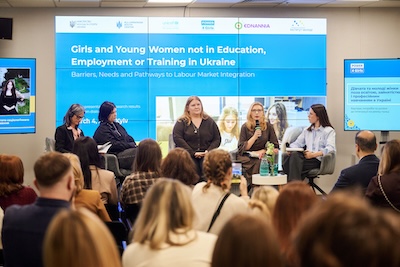
Numbers That Change the Perspective
In Ukraine, 1.34 million girls and young women aged 15–34 remain outside education and the labour market.
The study challenges the common stereotype about “inactive women without education.” The real picture looks very different.
35% of young women aged 15–34 fall into the NEET category (not in education, employment or training), while the share among men stands at 11.8%. The gap is threefold.
The highest rate appears among women aged 25–29: 48.7% of women in this age group remain outside education and the labour market. This stage often comes after women complete their education but before they manage to secure stable employment.
At the same time, 70% of surveyed women in NEET status hold higher or vocational education. The challenge does not lie in qualifications but in systemic barriers.
75.2% of young women aged 15–34 in NEET status provide unpaid care for children or relatives, without access to viable alternatives.
26.6% of respondents are internally displaced persons, and 20.3% experienced discrimination while searching for a job.
“This research answers two simple yet crucial questions: what prevents young women from working, studying and realising their potential, and what can help change the situation.
This large-scale work maps the real needs, fears and expectations of young women who remain invisible to the labour market,”
said Matvii Bidnyi, Minister of Youth and Sports of Ukraine.
Not a Choice but a Consequence
Researchers identified three interconnected groups of barriers.
Structural barriers include the lack of childcare infrastructure, transport isolation and digital inequality.
Institutional barriers involve the mismatch between education programmes and labour market needs, gender discrimination from employers, and an inflexible labour market.
Individual barriers stem from psychological trauma, chronic anxiety and the loss of life direction caused by the war.
One particularly striking finding shows that 39% of women in NEET status know nothing about support programmes, while 51% possess only limited information.
In other words, nine out of ten women who need support do not know where to find it.
“Girls and young women outside education and employment do not represent a homogeneous or passive group. They hold significant potential and show readiness to act when they gain access to opportunities that recognise their circumstances.
Our research clearly shows that the challenge lies not in the lack of motivation but in the lack of information about available opportunities,”
emphasised Nataliia Tilikina, PhD in Economics, Head of the NGO Institute of Youth and the lead researcher of the study.
From Research to Solutions
During the panel discussion, speakers included:
• Uliana Tokarieva, Deputy Minister of Youth and Sports of Ukraine
• Yuliia Zhovtiak, Director of the State Employment Service
• Clara Bastardes, Gender Programme Manager at UNICEF
• Anastasiia Matviienko, participant of the POWER4Girls initiative from Chernivtsi, whose personal experience of leaving NEET status became one of the most powerful moments of the event.
Government representatives confirmed that the research findings will directly inform the development of the National Youth Guarantee Plan and gender-responsive youth policy.
The discussion outlined five key directions for practical action:
• human-centred support and psychological assistance
• expansion of childcare infrastructure
• short practical training programmes and development of soft skills
• support for women’s entrepreneurship
• communication through social media, chatbots and real success stories
About the Study
The Institute of Youth NGO conducted the research in October–November 2025 at the request of ISAR Ednannia.
The methodology included:
• 512 structured interviews
• 8 focus groups involving 61 participants
• 23 in-depth interviews with representatives of hard-to-reach groups (IDPs, women with disabilities, and Roma community representatives)
• 30 expert interviews across all regions of Ukraine, except temporarily occupied territories and areas of active hostilities.
The full report and executive summaries in Ukrainian and English are available in the Analytical Library of ISAR Ednannia.
The event took place under the global UNICEF POWER4Girls initiative and the project Unlock Youth: Systemic Strengthening of Youth Services in Preparation for the EU Youth Guarantee in Ukraine Project.