The "Recovery and Development Consultants" program is a training initiative by ISAR Ednannia, implemented with support from the European Union. It prepares specialists who help communities recover and develop, build partnerships between authorities and citizens, launch local change projects, and attract funding. Participants are people from NGOs, local government, and business initiatives who are already working at the local level and want to do so more systematically.
From a University Department to the Civil Society Sector
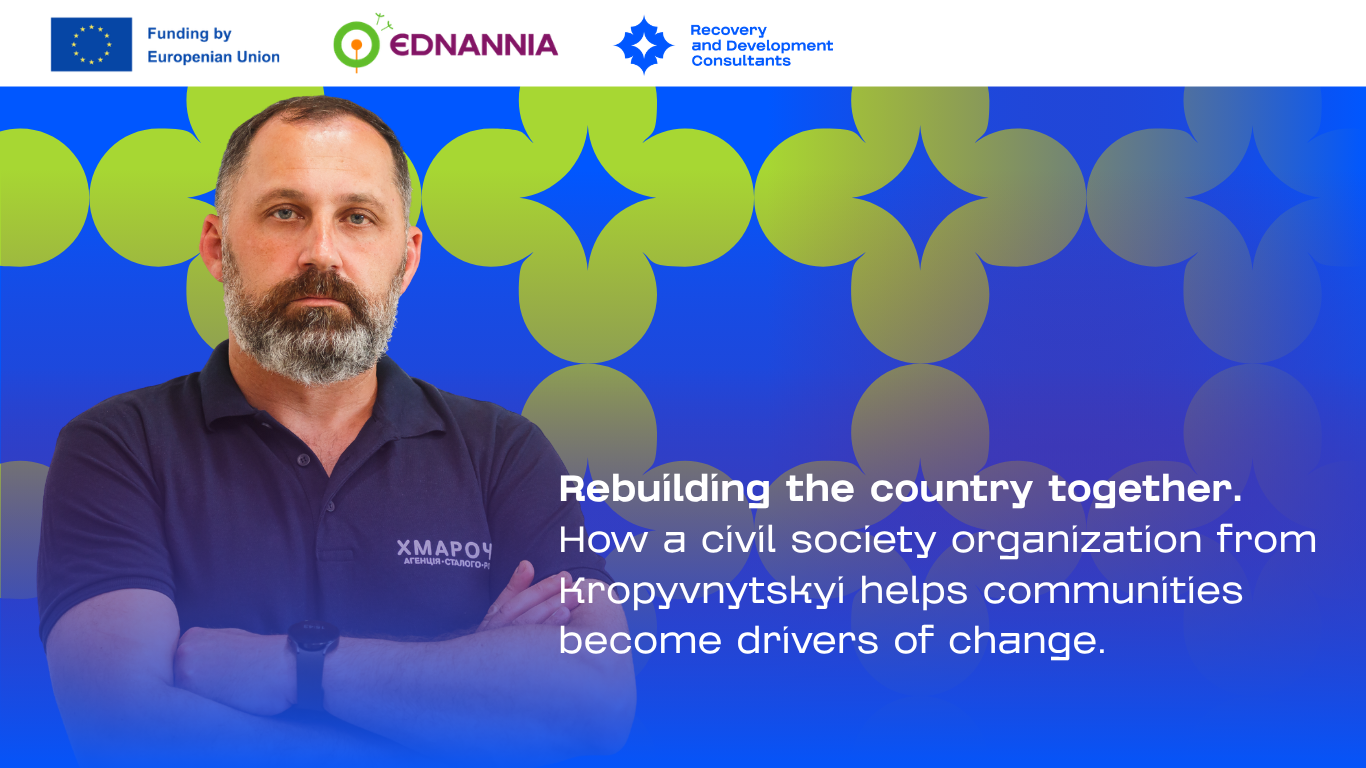
Serhii Tkachenko works at the NGO "Sustainable Development Agency 'Khmarochos'" in Kropyvnytskyi. His path into the civil society sector began in 2011, when he was still teaching at the Department of Publishing and Editing at the local pedagogical university.
At the time, he joined a community of lecturers and students who felt confined by university classrooms. They wanted to do something useful for the city's youth — organizing cultural, artistic, and educational initiatives. For five years they worked as an initiative group, and in 2017 they officially registered the organization.
Today, the "Sustainable Development Agency 'Khmarochos'" NGO works with civil society organizations and youth, supports youth councils and centers, develops a security-focused area of work, and helps initiative groups in local communities become institutionalized and turn into drivers of change. The team also helped establish a regional association of NGOs, which now includes around 30 organizations.
"In many communities, especially rural ones, NGOs are still seen as something exotic. We want to change that attitude and help as many different organizations as possible appear in communities — from animal rights groups to youth organizations. This is a normal mechanism that helps people unite and act together," says Serhii.
Training to Help Communities
Interest in the "Recovery and Development Consultants" program grew directly out of his work with communities. Serhii wanted to learn an approach and methodology that could later be shared through the regional association — reaching proactive representatives of the civil society sector who live in small communities and often simply don't know where to look for such opportunities. So he applied for the training-of-trainers program.
Before joining the program, he already had experience in facilitation, training, and strategic sessions, but lacked knowledge of the legislative aspects of recovery — legal innovations that are only just emerging in Ukraine.
"We all need to understand these legislative mechanisms, regardless of whether we work in the civil society sector, local government, or business. We have to rebuild the country together," he explains.
Training You Can Apply Right Away
Serhii describes the five days of in-person training as a great opportunity to immerse himself in a concentrated intellectual environment. The group was diverse — ranging from local government officials to experienced trainers and facilitators.
What impressed him most was how well-organized the training was — everything had a clear structure and was thought through down to the smallest detail.
"It's such a luxury to have material that's already fully developed. You just take it, adapt it to your training group's specifics, and deliver it," he says.
Half of the training was hands-on practice: participants prepared in teams and delivered modules to the whole group, while the program developers gave real-time feedback.
Life After the Training
Serhii delivered his own training under the program together with his colleague Inna Khmelnytska in two communities in Khmelnytskyi region — Volochysk and Shepetivka. Both sessions focused on strengthening community resilience by increasing resident participation in recovery processes.
Although the topic was the same, the two trainings unfolded quite differently. In Volochysk, representatives of both local authorities and the civil society sector trained together. In Shepetivka, only local government employees involved in recovery took part.
"We chose this format deliberately, to get experience working with different audiences. Where it's a 50/50 mix, you get a different dynamic and a broader discussion. Where the group is more homogeneous, it's simply different — but not worse."
After the training, Serhii shared his experience with the team — a standard practice at the organization, where members regularly gather to share the knowledge and insights gained from trainings they've attended.
Serhii is now working to apply methodological approaches from the program — particularly around inclusive decision-making as a key to effective recovery — both in his team's work and in the educational content they develop.
But the bigger plan is more ambitious. There are 49 communities in the region, and Serhii believes it would be worthwhile to have at least one recovery and development consultant in each of them. In the near future, the organization plans to hold training for representatives of the regional association.
"Not everyone in a small community can afford to travel to Kyiv to study. But if someone comes to them instead, joining such training becomes far more realistic. I think it's an entirely achievable goal."
At the same time, the organization is running several other active projects. Together with the British Council in Ukraine, they are implementing the Youth Connect for Ukraine program — five-day leadership trainings for young people from different communities, with the opportunity to receive a micro-grant for their own initiative.
There is also the "Youth Connect EU – Ukraine (YOU)" project, involving Ukraine, Poland, Czechia, and Romania, which supports young people and those who work with them. Soon, with support from the "eMistechko – Third Places" program, another initiative will launch to create "third places" in cultural institutions — open spaces where community residents can meet, communicate, learn, and carry out joint initiatives.
One area of focus will be preserving memory. In particular, the team is preparing an audiovisual performance based on letters from World War II camp prisoners that never reached their intended recipients.
"We want these voices to finally be heard. And we want this to give us the courage to make sense of what we're living through now — so as not to leave behind yet another scar that keeps our country from spreading its wings."
"If You Don't Apply — There's No Chance"
To those hesitating about whether to apply for the "Recovery and Development Consultants" program, Serhii says:
"If you don't apply, there's no chance. If you do apply, there's always a chance. How big a chance depends on how many people applied and how well you put together your application."
According to him, the program is open to a wide range of people — no specialized education or particular requirements are needed. To start, it's enough to want to learn something new, to genuinely believe in your community, and to want to contribute to its development.
"Even if, after the training, all you do is join your community's advisory public council and start voicing these ideas at meetings — that's already a far bigger impact than not taking the training at all. Apply."
The programme is implemented within the framework of the EU Unity4Community project, funded by the European Union.
This publication was produced with the financial support of the European Union. Its contents are the sole responsibility of ISAR Ednannia and do not necessarily reflect the views of the European Union.