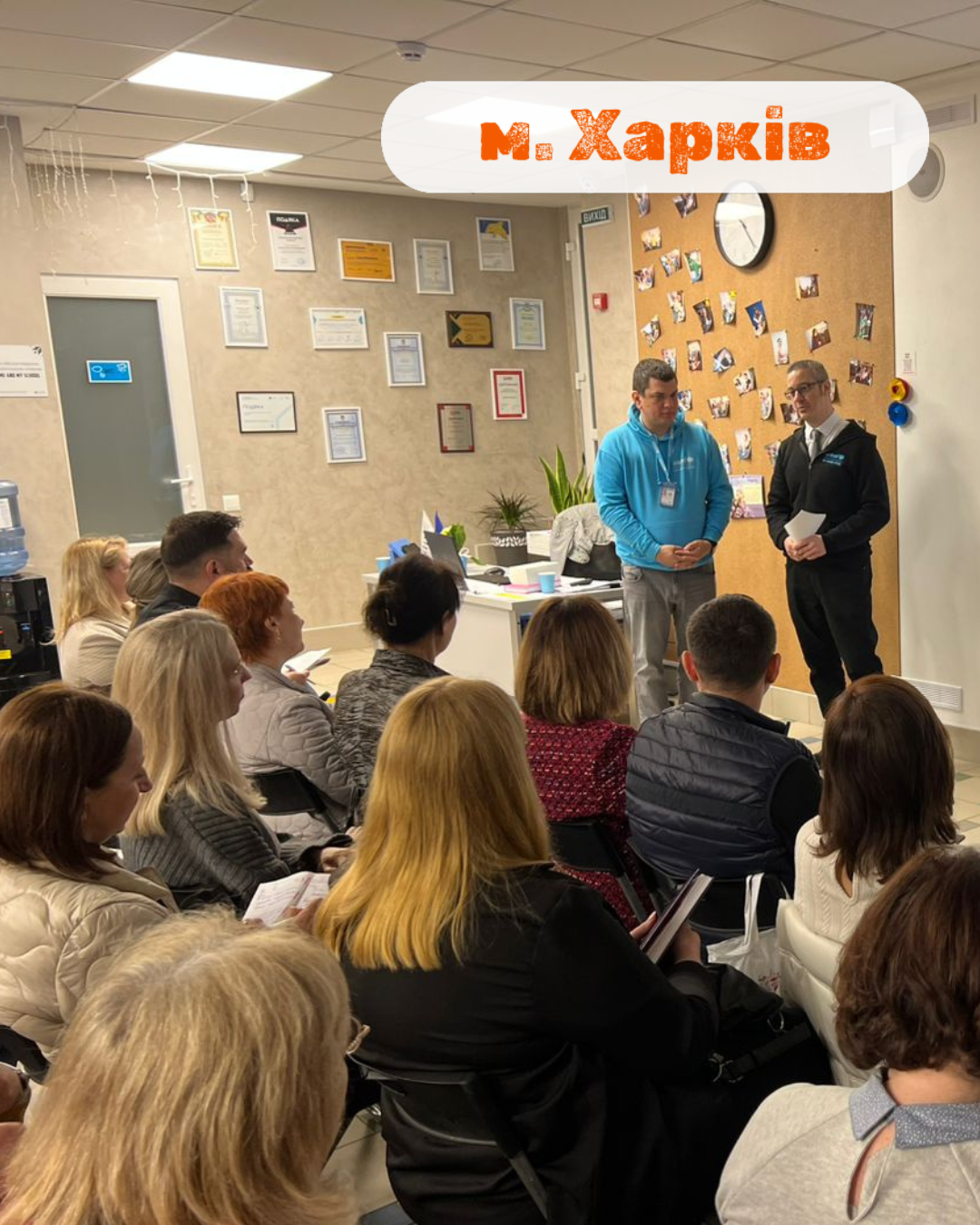
Ukraine’s recovery amid a full-scale war is about far more than rebuilding destroyed homes, roads, or schools. Above all, it is about people who help communities develop, find solutions, build dialogue, and drive change. It was with the aim of preparing such professionals that ISAR Ednannia, with the support of the European Union, developed the Recovery and Development Consultants Programme.
Participants learn how to work with communities: support development planning, foster cooperation between local authorities and residents, launch local initiatives, and mobilise funding. The second cohort of the programme is currently underway. In total, by 2027, three cohorts of participants from civil society organisations, local self-government bodies, and businesses across different regions of Ukraine will have completed the programme.
The Recovery and Development Consultants curriculum was developed by Alona Dolia, Head of the First Ukrainian Association of Interactive Learning “Good Fortune” (“Dobra Dolia”), an educational programme methodologist, trainer and facilitator, and community development specialist with more than 20 years of experience.
From Public Service to Civil Society
After graduating from university, Alona worked in public service and later moved to Donetsk, where she discovered the civil society sector. It was there that she saw how civil society projects could become a genuine tool for change. She continued working on community development, this time as a project manager at a civil society organisation.
Alona began delivering training 25 years ago. She says she was initially afraid of speaking in front of people, but quickly realised that training was one of the ways she could help others.
“I really enjoyed it. I followed this path because I wanted to help people — including through training.”
Over the years, she has completed dozens of international programmes focused on facilitation, interactive learning, and community development. Following a training-of-trainers programme in Poland in 2008, Alona systematised her experience and developed her own training methodology.
“What I had been doing intuitively, combined with theory, came together into a broader vision.”
In 2016, Alona began training trainers using her own methodology. This gradually led to the formation of the “Dobra Dolia” team, which now delivers training and develops educational programmes.
According to Alona, a modern consultant needs to understand not only how a community functions, but also be knowledgeable across a broad range of areas — from community development and recovery to European integration. That is why the programme is continuously adapted and expanded in response to emerging challenges.
How the Recovery and Development Consultants Programme Was Created
Alona’s cooperation with ISAR Ednannia dates back to 2007, when she participated in the “NGO Management” training programme. In 2019, she joined the team as a trainer and expert, helping civil society organisations develop and improve their own educational programmes.
When ISAR Ednannia announced a tender in 2025 for the development of the Recovery and Development Consultants Programme, Alona was selected. The “Dobra Dolia” team joined her in delivering the programme.
Alona explains that the programme was developed based on a competency profile for recovery and development consultants created by expert Roman Kolyshko. This profile served as the foundation for designing the curriculum.
Interestingly, the programme’s name also evolved during the development process. The initial title, “Recovery and Development Officers”, was rejected. The team ultimately chose “consultants”, as this term more accurately reflects the role they are expected to play.
Three Weeks of Preparation for Three Days of Training
Developing a training programme involves much more than simply preparing a presentation. Designing a single day of training takes approximately four to five days of work, while developing the first core module took more than three weeks. The core module was designed so that it could be delivered both offline and online.
“When I create a training script and facilitator’s guide, I already experience and go through the training in my mind. Everything is planned down to the minute. Even practical details: here, participants will need to be divided into groups — that will take two or three minutes; then explaining the task will take at least another two minutes.”
The full programme consists of three stages. First, participants complete a core course. They learn how communities function, how local authorities and civil society interact, and what knowledge and skills a consultant needs.
After completing the core course, consultants move on to advanced modules: “Strategic Communication in Communities”; “Public Participation in the Legislative Process: Advocacy and Lobbying”; “European Integration in Recovery Processes”; “Fundamentals of Project Management”; and “Fundamentals of Cyber Hygiene and the Use of AI in Daily Work.”
The final stage of the programme is a training-of-trainers course, during which participants learn how to deliver training themselves and conduct their own pilot sessions.
For each module, the team develops a programme, presentation, participant and trainer materials, as well as practical assignments and assessment tools.
The training is designed so that even its visual elements help participants better understand and retain the material. For example, the same images are used consistently across presentations, handouts, and participant materials.
“Participants need to see this visual connection. If an image appears in the presentation, the same image should also appear in the participant guide and handouts. This helps participants better perceive and absorb new knowledge.”
The Programme Is Improved After Every Cohort
According to Alona, the Recovery and Development Consultants Programme was not created in a matter of days, nor was it simply a collection of ready-made presentations. It was built on many years of experience working with communities and has been continuously updated and expanded since its launch, taking into account participants’ feedback and needs.
After each module, the team does more than simply collect feedback forms — they analyse them in detail. Trainers discuss what worked well, which topics proved challenging, and what needs to be explained differently or expanded.
“For example, when developing the core module, I drew on many years of my previous work. Later, during the first delivery of the core module, we analysed participants’ feedback: what was missing, what needed to be added to the curriculum, and so on. We then made adjustments for the next cohort,” Alona explains.
The training programme covers a wide range of topics. One of the biggest challenges was teaching future consultants how to build partnerships between local authorities and civil society.
“In some communities, we saw confrontation between local authorities and civil society. Our task was to explain to the consultants that this paradigm needs to change. Local authorities are representatives of the community, and everyone — local authorities and civil society alike — lives and works in the same community. Community development and recovery happen through joint efforts.”
Building effective interaction starts with communication. That is why a significant part of the training focuses on communication skills, facilitation, and working with people.
“The ability to communicate is probably one of the most important competencies for a consultant.”
There are many topics and tasks, but for Alona, the best indicator of the effectiveness of each training is not limited to participants’ ratings in feedback forms.
“Every training is, first and foremost, about bringing people together, motivating them to continue their personal development and self-improvement. If we have managed to inspire people, help them come together, and encourage them to start doing something afterwards — that is a huge success for us.”
People-Centred Approach at the Core
The “Dobra Dolia” team continues working with programme graduates after they complete their training. An informal community of trainers has been established, where graduates regularly meet, share their experiences, learn new tools, and can always turn to one another for professional advice.
For Alona, the programme’s primary objective is not to issue certificates, but to build a community of people who will help their communities recover and develop.
“For me, what matters is that, several years from now, Recovery and Development Consultants will be working for the people in these communities. That they will be people-centred, open, and motivated to help. If we can do more than simply provide knowledge and skills — if we can also help our consultants work on the ground for their own communities — that will be a huge success.”
The programme is implemented within the framework of the EU Unity4Community project, funded by the European Union.
This publication was produced with the financial support of the European Union. Its contents are the sole responsibility of ISAR Ednannia and do not necessarily reflect the views of the European Union.