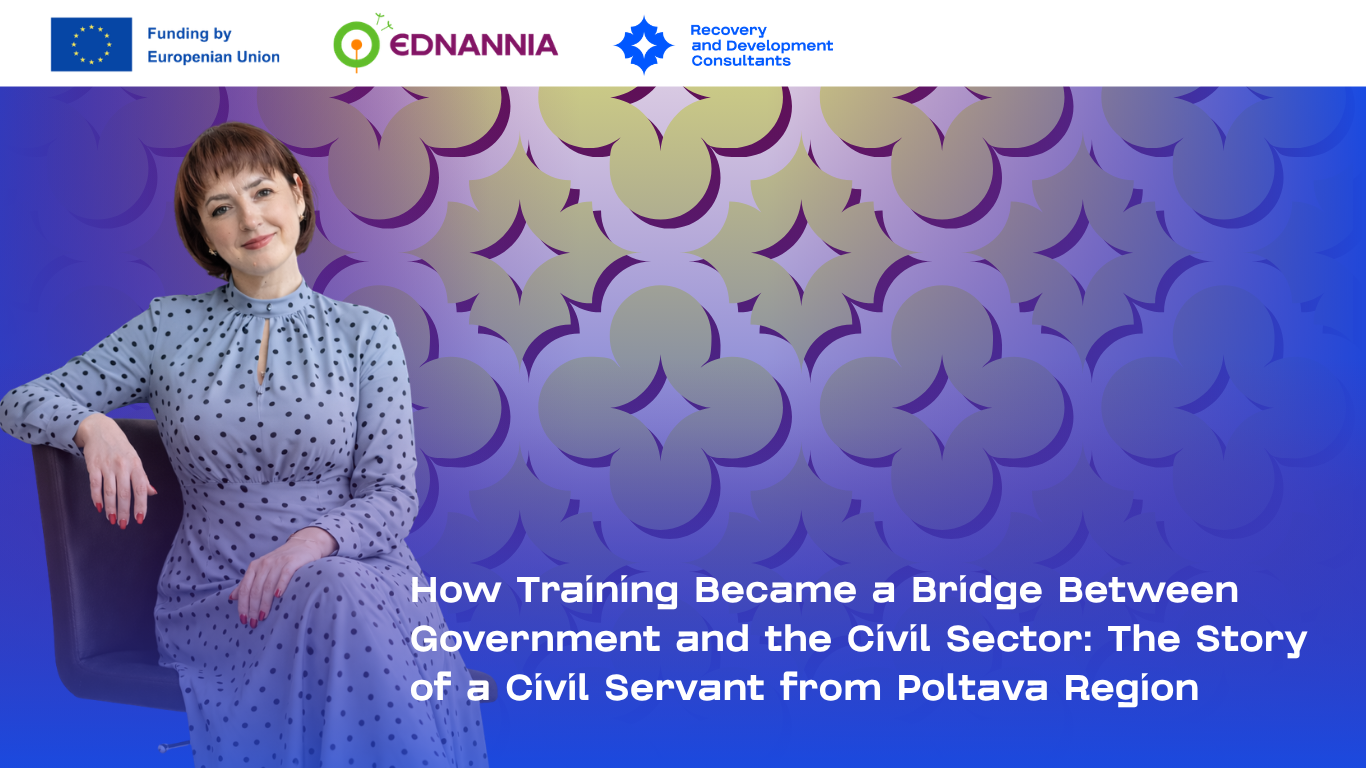
The "Consultants for Recovery and Development" program is a training initiative by ISAR Ednannia, implemented with support from the European Union. It prepares specialists who help communities recover and develop, build partnerships between authorities and citizens, launch local change projects, and attract funding. Participants include people from NGOs, local self-government, and business initiatives who are already working at the local level and want to do so more systematically.
From a Pottery Museum to Community Communication
Zhanna Chechel is relatively new to the civil sector. Before that, she spent twenty years working as a research fellow at the National Museum of Ukrainian Pottery in Opishnia, Poltava region. When the decentralization process began, she was offered the position of head of the social and humanitarian department of the newly formed Opishnia community.
That's when Zhanna, together with her team, learned to write grant applications, and one of their first successful projects was the Slyvafest festival, which received funding from the Ukrainian Cultural Foundation.
Today Zhanna is Deputy Head of the Internal Policy Department and Head of the Communication with Public Associations Division at the Department of Information Activities and Public Communications of the Poltava Regional Military Administration. She advises civil society organizations, helps them find grant opportunities, shares her own experience, and supports their development.
"I like seeing organizations not stop after a single project, but gradually build strength and grow," she says.
Learning in One Breath
Zhanna had known about the ISAR Ednannia program since the time she was setting up a charitable foundation and looking for knowledge on civil society organization development. Realizing that effective work required systematic knowledge in communication, strategic planning, and project management, she enrolled in the "Consultants for Recovery and Development" program, this time as a civil servant. She applied as a consultant and later was also selected as a trainer.
The training took place in both online and offline formats. What Zhanna liked most was the opportunity to work in person with trainers and participants from different sectors — local self-government, civil society organizations, and civil service. According to her, this was what helped her better understand how to build cooperation between different environments.
"We learned not only to speak but also to listen to one another. We found common ground between the government and civil sectors and worked through crisis situations. I was the only civil servant in the group, but I never once felt out of place — we were all looking in the same direction."
Life After the Training
After completing the program, Zhanna began actively applying the knowledge she had gained in her daily work. Today she advises a municipal institution in her community that received a small grant. For more than six months now, she has been helping the team with data collection, results analysis, reporting preparation, social media management, and building strategic communications — both within the organization and with the community.
"This is exactly the kind of case that really helps me. It's nice that we speak the same language, since communication runs like a red thread through the entire ISAR Ednannia training. They understand what I want from them, and I understand how to help them," says Zhanna.
Zhanna is currently taking part in implementing a safety training program for youth in 12 communities across Poltava region. Together with her team, she helps establish communication between communities and security agencies, and works to make complex safety topics understandable for young people. According to her, the training helped improve the project's format, in particular by strengthening the speakers' communication skills.
Equally valuable turned out to be the knowledge gained in preparing grant applications. Colleagues and representatives of civil society organizations now regularly turn to Zhanna asking her to review project applications before submission to competitions. She helps them identify weak points, properly formulate their ideas, set priorities, and avoid common mistakes.
"This knowledge is useful not just for a trainer, but in work in general. I've had to sit down, read grant applications, and advise on how best to prepare them, what to pay attention to, and what not to emphasize. It really works," she says.
To those who are just considering applying for the "Consultants for Recovery and Development" program, Zhanna advises not to be afraid of change. According to her, the main thing is to take the first step and stay open to new experience.
"I would advise against being afraid to go for it. Change always brings results. Even a negative result is still experience. Without trying yourself, you'll never understand your own potential," she says.
Zhanna is convinced that the knowledge gained during the training finds practical application right away. She recalls how she is already using these skills today, advising municipal institutions and helping them build effective communication with different audiences.
"You have to get this knowledge from somewhere, because it doesn't fall from the sky. Trainings like this don't give ready-made answers or universal recipes. They help you find, on your own, the mechanisms that will actually work in your own community and in your own job."
The programme is implemented within the framework of the EU Unity4Community project, funded by the European Union.
This publication was produced with the financial support of the European Union. Its contents are the sole responsibility of ISAR Ednannia and do not necessarily reflect the views of the European Union.