The "Consultants for Recovery and Development" program is a training initiative by ISAR Ednannia, implemented with support from the European Union. It prepares specialists who help communities recover and develop, build partnerships between authorities and citizens, launch local change projects, and attract funding. Participants include people from NGOs, local self-government, and business initiatives who are already working at the local level and want to do so more systematically.
From a Memory Coach to Hospital Corridors
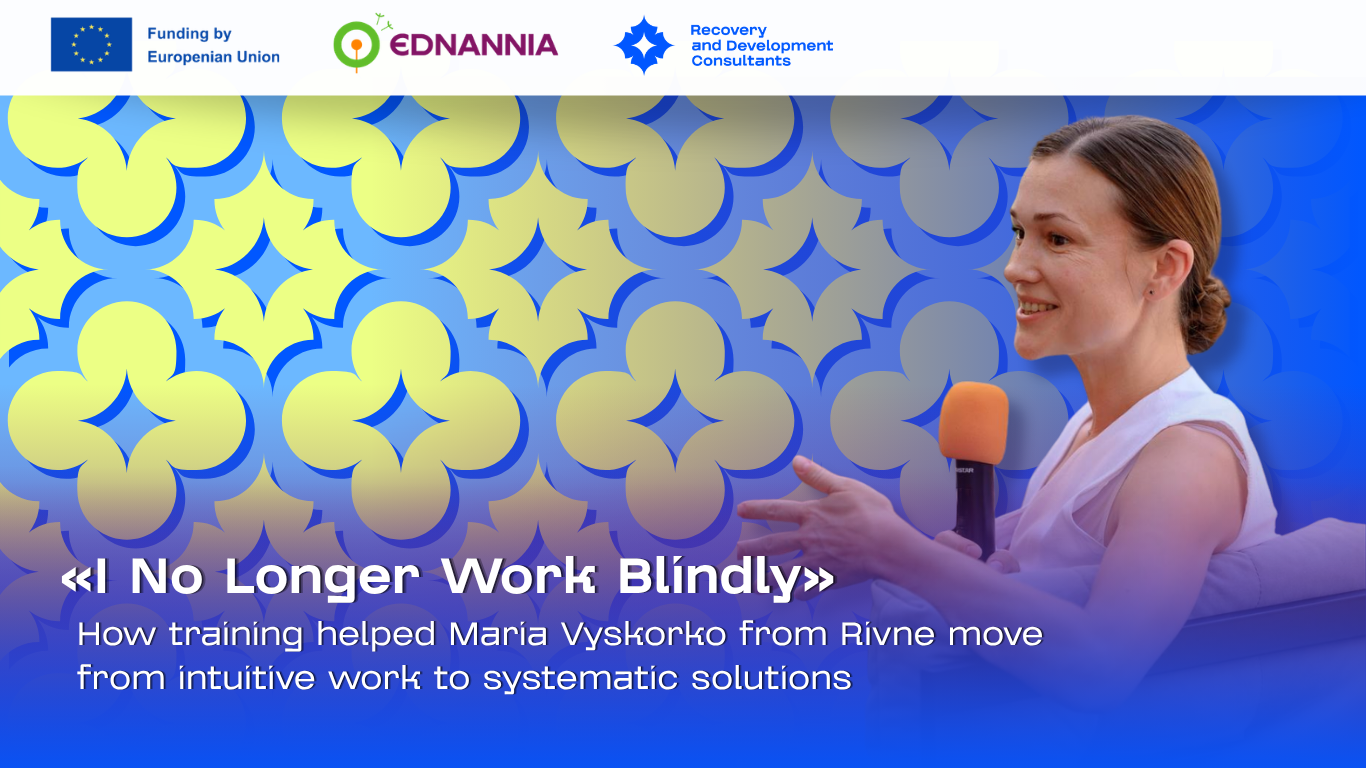
Maria Vyskorko is from Rivne. She is a personnel development specialist at the Central City Hospital and a local consultant for Olena Zelenska's nationwide mental health program. She has been working in the civil sector for over six years now. Before that, she knew almost nothing about NGOs or social work and worked as a speed-reading and memory-training coach, developing cognitive skills in children.
After the start of the full-scale war, Maria offered her help at a hospital treating military personnel with concussions. There she began holding memory-development sessions: at first for small groups of five people, later growing to as many as thirty participants.
From there, Maria's path led her to the "Integration Center" NGO, where she worked in mobile psychosocial support teams, met evacuation trains together with her team, and accompanied displaced children, helping them adapt to their new community.
She later became a social manager at the Resilience Center of the Dubno territorial community, where she coordinated interaction with authorities, businesses, and the community, and was responsible for monitoring, analytics, reporting, and grant project management.
Training: Practice Instead of Dry Theory
Maria learned about the "Consultants for Recovery and Development" training while working at the Resilience Center, since the role required constantly upgrading her qualifications.
"I wanted to do more than just react to individual requests — I wanted to build systematic services within communities. I lacked a clear methodology: how to professionally conduct a community audit, coordinate interaction between business, authorities, and residents, and turn people's chaotic requests into concrete projects," she says.
Maria first went through selection for the consultants' course, and after the first wave, she also applied for the training-of-trainers program. According to her, she wanted to gain practical facilitation tools and learn how to build effective dialogue within a community, with a focus on developing human capital.
What she remembers most about the training is how practical it was:
"It wasn't dry theory. We worked through interactive exercises, design thinking, and real crisis case studies. Almost everything we learned could be applied directly in our work right away," Maria recalls.
Equally valuable to her was the exchange of experience with other participants.
"There were more than twenty of us consultants, and each one had enormous professional experience. At first I even thought, 'What am I doing here?' But listening to their stories and watching how they changed throughout the training, I realized how important it is to be among people like that," she says.
The final stage of the program was a practical exam. Together with fellow consultant Anna Slozanska, Maria conducted a training in a community in Ternopil region for local self-government representatives and educators on interaction between authorities and the public.
Life After the Training
The training brought the biggest changes to Maria's work. The main result, she says, was a push for career growth. She applies the tools she gained every day, both as a consultant for Olena Zelenska's program and as a personnel development specialist at the Rivne City Central Hospital. Above all, her overall approach to working with people has changed.
"Before, I did a lot of things intuitively — 'by feel,' as they say. Now I start any work with an analysis of the needs of the people I'm working with. First I try to understand what they actually need, and only after that do I build further interaction," Maria explains.
According to her, this approach helps her communicate more effectively with medical staff, local authorities, donors, and partners, attract funding, and launch new initiatives.
One such project is a program Maria is currently working on. It's meant to help build interaction between veterans and young people through joint training sessions and meetings. She is developing the idea using a design-thinking methodology, testing it together with veteran and youth organizations.
At the same time, Maria is developing another initiative — creating a dedicated space within the Mental Health Center for medical workers to recover and recharge.
"We talk a lot about rebuilding the country, but it's just as important to help people recover. I want doctors to have a place where they can spend even just a few minutes in silence, recover, and gather their strength," she says.
To those who are afraid to apply for the "Consultants for Recovery and Development" program, Maria advises not to hesitate:
"Wanting to help isn't enough — you need professional tools. The ISAR Ednannia training is an investment in yourself, in your capacity to create real change. It's not just a diploma — it's step-by-step approaches that work from day one," she says.
The programme is implemented within the framework of the EU Unity4Community project, funded by the European Union.
This publication was produced with the financial support of the European Union. Its contents are the sole responsibility of ISAR Ednannia and do not necessarily reflect the views of the European Union.