The "Consultants for Recovery and Development" program is a training initiative by ISAR Ednannia, implemented with support from the European Union. It prepares specialists who help communities recover and develop, build partnerships between authorities and citizens, launch local change projects, and attract funding. Participants include people from NGOs, local self-government, and business initiatives who are already working at the local level and want to do so more systematically.
From Reviving an Organization to Restoring Communities
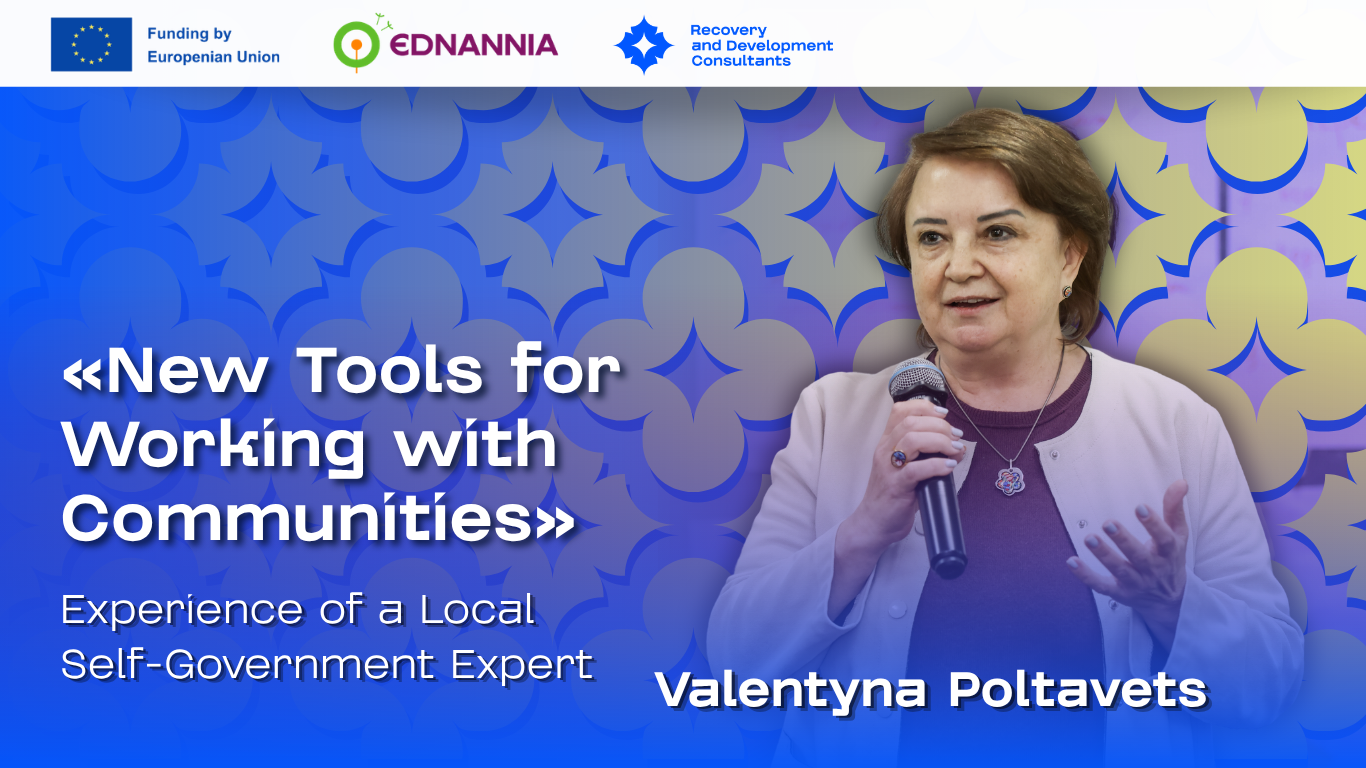
Valentyna Poltavets heads the "Center for Quality of Local Self-Government" — an organization with almost 20 years of history, which she essentially had to "revive" after seven years of inactivity. Together with her team, she carried out a rebranding and revisited the organization's goals, while keeping its main focus intact: local self-government and the development of local democracy.
"We work from both sides: we help the public understand how local authorities work, and we help authorities work with the public," Valentyna explains.
The organization mainly works in Kyiv region, but also has experience cooperating with communities in Zaporizhzhia, Kharkiv, and Kherson regions.
One of the "Center for Quality of Local Self-Government's" largest projects was implemented in 2024 with support from USAID's "Democratic Governance in Eastern Ukraine" (DG East) project. Together with Taras Shevchenko National University of Kyiv, the organization developed a training program on the recovery and reconstruction of de-occupied communities in Zaporizhzhia region.
"One of the clients was the Zaporizhzhia Regional State Administration. Back in 2024, there were expectations that Ukraine would soon be liberating territories, so local self-government bodies needed to learn how to work on recovery."
The program concluded with a regional forum for communities of Zaporizhzhia region, where participants presented their recovery ideas and projects together with architects and experts.
"I Needed New Tools I Could Take Off the Shelf and Apply"
Valentyna learned about the "Consultants for Recovery and Development" program from Facebook and decided to apply as a trainer on behalf of her organization.
She was a little worried she wouldn't be accepted, given her extensive training and expert experience.
"I hold a PhD in public administration and have worked in teaching. I've also conducted and developed trainings, but time moves so fast that you constantly need to update your knowledge. That's why I was specifically interested in the training-of-trainers program."
What interested Valentyna most was the practical part. According to her, many people still don't share a common understanding of what "recovery" actually means. That's exactly what she wanted to help change.
"I knew that during the training we'd be given tools we could then easily use later. For example, a problem comes up, and you take this tool off the shelf and use it to solve the problem."
The application process turned out to be straightforward, since Valentyna's professional profile was already well established — all that was left was to adapt her materials.
"I was afraid I wouldn't be accepted because of my extensive experience. But I understood how useful this training could be for me, since afterward I could train even more people who will go on to work in communities."
"In One Breath"
Valentyna describes the five days of training briefly: "in one breath."
"It was very important that the training had precise timing and a clearly built structure: mini-lectures, practice, group work. The trainers explained how thoroughly every component of any training needs to be worked out. You could also see how carefully every element had been prepared, down to the smallest details: marker colors, the structure of the materials, instructions for trainers. It left a pleasant impression to see a training worked out in such detail."
She says she never used to pay attention to such small details before, but after the training she started looking at how trainings are organized differently.
"After something like this, you definitely improve your own approach to preparing and delivering trainings. You pay more attention to structure, details, and the logic of how participants perceive both the content and the format of the training."
Life After the Training
"Not much time has passed since the training, but it has already strengthened our organization. We held a strategic session within the organization and formed a clearer direction for how we help communities with recovery and development. Now we have a better understanding of exactly what we can offer communities: which trainings and courses."
Valentyna, together with a colleague, has also already run a pilot training in the city of Ukrainka for representatives of local self-government and the civil sector. They deliberately chose a 50/50 format.
"It's a very effective format. It shows that dialogue between authorities and the public is genuinely possible. We showed the public that authorities aren't some distant entity, but people they can actually interact with. And we showed the authorities where the active public is, and that it's possible to work with them and solve problems together."
The "Center for Quality of Local Self-Government" team is currently working on three projects.
"We're developing strategies for six communities in Kyiv region, working on barrier-free accessibility plans, and want to strengthen the organization's analytical capacity. We're also preparing an application for an inter-municipal cooperation project, because we see that communities have demand for this, but often lack the experience and understanding of how it works."
Valentyna also adds that the training program helped their organization systematize its approaches to shaping local self-government policies in the field of recovery, and strengthened the team's focus on engaging the public in decision-making processes.
"The training program provided a clear structure of issues that shape local self-government policy in recovery projects and programs. The experts and trainers at our organization now pay more attention to questions of public participation and engagement in recovery projects, in the formation of local policies, and in developing community development strategies and other local programs and projects."
"Just Do It"
To those who are hesitant about whether to apply for the program, Valentyna advises not to wait until they feel confident.
"Many people think they don't have enough experience or knowledge. But until you try, you won't know."
The programme is implemented within the framework of the EU Unity4Community project, funded by the European Union.
This publication was produced with the financial support of the European Union. Its contents are the sole responsibility of ISAR Ednannia and do not necessarily reflect the views of the European Union.
Author: Elia Serkozhaieva