Ahead of Civil Society Week, we're sharing the stories of organizations that work every day to bring about change in their communities and across the country. The first story is about the NGO World of Silence, which works to ensure that deaf people are not left invisible to society.
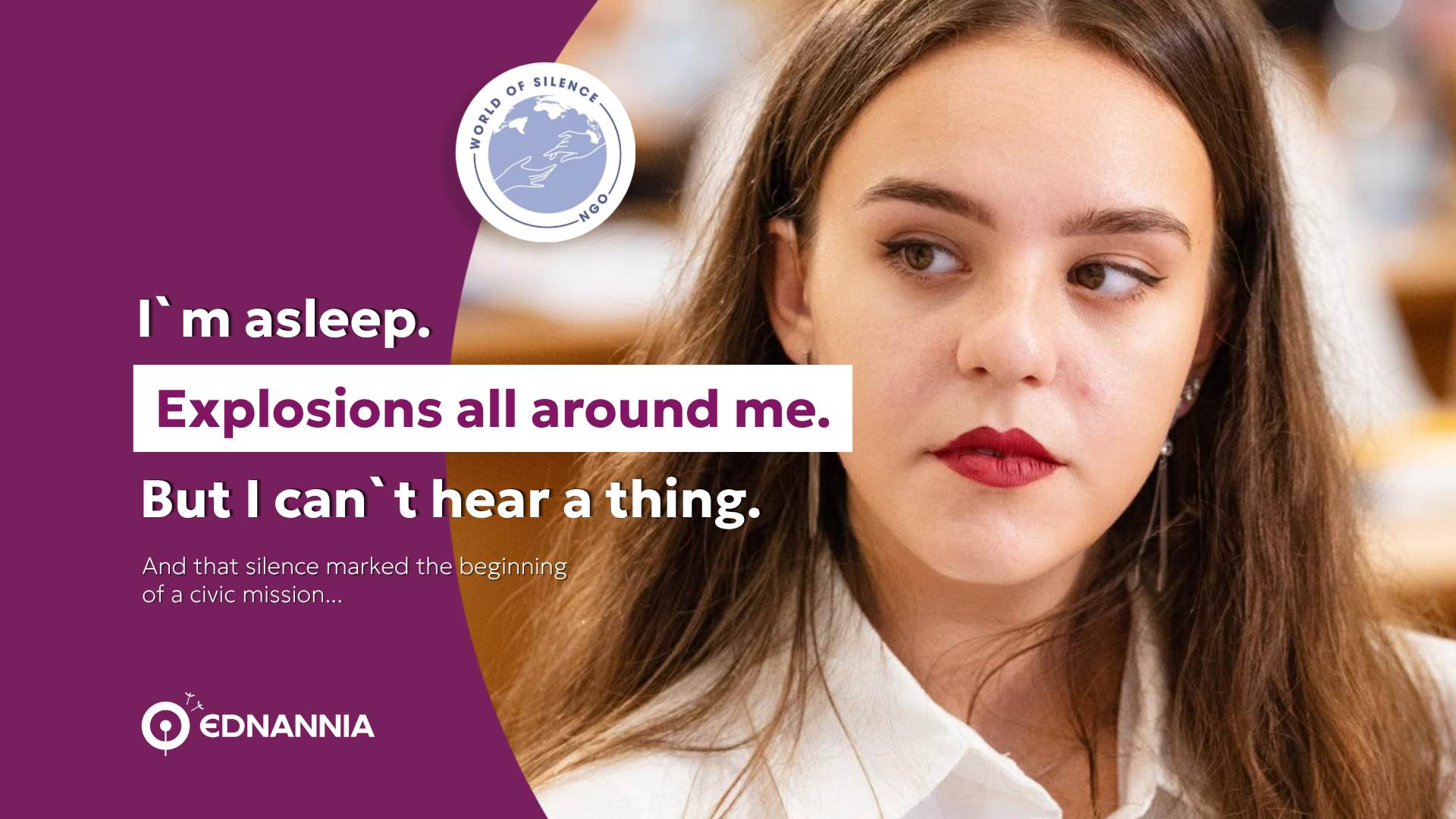
"I'm asleep. There are explosions all around. And I hear nothing"
For every Ukrainian, a night filled with the sound of explosions is an experience of fear and uncertainty. But for a person with a hearing impairment, such a situation has another dimension — a particular kind of silence.
It was from exactly this kind of experience that the civic work of the World of Silence team began.
"I remember a night when I was asleep, there were explosions all around, and I heard nothing. In moments like that, you sharply realize: your safety depends on whether others can help you in time," says a representative of the organization.
The emergency revealed a problem that deaf people face far more often than one might think: not nearly everyone knows how to properly communicate with a person who cannot hear.
This information gap became the push to act.
The team began working on a project to promote sign language use in emergency situations. After all, in a critical moment, the ability to understand one another isn't just a matter of comfort — it's a matter of safety, and sometimes of life itself.
From Individual Good Deeds to Systemic Change
Over time, it became clear: individual initiatives can help here and now, but lasting change requires systemic work.
"When it became clear that isolated good deeds only produce a quick, small result, we decided to unite. To defend rights, teach people, and actually change something within institutions, you need official status, a strong team, and a shared goal."
That's how the NGO World of Silence came to be.
The team came to include active deaf people and specialists who wanted not just to talk about accessibility, but to build it in practice every day.
"We know from our own experience what barriers are"
All members of the organization's team have a hearing impairment. That's why accessibility isn't an abstract concept for them, or a formal word from official documents — it's their own lived experience.
The experience of situations when you're not understood. When it's hard to get a service. When you have to explain the obvious. When, because accessible communication isn't there, a person can end up alone with their problem.
Sign language interpreters, activists, speakers, and people who believed in the need for change joined the team.
Together, they work to break down the walls in communication between hearing and deaf people.
What World of Silence Does
The organization's goal is for deaf people to have equal rights and opportunities, and for society to become genuinely accessible.
The team:
- teaches Ukrainian sign language to workers in the social, educational, and public sectors;
- runs educational trainings;
- creates training materials for crisis situations;
- develops special video instructions;
- works on making services accessible for deaf people;
- raises public awareness about the culture and needs of the deaf community.
With the support of ISAR Ednannia, the organization has carried out initiatives to teach Ukrainian sign language. In particular, it has run educational courses for public sector specialists and created special video instructions and a practical guide.
A Small Gesture That Can Become a Big Change
For the team, one of the most important results isn't just the number of trainings held or materials created. What they're proudest of are the people who, after training, can use sign language in their everyday work.
"We're proud of every graduate of our courses who can now hold a basic conversation in sign language with a deaf client or colleague."
It might seem like just a few gestures. But behind them lies the ability to understand each other, get help, ask a question, explain a problem.
The ability to no longer remain invisible.
It's precisely the people who come to these trainings who become one of the team's main sources of motivation.
"I'm inspired by people. The deaf community itself, their openness, and also the eager eyes of our course participants — who arrive with stereotypes and leave with a deep understanding of and respect for deaf culture."
A Future Without the Feeling of Invisibility
War, air raid alerts, power outages, and the difficult life circumstances of participants are only part of the challenges the organization deals with today. But the team keeps moving forward, because it sees the results of its work in people. Their vision of the future is simple, yet very important:
A deaf person should not have to feel invisible.
In a hospital, a school, a government office, or anywhere else, a person should have the chance to be understood and to receive the help they need. Without unnecessary barriers. Without having to prove, every single time, their right to be heard.
"Change Begins With One Person"
What would the World of Silence team say to people who want change but don't believe they can have any real impact?
"Change doesn't start with sweeping laws — it starts with one person who decided not to stay silent. Take even one small step for someone nearby, and you'll see others follow you."
For the team, this is exactly what civil society is about. About responsibility for the space we live in. About the readiness to say: "This is my city. My country. My people. And I have the power to make it better." About solidarity and the ability to act together. Sometimes big changes really do start with a small step.
And sometimes — with a silence that someone finally decided to listen to.
*within the framework of the "Sparks of communities: ISAR Ednannia and GlobalGiving partnership for sustainability" grant competition, implemented by ISAR Ednannia, funded by GlobalGiving.