Home
Home
"Thawing" the Grief of Those Waiting for the Missing: A Project from Kryvyi Rih Called "Alongside in Uncertainty"
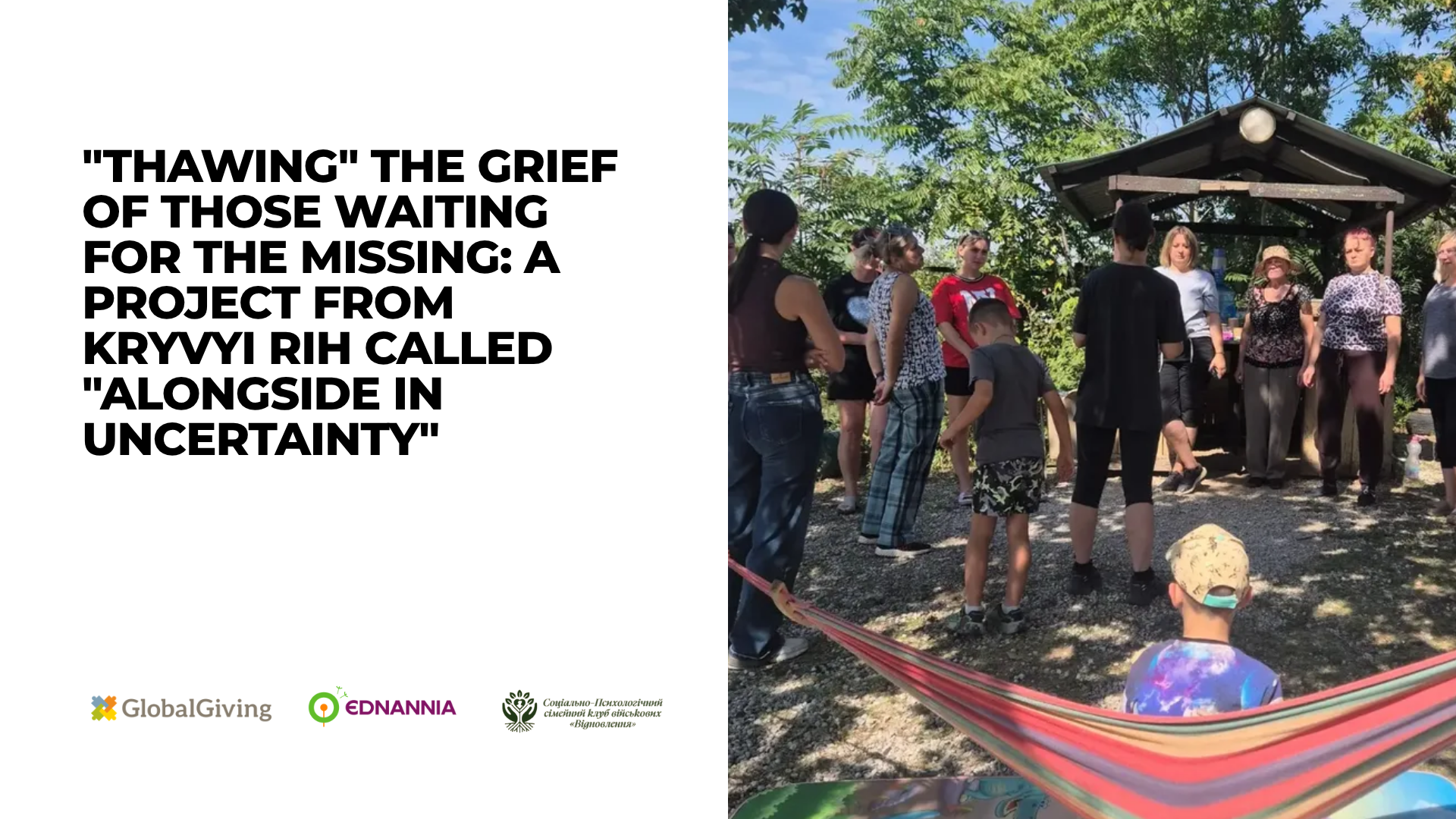
Today, thousands of Ukrainian families live in a state psychologists call "ambiguous loss" or "frozen grief." This refers to those whose military loved ones are missing in action, with no information about their fate. The absence of information — even news of the worst kind — forces the nervous system into a state of exhausting, round-the-clock mobilization. On top of that, such families often become "invisible" to society: people around them don't know how to communicate with someone in this state, and choose to keep their distance instead. This forced social isolation only deepens the crisis, trapping women (and here we're talking primarily about wives and mothers of servicemen) in a cycle of shock, anger, and depression.
A way out of this cycle was offered by the NGO "Social and Psychological Family Club of Military Families 'Vidnovlennia' (Recovery)", which has been operating in Kryvyi Rih since March 2025. The organization was founded by wives of defenders who deeply understand the essence of the problem and say: "We're there both when someone needs to cry it out, and when they simply want to smile." So the project "Alongside in Uncertainty" is built on the fundamental principle of "peer to peer," and the small number of participants (two groups of 10 women each) is what guarantees deep, meaningful support for each of them.
One of the project's key elements is legal support, which turns into a powerful therapeutic tool. When a woman receives a professional review of her specific situation and a clear course of action, she regains a sense of agency and control over her own life — right in the area where she previously felt helpless.
Another component of the project is psychological support, including through non-traditional methods of restoring one's inner resources. "Vidnovlennia" favors family equine therapy, meaning outdoor interaction with horses. This lets participants literally "exhale" and reconnect with their own bodies through contact with animals.
By the way, so that mothers can fully immerse themselves in the recovery process, the project takes care of children's activities during training sessions and consultations. "Alongside in Uncertainty" is built to last: participants master self-help techniques, which turns them from service recipients into potential leaders capable of independently moderating support groups in the future. This creates a self-sustaining network of solidarity that will continue to exist even after the active phase of the grant ends — a grant the "Vidnovlennia" NGO team received through the "Sparks of Communities: ISAR Ednannia and GlobalGiving Partnership for Resilience" competition. The grant support became the catalyst that turned a private initiative of defenders' wives into a professional institution.
As the project's lawyer — herself the wife of a serviceman awaiting news — put it: "This community became a lighthouse for me." This metaphor best captures the project's mission: to serve as a guiding light in the fog of uncertainty, restoring families' faith that they are not left alone with their pain, and that their community can be a source of support and recovery.
The grant competition “Community Sparks: ISAR Ednannia and GlobalGiving Partnership for Resilience” is implemented by ISAR Ednannia with funding from the GlobalGiving platform.
From Donetsk Region to 21 Regions: How Zadzerkallia Helps Communities See Recovery as a System
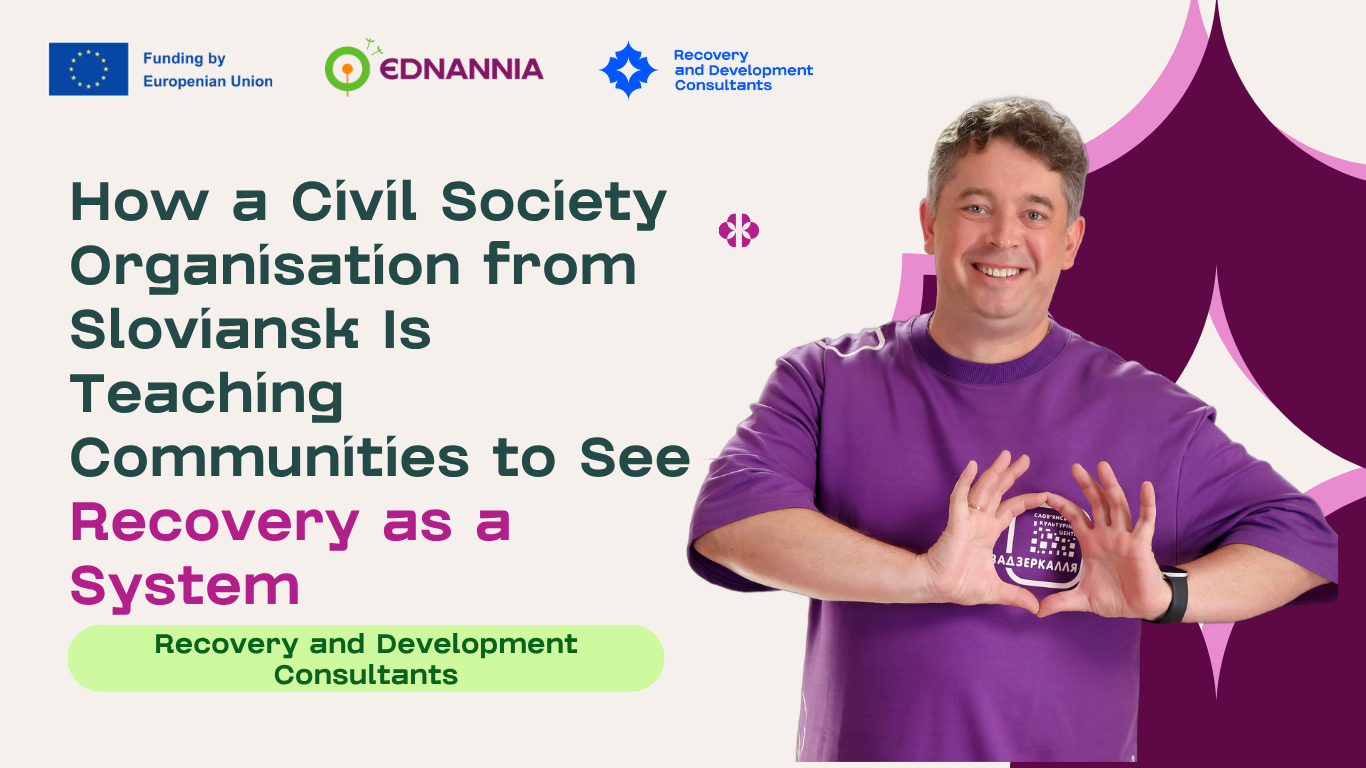
The Recovery and Development Consultants Programme is a training initiative by ISAR Ednannia, supported by the European Union. It prepares professionals who help communities recover and develop, build partnerships between local authorities and residents, launch local change initiatives, and attract funding. Participants include people from NGOs, local governments, and business initiatives who are already working at the local level and want to make their work more systematic.
Oleksandr Kashlakov has been working in the civil society sector since 1996, when he headed one of the children’s NGOs in Donetsk region. Today, he leads the Slavyansk Cultural Centre “Zadzerkallia”. Founded in 2005, the local organisation relocated to Kropyvnytskyi following Russia’s full-scale invasion.
Today, Zadzerkallia implements projects in culture, education, civic engagement, support for civil society organisations and local communities. The NGO also serves as an implementing partner for UN agencies, including UNDP, UNICEF, and others. The organisation gained its first experience working on recovery projects back in 2014 in Donetsk and Luhansk regions. Today, its work spans 21 regions of Ukraine.
“If we provide consulting, we need to know what we are talking about”
Oleksandr says he decided to apply for the Recovery and Development Consultants Programme because his organisation was developing rapidly and taking on increasingly complex and important issues for communities. One example was supporting communities as they introduced the preschool education reform, for which there were not enough ready-made tools.
“After 2022, we shifted from humanitarian response projects to recovery and development projects. Communities received new powers and responsibilities, but unfortunately, there were not enough tools to put them into practice. So we needed to strengthen our own expertise to better support communities in analysing problems, strategic planning, budgeting, and implementing recovery and development projects.”
The programme’s very name became a guiding principle for him:
“If we are already providing consulting on recovery and development, we need to have a solid understanding of what we are talking about ourselves. So I joined the programme to fill these gaps in my own expertise and to see our work with communities as a system rather than as something emotional, volunteer-driven, or inspirational.”
Oleksandr was selected as a trainer and, during the second cohort, joined the programme as a consultant.
“It is very rare for reality to exceed expectations. I really got exactly what I came for,” he says.
Training that doesn’t feel like five days
The five-day training format surprised Oleksandr with its intensity: he says the days seemed to fly by. But what impressed him most was the programme’s methodological rigour:
“The programme stands out for the exceptionally high quality of its materials — the methodological support, presentations, and handouts. And it is very encouraging to see how carefully and rigorously the organisers ensure that the methodology is followed. In reality, not all trainers have a pedagogical background or strong public-speaking skills. Following this system gives us the confidence that we can deliver the material to communities in a safe and respectful way.”
With 25 years of experience in teaching and training, Oleksandr says the programme stood out for its well-organised learning process:
“This is one of the few times in my practice when I have been 100% satisfied with how the process was organised — technically, methodologically, and organisationally.”
Life after the training
After completing the programme, Oleksandr says that what changed was not so much what he does, but how he looks at his work. He says he has become more attentive and critical when assessing the information he works with every day, even when dealing with what may seem like purely digital research.
Oleksandr is already applying this approach in real-life projects. In particular, as part of a pilot supporting the implementation of the preschool education reform, his team is working with three very different communities: the small rural Mostivska community in Mykolaiv region, the medium-sized Starokostiantyniv community in Khmelnytskyi region, and the large Brovary community in Kyiv region.
“This differentiated yet systematic approach that the programme provided helps us find common ground and consensus-based solutions in different communities. I realise that we have been working with communities like these for many years, but the programme has changed the way I approach my work in practice. What I did in the same community a year or two ago, I would do differently today,” he says.
Oleksandr also applies the knowledge gained through the programme to his academic work and to youth policy initiatives in several regions of Ukraine.
“I drew a lot of inspiration for certain hypotheses in my academic research from the programme’s practical exercises. The programme is like artificial intelligence: if a person is motivated and knows how to use it, it multiplies their capabilities, expertise, knowledge, and confidence,” he explains.
He also shares the materials and approaches he gained through the programme with his organisation’s team so that his colleagues can benefit from the tools as well.
At the same time, Oleksandr’s organisation is expanding its cooperation with local authorities and new partners, including the Investment Department of Rivne region, which has already invited him several times to speak as an expert at its events.
“We plan to move forward in one of the organisation’s areas of work — supporting local communities and civil society organisations on this journey,” he says.
Advice for those who are hesitating
Oleksandr advises anyone considering whether to apply for the programme to look at whether it aligns with their values and aspirations. He says the community the programme creates is particularly valuable:
“In a time of total uncertainty, having a community of people united by the same values, with whom you can speak the same language, is a great gift.”
And he concludes: “Every community and every civil society organisation should have a graduate of this programme.”
The programme is implemented within the framework of the EU Unity4Community project, funded by the European Union.
This publication was produced with the financial support of the European Union. Its contents are the sole responsibility of ISAR Ednannia and do not necessarily reflect the views of the European Union.
By Elia Serkozhaieva
NGO "World of Silence" Builds a System to Help Deaf People in Emergencies by Teaching Sign Language to Specialists
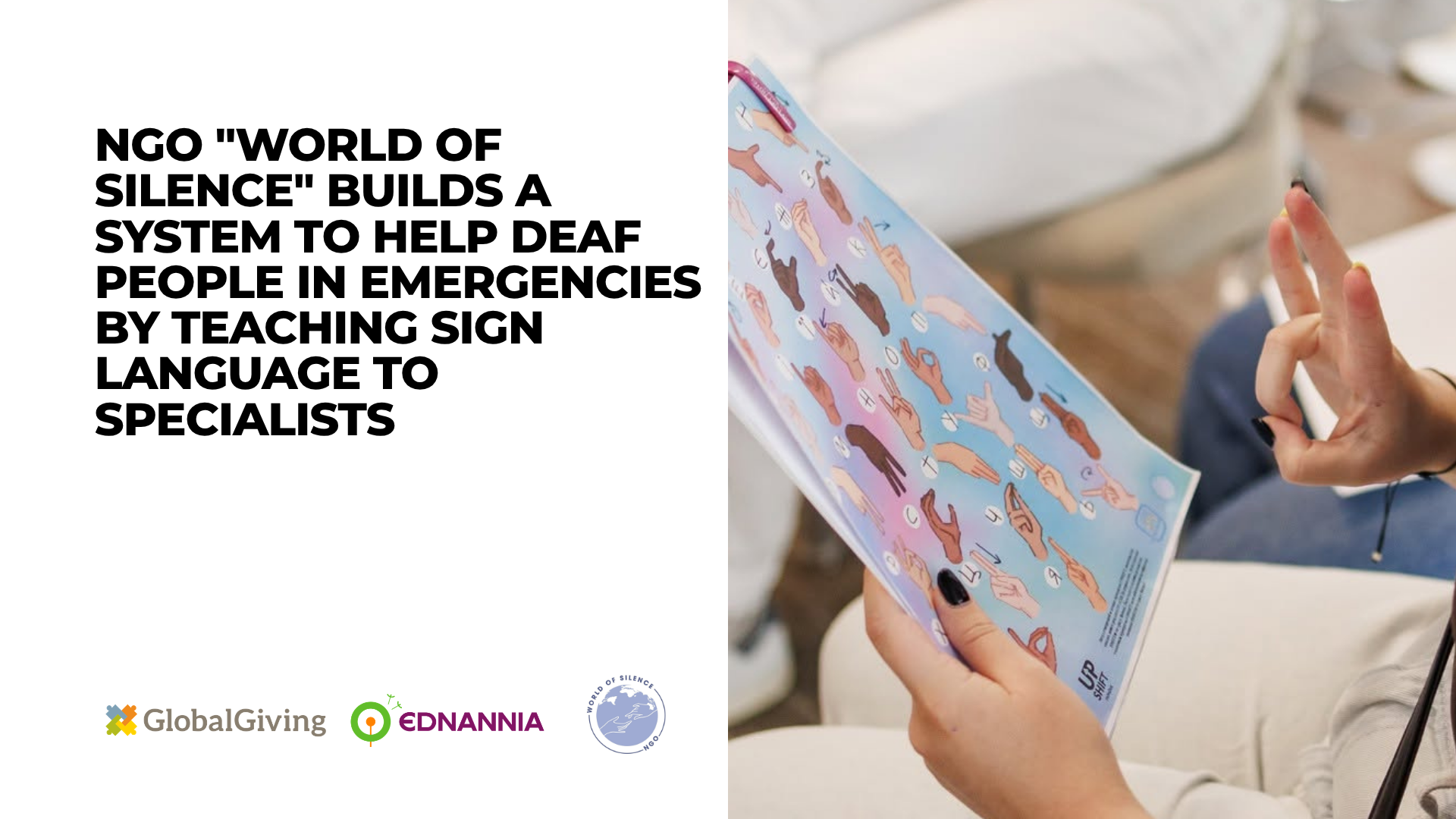
The sounds that accompany Ukrainians' lives during the war are hardly ones you'd call pleasant — wailing sirens, buzzing drones, explosions, the drone of generators during long power outages... But to some extent, these very sounds provide bearings and hope for survival, warn of danger, or signal that life goes on. And it's hard to even imagine how much more limited and dangerous the world is for people who are hard of hearing or deaf. These people are often left facing wartime danger completely alone, since they can't hear warnings from loudspeakers or instructions from emergency workers. In Ukraine today, you still can't count on medics, police officers, or rescuers knowing sign language when it's needed...
The NGO "World of Silence" decided to try to change this situation. Its leader, Ivanna Mykhailenko, understands the urgency of the need firsthand, since she is herself deaf. This gave rise to the idea of teaching sign language to rescuers, medics, social workers, and civil servants from different regions of Ukraine, so they could help deaf people in crisis situations.
Turning a volunteer idea into a professional educational hub became possible thanks to support from the "Sparks of Communities: ISAR Ednannia and GlobalGiving Partnership" grant competition. The project was named "Ukrainization.Deaf." As a result, a sign language training course was created, focused on practical vocabulary for critical situations: evacuation, mine danger, first aid, and communication during air raid alerts. Demand for this kind of specialized knowledge turned out to be enormous: "World of Silence" received 189 applications for the course, while the project, which launched in May 2026, was designed to train 50 specialists from the most vulnerable regions: Sumy, Chernihiv, Kharkiv, Mykolaiv, and Zaporizhzhia oblasts.
Grant funds were used to purchase professional equipment and studio lighting to produce high-quality video content. This matters because in sign language, every movement and every facial expression carries meaning. As a result, the project team built a database of 343 sign language video dictionary entries. Alongside this, participant training was underway, focused on actions to take during emergencies. Experts were also brought in to help participants master correct terminology and learn how to communicate with cochlear implant users and with deaf people who also have autism.
The project's results confirmed a massive shortage of inclusion skills across society. Despite its "niche" topic, social media posts about the training rack up tens of thousands of views. Precisely because society has a demand for this kind of knowledge, "World of Silence" has already sent official letters to the Departments of Social Protection in Ukraine's front-line regions, proposing that sign language become a mandatory skill for every worker in critical fields.
The "Ukrainization.Deaf" project has set a precedent for transforming total vulnerability into a systemic solution. It's not just a successful initiative — it's a model ready to be scaled up at the national level.
The grant competition “Community Sparks: ISAR Ednannia and GlobalGiving Partnership for Resilience” is implemented by ISAR Ednannia with funding from the GlobalGiving platform.
From Journalism to Working with Communities: How an OPORA Coordinator in Rivne Region Is Helping Drive Change
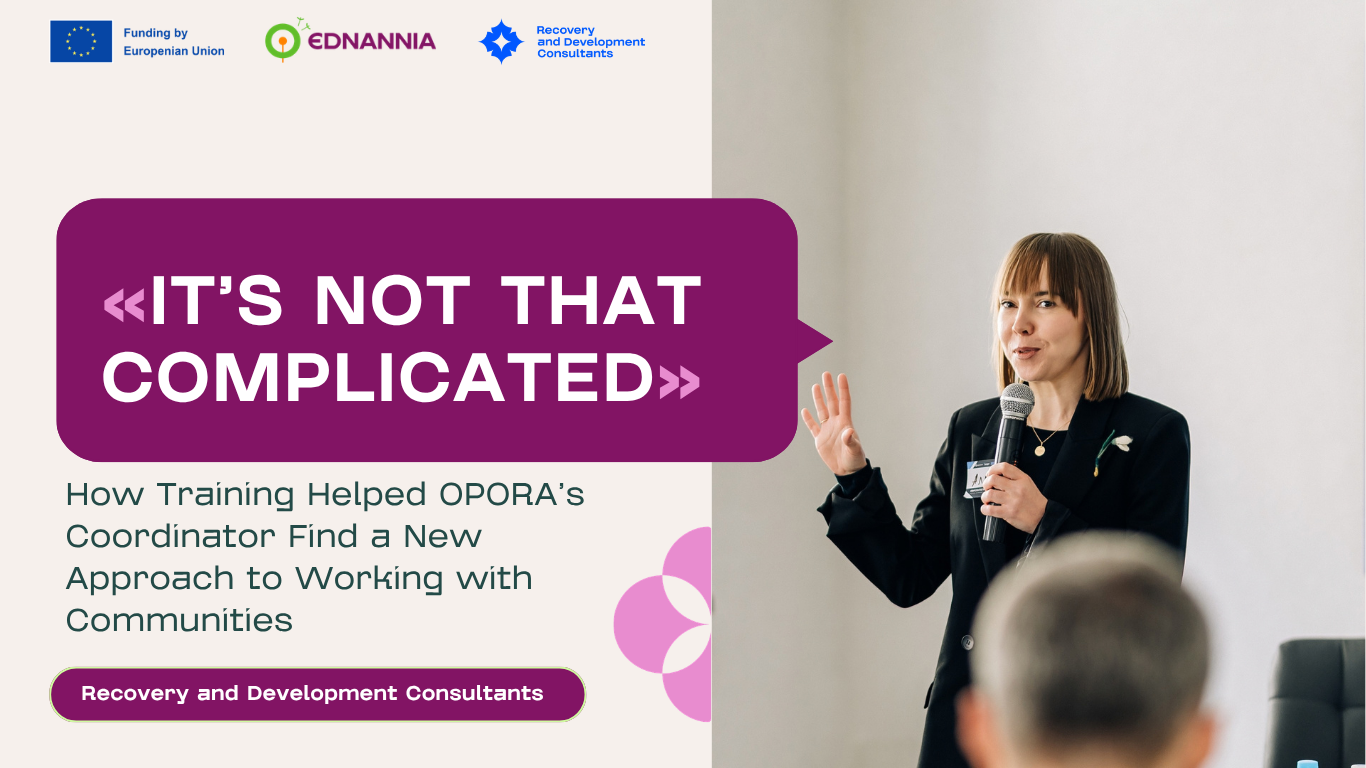
The “Recovery and Development Consultants” programme is a training initiative by ISAR Ednannia, implemented with the support of the European Union. It prepares professionals who help communities recover and develop, build partnerships between local authorities and residents, launch local change initiatives, and attract funding. Participants include people from NGOs, local governments and business initiatives who are already working at the local level and want to make their work more systematic.
From Investigative Journalism to the Civil Society Sector
Alla Maksymchuk is a Project and Communications Coordinator at the Civil Network OPORA in Rivne Region. She joined OPORA almost four years ago, after working as a journalist and conducting investigative reporting.
“At the beginning of the full-scale invasion, I realised that I was burned out: there were too many emotions and crises happening at once. I decided that something had to change, so I left journalism and joined OPORA,” she recalls.
Today, at the regional level, OPORA promotes participatory tools and develops local democracy, works to strengthen community cohesion, facilitates cooperation between local authorities and residents, supports advocacy campaigns, and helps develop documents related to public participation and communication.
“I really enjoy working with communities. There are incredible people and incredible ideas there. And when you work with them, support them and help newly established organisations take their first steps towards cooperation with local authorities, prepare grant applications and so on, it strengthens you as well. And then, when we ‘leave’ a community, that cooperation remains, and people continue creating change. It shows that our work matters.”
“It’s Not That Complicated”
Alla learned about the “Recovery and Development Consultants” programme while completing another project supported by ISAR Ednannia. Despite her busy schedule, she decided to apply.
“I decided that I should open myself up to something new. It was important for me to find out whether our goals, values and vision for the development and recovery of communities align with those of major partner organisations,” she explains.
Alla took part only in the training-of-trainers component. Even participants who did not complete the main training received all the necessary materials to understand the programme’s content and approaches.
According to Alla, the training involved a lot of practical work. Participants worked in teams, prepared parts of the training for their colleagues, and then discussed together what had worked and what could have been done better.
“So it was a very practical training. I had never attended anything like it before. I will take this experience and share it with the communities we work with,” she recalls.
Life After the Training
As part of the practical component of the training, Alla independently conducted an open training session in Rivne on participation tools and policy development.
“I wanted to see whether I could do all of this on my own. Because conducting a training session is actually not easy. It was a kind of test of myself, my abilities, goals and motivation,” she says.
Representatives of communities, young people and local residents who had seen the announcement on social media attended the training.
“Everyone wanted the same thing — to understand how citizens can participate in policymaking at the local level. It is an important topic, especially in the context of Ukraine’s accession to the European Union. Overall, it went quite well. We continue to work with some of the people who attended. It was a useful experience both for us and for them,” Alla says.
She also notes that the Consultants’ handbook, which she received during the training, has had the greatest impact on her work.
“I think this handbook is excellent. It contains all the information a community needs, as well as what someone working with communities in the context of recovery and European integration needs to know. So I am already using it,” she says.
The knowledge gained through the programme also came in handy when creating a video course on Ukraine’s accession to the EU. For one of the videos, she used materials from the programme’s handbook to talk about recovery and cohesion in Ukraine and the EU.
At present, OPORA is preparing new grant applications, including applications to ISAR Ednannia, and continues working with communities because this is where important changes take place.
“Ukraine is not made up of the capital alone. It consists of communities, most of them rural. And the people who live there, their experience — it is immense, invaluable and remarkable. That is why communities should always be given attention, and our projects are specifically focused on them. We do not simply come to a community, work with it and leave. We always leave something behind — a lasting impact and practices that people can continue to use and share. We always support them and help them develop,” Alla says.
“If You’re Not Motivated, There’s No Point in Going”
For those who are unsure whether to apply for the programme, Alla Maksymchuk advises them to listen to themselves:
“If you are not motivated, you feel tired, and you do not genuinely want to take part, I would advise you not to go. There is no need to do something just to tick a box because everyone else is doing it. You need to find something that truly speaks to you.”
But if the programme resonates with you, she says, there is no need to hesitate:
“If you see the programme and feel that you have the strength, energy and desire to help people and communities, support them, and you know that you have experience worth sharing — then you should go for it and give it a try.”
The programme is implemented within the framework of the EU Unity4Community project, funded by the European Union.
This publication was produced with the financial support of the European Union. Its contents are the sole responsibility of ISAR Ednannia and do not necessarily reflect the views of the European Union.
By Elia Serkozhaieva