Home
Home
Other Ukrainian Cities Are Taking Interest in an Inclusive Barista School Piloted in Khmelnytskyi
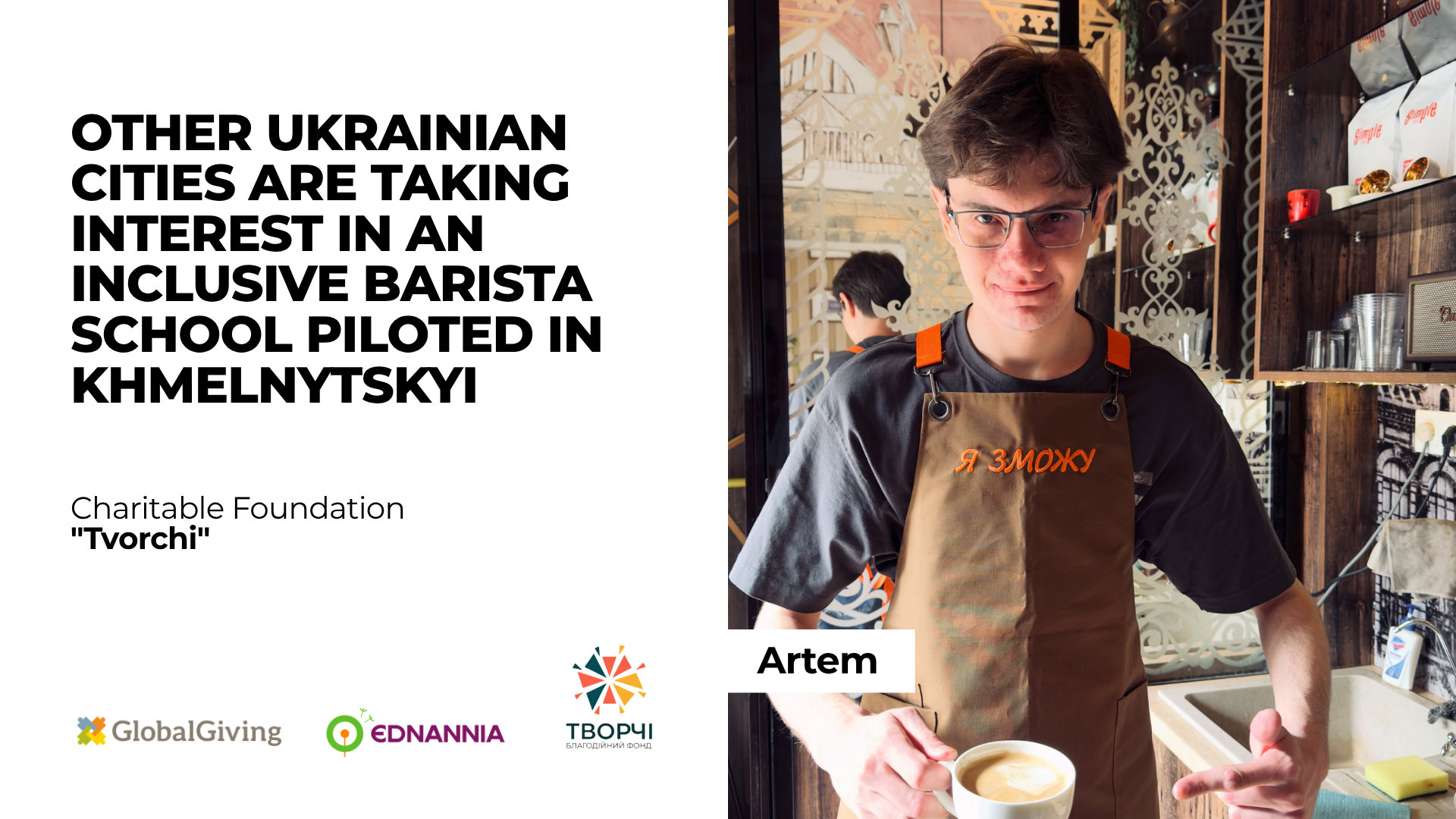
It has always been hard for people with disabilities to get a profession and then actually earn a living from it. Unfortunately, this situation is still common in Ukraine today. As a result, young people are pushed to the margins of the labor market, and communities lose people who, given the right conditions, could be active and self-sufficient. But in spring 2026, a community initiative appeared in Khmelnytskyi that shows how the needs of these young people can be combined with... the coffee business, creating a win for everyone.
The thing is, at most cafés, staff don't stay long: young men and women are happy to work as baristas while they're studying, and then they move on. So café owners are constantly stuck searching for and training new people. At the same time, young people with disabilities dream of stable, long-term work — but who's going to teach them the barista profession, and how?
Charitable Foundation "Tvorchi" from Khmelnytskyi decided they were the ones who could build an inclusive barista school. According to foundation co-founders Andriy Shcherbytskyi and Ilona Bilyk, they put the idea on paper under the name "I Can!", submitted an application to the "Sparks of Communities" grant competition by ISAR Ednannia and GlobalGiving, and ended up among the winners. The project launched on April 1, 2026: 12 residents of Khmelnytskyi with disabilities, aged 16 to 25, began their path toward becoming baristas.
Overall, the training consisted of three parts. First came the theoretical classes: the history of coffee, service standards, hygiene, financial literacy. Then practice began: participants learned to make coffee on professional equipment, froth milk, calculate the right proportions, and even create simple latte art. There were also field trips to a coffee production facility and a bakery, to show the young people other paths in the field in case barista work didn't turn out to be right for them.
The project came together thanks to the support of several partners — the "Hesed Besht" Charitable Foundation, the NGO "Podilskyi Prostir," and Mykhailo Kvoka's café chain, which provided space for hands-on practice, its best baristas as instructors, and later committed to hiring at least a third of the graduates.
Special attention was given to psychological support for participants and their parents. 49 hours of sessions with a psychologist helped parents build strong confidence in their children and their ability to be independent. Oksana, the mother of one of the project participants, says that for parents of children with disabilities, it's a big dream for their child to have a profession, to be steadily engaged in something, and to earn a living.
Even before it wrapped up, the "I Can" project had already drawn interest from other Ukrainian cities, including Kyiv, Lviv, Zhytomyr, and Vinnytsia. This shows that the model works, and that when communities, businesses, and donors join forces, inclusion stops being an "empty" word and becomes a working process. The "Tvorchi" Charitable Foundation has built a viable business model that proves the sincerity and diligence of employees with disabilities is a powerful asset for modern service.
The grant competition “Community Sparks: ISAR Ednannia and GlobalGiving Partnership for Resilience” is implemented by ISAR Ednannia with funding from the GlobalGiving platform.
From the First Grant to Supporting Communities: How "Future of Koropshchyna" Scales Its Impact

The "Consultants for Recovery and Development" program is a training initiative by ISAR Ednannia, implemented with support from the European Union. It prepares specialists who help communities recover and develop, build partnerships between authorities and citizens, launch local change projects, and attract funding. Participants include people from NGOs, local self-government, and business initiatives who are already working at the local level and want to do so more systematically.
How It All Began
Larysa Vashchenko is the head and co-founder of the "Community Development Fund 'Future of Koropshchyna'" NGO, which helps communities in Chernihiv region attract resources, develop local initiatives, and build partnerships.
She came to the civil sector in 2016. At that time, Larysa was invited to head the HR department of the newly formed Korop community. She later founded a civil society organization together with colleagues, understanding that community development is impossible without attracting resources, training, and project work.
The impetus came from the first grant competition, which Larysa applied to as a private individual. The winning project — setting up a children's playground — marked the beginning of the organization's work.
The NGO went on to launch separate waste collection, create a youth space that grew into a 3D-modeling hub, and began helping communities attract resources and implement their own initiatives.
After the start of the full-scale war, one of the main areas of focus became supporting newly established civil society organizations.
The Korop community is located near the Russian border. It hosts people from border communities who are forced to leave their homes due to constant shelling. At the same time, according to Larysa, "conditions have not yet been created for internally displaced persons." Despite its proximity to the front line and regular Russian attacks, the civil sector continues to develop and implement local initiatives.
Why She Applied for the Program
Before joining the program, Larysa already had significant mentoring experience: she guided newly established civil society organizations from registration through to reporting, helped implement grant-funded projects, and advised local businesses.
She applied for the "Consultants for Recovery and Development" program in order to systematize her practical experience and gain new tools for working with communities. Filling out the application, she admits, wasn't difficult, but she wasn't particularly confident about her chances of success.
"Filling out the application wasn't hard. Honestly, I didn't expect to get in, because the competition was very large."
The format of the training fully matched her own approach to work. What Larysa liked most was that the program was built around practice rather than theory.
"I really liked it, because I love a lot of practice. When I run trainings myself for local civil society organizations, I try to explain everything through practice."
According to Larysa, this was the program's main advantage.
"There are all kinds of trainings, but when there's too much theory, it's very hard to absorb the information. Here there was a lot of practice, and that's what brought us together — it was easy for us to work together."
Life After the Training
As part of the program's practical component, Larysa conducted two trainings — in the Kobyliaky community in Poltava region and the Tupychiv community in Chernihiv region. The second training she ran together with Mykola Sylenko. One of the key topics was cooperation between local self-government bodies and the civil sector.
However, according to Larysa, the program's biggest impact was on the development of the fund itself. While still in training, the team prepared a grant application for a business development project in partnership with local self-government bodies — and won the funding. The project combined several areas at once: training for local businesses, development of 3D-modeling courses, and the launch of foreign language courses for children and adults.
"I'm not sure we would have won this project if it hadn't been for our participation in this program. It's a direct result of the training component, and we're very happy about it."
At the same time, the fund continued to scale its own initiatives. One of the most successful is the "Fruitful Path" ("Urozhainyi shliakh") project, implemented together with the National Network for the Development of Local Philanthropy. Through it, households receive financial support to develop their household plots. While the project initially operated in just a few communities, today it covers 12 communities across Chernihiv region.
"The project worked out so well for us that it scaled not because we went out seeking communities ourselves — communities started reaching out to us on their own."
This partnership also gave a boost to other areas of the fund's work, in particular the 3D-modeling courses. The team is also planning to launch foreign language courses soon, as demand for free educational opportunities keeps growing.
After completing the program, Larysa also expanded her consulting support for communities. Today she helps local self-government bodies and civil society organizations develop development strategies, prepare recovery projects, attract resources, and build partnerships.
"After the training, I felt that I now carry a wealth of practical experience that I simply have no right not to share, for the sake of the recovery, resilience, and capacity of our communities."
Advice for Those Who Are Hesitant
To those who are unsure whether to apply for the training, Larysa shares the words of her colleague Mykola Sylenko:
"If you don't try, you won't know. I always apply, even in cases where I'm not sure whether I'll get in or not. You have to try and keep learning constantly, so you can later pass your knowledge on to others. We work in order to scale our knowledge to others. But to share knowledge, you first have to gain it yourself."
The programme is implemented within the framework of the EU Unity4Community project, funded by the European Union.
This publication was produced with the financial support of the European Union. Its contents are the sole responsibility of ISAR Ednannia and do not necessarily reflect the views of the European Union.
By Elia Serkozhaieva
How Virtual Reality Supports the Real Recovery of Veterans With PTSD
Almost everyone who returns from the war that russia treacherously unleashed against Ukraine struggles with serious psycho-emotional issues. Given what veterans, both men and women, have lived through at the front, this is entirely understandable and normal. What's more, Ukraine already has a fairly developed system and established protocols for psychological and psychiatric care for patients with PTSD (post-traumatic stress disorder). But the problem is that even simply reaching out for professional help can be extremely difficult for them. Some don't trust conventional therapy, some just don't know where to turn, others can't bring themselves to speak about what they went through out loud...
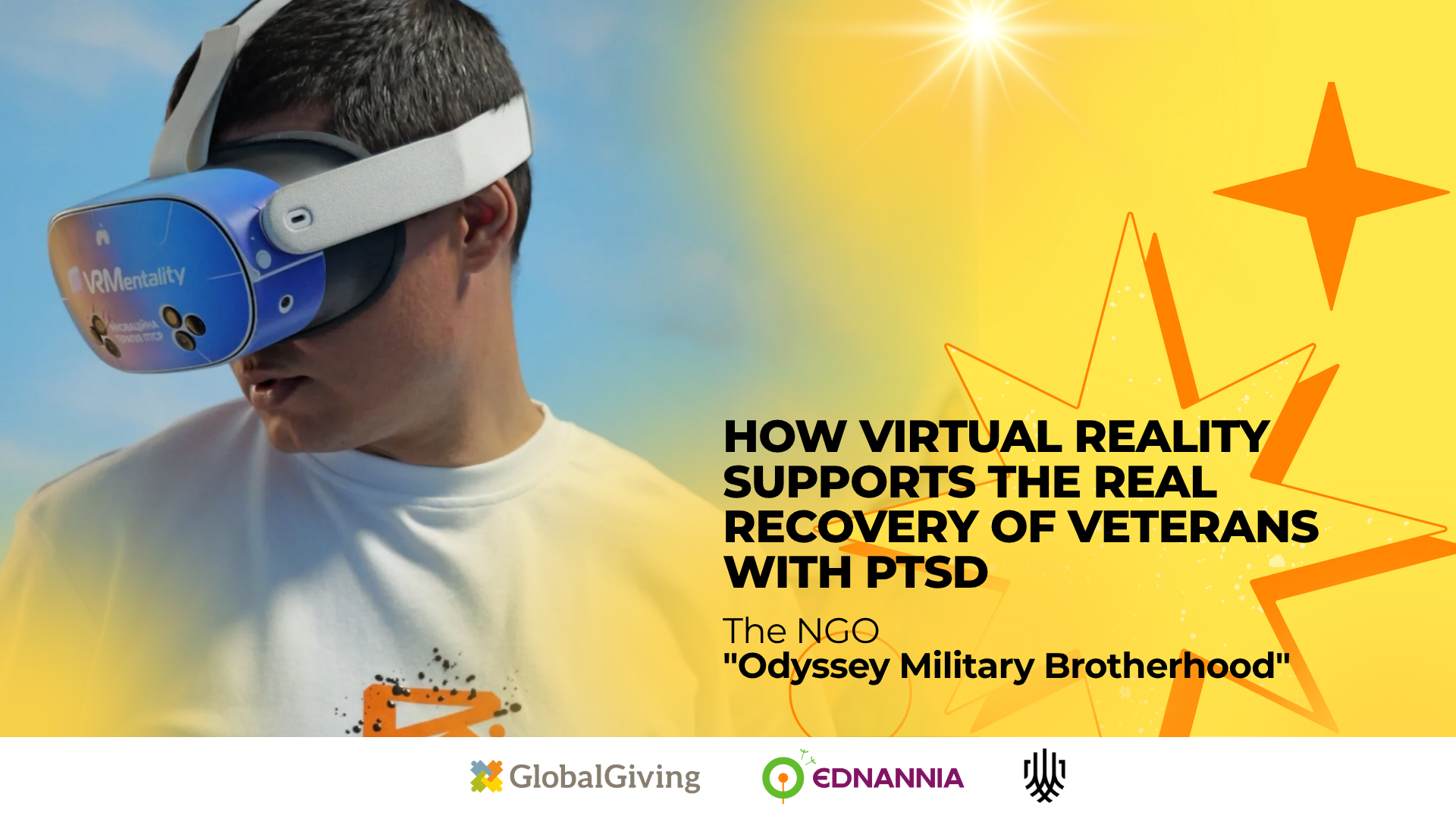
The NGO "Odyssey Military Brotherhood", which unites veterans and actively supports wounded comrades and veterans, decided to try a different approach to improving the psycho-emotional state of combat participants. Together with partner organizations, they launched a VR rehabilitation project for veterans, receiving grant support through the "Sparks of Communities: ISAR Ednannia and GlobalGiving Partnership for Resilience" competition. This technology has been spreading across Ukraine for three years now and is currently used in hospitals, veteran support centers, and mobile crisis teams, even near the combat zone.
VR therapy works like this: a person puts on special goggles (a virtual reality headset) and is instantly transported to a place where they can feel more relaxed and calm — or, conversely, revisits a situation that brought on traumatic memories... This "magic" can be accompanied by music or a specialist's voice, but the key point is that it helps the body and brain relax, and it sometimes works better than an ordinary conversation with a psychologist. VR (virtual reality) helps redirect attention and gradually reduce anxiety without the pressure of having to talk about difficult things right away.
The project's psychologists report that after sessions, people's breathing slows down, tension in the body decreases, and anxiety drops. Most importantly, this method builds trust even among those who were previously skeptical of psychological help. At the same time, VR doesn't replace a psychologist or psychotherapist — it helps the specialist work more effectively.
Twenty veterans took part in the "Odyssey" project. The program was open to veterans. Importantly, everyone applied voluntarily by filling out a simple online form. Each participant received between 4 and 12 individual consultations — as many as that particular person needed. An independent assessment confirmed that participants' condition improved. But the best evidence of the project's success is that all 20 veterans agreed to continue therapy in this format. That's rare. Even people who are ready to start therapy often quit halfway through.
So when donor support, technology, and specialists' care reinforce one another, they create the shortest path to restoring trust. "We've achieved exceptional results: even veterans who typically resist therapy agreed to a full course in VR format. This confirms that technology can break through psychological defenses that have remained impenetrable to standard methods for years," say the project manager and psychologist of "Odyssey."
The grant competition “Community Sparks: ISAR Ednannia and GlobalGiving Partnership for Resilience” is implemented by ISAR Ednannia with funding from the GlobalGiving platform.
Kids are Our Greatest Treasure: How ISAR Ednannia Supported Children with Cancer

The war significantly disrupted access to education, medical treatment, and social services for children with cancer. Many families had to relocate to continue treatment, while others remained in dangerous areas. The war also complicated efforts to deliver aid and coordinate charitable support.
In 2022, ISAR Ednannia supported the public organization Sumy-based "Parents of Children with Cancer" and enhanced their ability to provide quality services to families with children battling cancer. This initiative included developing digital information and communication resources, organizing in-person art therapy sessions, and holding meetings with psychologists to increase parents' awareness of social and legal support issues.
Thanks to the support from ISAR Ednannia's "Emergency Support to Civil Society Projects" grants competition, "Parents of Children with Cancer" conducted a series of psychological sessions from December 2022 to March 2023. 16 parents and 10 children in the hematology department of the Sumy Regional Children's Clinical Hospital attended these sessions.
Marina Volkova, a mother of a child with cancer, shared her experience of the psychological and art therapy sessions: "Spending two months in the pediatric oncology department feels like life has come to a standstill. It was challenging to engage my daughter in anything beyond pain, tears, and long-term treatment. But after just one session with the art therapist, my daughter began to smile, plan her next session, and choose clothes for the meeting. When I attended a session myself, I understood her enthusiasm. Meetings with psychologist Victoria Ratyeva helped me not to focus solely on my daughter's illness — it’s all temporary. I realized that I also need to take care of myself because my child needs a happy, confident mother."


As part of their support efforts, the "Parents of Children with Cancer" team offered counseling services to Sumy Oblast people and created and distributed informational leaflets about the organization's assistance and activities. Overall, the project reached 5,000 Ukrainians.
"I felt the impact of the project's meetings. Group psychological practices helped me initiate changes within myself, which I noticed both internally and externally. I allowed myself to focus more on my identity as a woman. Special thanks go to the children's art therapy - the necessity for our kids. These sessions bring variety into their lives, lift their spirits, and prepare them for positive changes. I am grateful to everyone involved in organizing these events and look forward to future meetings," expressed Julia Romanyuk, a mother of a child with cancer who has been undergoing tough treatment for a year, has experience receiving international medical services, and whose child's father is in the military and currently in a combat zone.
The project, implemented by the public organization "Parents of Children with Cancer," aimed to enhance the capacity to provide quality services to families raising children with cancer and young people with disabilities who had experienced childhood cancer. This was achieved through the creation of digital information and communication resources and made possible by the generous support of the American people through the United States Agency for International Development (USAID) within the Ukraine Civil Society Sectoral Support Activity implemented by ISAR Ednannia in partnership with the Ukrainian Center of Independent Political Research (UCIPR) and Centre for Democracy and Rule of Law (CEDEM). The contents are not the responsibility of ISAR Ednannia and do not necessarily reflect the views of USAID or the United States Government.