Home
Home
From Helping One Child to Systemic Support for Families: The Story of the "Mriyu Zhyty" Charitable Foundation

Ahead of Civil Society Week, we are sharing the stories of our grantees — people and organizations who work every day to drive change and develop civil society in Ukraine. The story of the "Mriyu Zhyty" Charitable Foundation began with a simple desire — to help children with disabilities and their families not with words, but with concrete action.
"It's Not Enough to Help Just Once"
For me, it all started with a desire to help children with disabilities and their families not with words, but with concrete action. At the very beginning, this mainly meant helping children with cerebral palsy — paying for rehabilitation, finding treatment opportunities, and supporting families. But the more we worked with families, the more we saw: behind a single request there is almost always much more need.
Gradually, I came to understand that it's not enough to help just once. What's needed is to create opportunities that stay with the family for the long term. That's exactly where my civic engagement began.
From Personal Help to an Organization
In 2014, it became clear that individual personal help was no longer enough. To support more children, attract partners, and work transparently and systematically, an organization was needed. That's how the "Mriyu Zhyty" Charitable Foundation came into being.
At that time, our main work was helping children with cerebral palsy and paying for their rehabilitation. Today, 12 years later, the foundation's work has expanded far beyond that — from targeted assistance and rehabilitation to social services, inclusive programs, family support, and educational/awareness projects.
If I could go back to the day it all began, I would tell myself: "Don't be afraid to start small, but never think it will stay small forever."
In 2014, we had no way of knowing that 12 years later we would not only be paying for children's rehabilitation, but also developing social services, implementing large grant-funded projects, and working alongside government and international partners. And I would also say this: there will be many rejections. Mistakes too. What matters most is to keep moving forward after each one.
Families at the Center of the Work
There were people around us who were also ready not just to sympathize, but to act. But the most important factor in the foundation's development has always been the families themselves. It was from them that we heard what a child truly needs, what difficulties parents face every day, and what they lack.
Over time, a much wider circle formed around the foundation — volunteers, specialists, philanthropists, businesses, and civic and international organizations. And it was precisely these partnerships that made it possible to move from individual good deeds to larger projects.
12 Years of Work: From Rehabilitation to Social Services
The "Mriyu Zhyty" Charitable Foundation has been supporting children with disabilities and their families for 12 years now. Over this time, the foundation's work has changed considerably. We started out paying for children's rehabilitation. After the start of the full-scale war, we significantly strengthened our humanitarian work.
We implemented the "School Dream" ("Shkilna Mriya") and Mama Special projects, inclusive events, and programs for socialization and family support. Today, among our key areas of work are the day-care social service for children with disabilities of subgroup A, the "Dreams Without Limits" ("Mrii bez obmezhen") rehabilitation funding assistance program, as well as charitable and inclusive projects for children and families.
What Change We Want to See
We want to change the very approach to supporting families raising children with disabilities — so that help no longer depends solely on whether a family manages to find a benefactor or raise money for a specific need. So that sustainable social services, clear pathways to assistance, and professional support exist close to where the family lives.
For us, the future is one where a child with a disability has opportunities for development, education, and socialization, and their family is not left alone with its difficulties.
Challenges That Don't Stop Us
The hardest part is that there are always more needs than resources.
Over the years, we've faced very different challenges: the war, the humanitarian crisis, power outages, unstable funding, the need to retain our team, and ensuring continuity of support for children.
In 2026, some of our projects were specifically aimed at making sure social services for children didn't stop during the energy crisis. What keeps us from stopping are the results. When you see that something that was once just an idea is now genuinely working and needed by families, you find your answer to the question of "why keep going."
A "Result" Is When a Specific Child's Life Gets Better
What I'm proudest of isn't any single project, but the whole path the foundation has traveled. We started by helping individual children and paying for their rehabilitation. Then came humanitarian programs, hundreds of children's stories, "School Dream," Mama Special, dozens of partnerships, and grant-funded projects.
And today we already provide a day-care social service for children with disabilities of subgroup A and are building a more systemic model of family support.
To me, this is an important result: the foundation never stood still, but kept changing in line with what children and families actually need.
Personally, what inspires me most is the result. I can talk all I want about projects, grants, or performance indicators, but my biggest motivation is seeing that a specific child's life has gotten better.
When a child starts doing something they couldn't do before. When they come in happy. When parents see the changes and realize they're not alone. It's in these moments that all the difficulties of this work make sense.
Where Change Can Begin
It's true that not everything depends on one person. But very often, whether something starts at all does depend on one person. You don't need to immediately create a large foundation or change the entire system. You can start with one problem. One family. One idea. One decision. Our foundation didn't start with big grants, social services, or dozens of partners either. At first, there was simply a decision to act.
Civil Society Begins with Not Staying Indifferent
With not staying indifferent — turning that into action.
You can wait a long time for someone else to solve a problem. Or, at a certain moment, you can ask yourself: "What can I do?" Then other people appear alongside you. A team forms. Partnerships. An organization. And what began as a single initiative can gradually come to affect the life of an entire community. That, to me, is exactly what civil society is.
Partnership with ISAR Ednannia
The partnership between the "Mriyu Zhyty" Charitable Foundation and ISAR Ednannia has already lasted several years. Importantly, this support has taken different forms at different stages of the foundation's development.
In 2021, the foundation received support for organizational development, and in 2022 — for conducting an external evaluation of the organization.
In other words, even before the larger programs, ISAR Ednannia was already helping the foundation grow stronger as an organization.
The next major stage was the project for the day-care social service for children with disabilities of subgroup A.
For us, this cooperation clearly illustrates our own development: from strengthening the organization itself — to the capacity to independently provide social services and implement much larger-scale projects.
*under the SPIRIT project, implemented in collaboration with the Ministry of Social Policy, Family and Unity of Ukraine, the Fund for Social Protection of Persons with Disabilities, and UNICEF Ukraine, with administration by ISAR Ednannia.
"The Training Gave New Perspective and Approaches to Working with Communities." The Experience of Expert and Trainer Valentyna Poltavets
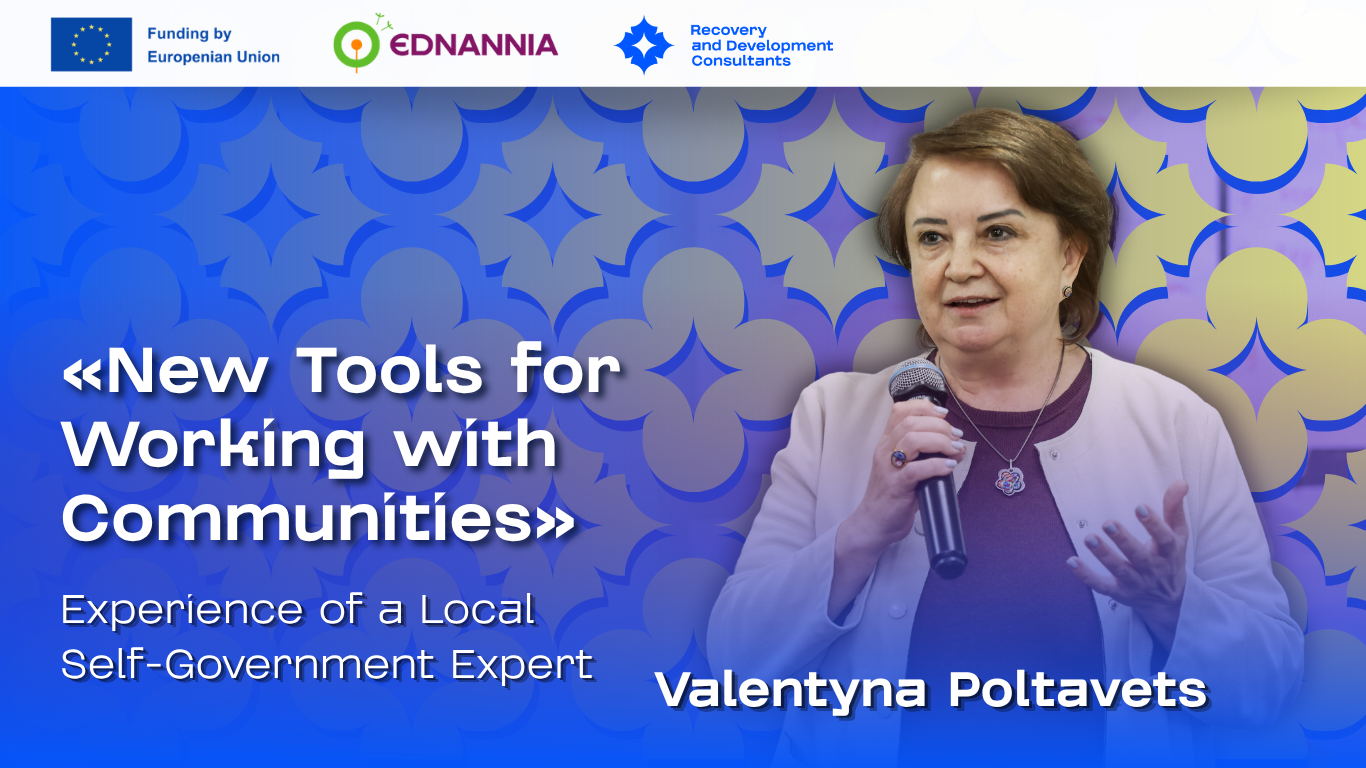
The "Consultants for Recovery and Development" program is a training initiative by ISAR Ednannia, implemented with support from the European Union. It prepares specialists who help communities recover and develop, build partnerships between authorities and citizens, launch local change projects, and attract funding. Participants include people from NGOs, local self-government, and business initiatives who are already working at the local level and want to do so more systematically.
From Reviving an Organization to Restoring Communities
Valentyna Poltavets heads the "Center for Quality of Local Self-Government" — an organization with almost 20 years of history, which she essentially had to "revive" after seven years of inactivity. Together with her team, she carried out a rebranding and revisited the organization's goals, while keeping its main focus intact: local self-government and the development of local democracy.
"We work from both sides: we help the public understand how local authorities work, and we help authorities work with the public," Valentyna explains.
The organization mainly works in Kyiv region, but also has experience cooperating with communities in Zaporizhzhia, Kharkiv, and Kherson regions.
One of the "Center for Quality of Local Self-Government's" largest projects was implemented in 2024 with support from USAID's "Democratic Governance in Eastern Ukraine" (DG East) project. Together with Taras Shevchenko National University of Kyiv, the organization developed a training program on the recovery and reconstruction of de-occupied communities in Zaporizhzhia region.
"One of the clients was the Zaporizhzhia Regional State Administration. Back in 2024, there were expectations that Ukraine would soon be liberating territories, so local self-government bodies needed to learn how to work on recovery."
The program concluded with a regional forum for communities of Zaporizhzhia region, where participants presented their recovery ideas and projects together with architects and experts.
"I Needed New Tools I Could Take Off the Shelf and Apply"
Valentyna learned about the "Consultants for Recovery and Development" program from Facebook and decided to apply as a trainer on behalf of her organization.
She was a little worried she wouldn't be accepted, given her extensive training and expert experience.
"I hold a PhD in public administration and have worked in teaching. I've also conducted and developed trainings, but time moves so fast that you constantly need to update your knowledge. That's why I was specifically interested in the training-of-trainers program."
What interested Valentyna most was the practical part. According to her, many people still don't share a common understanding of what "recovery" actually means. That's exactly what she wanted to help change.
"I knew that during the training we'd be given tools we could then easily use later. For example, a problem comes up, and you take this tool off the shelf and use it to solve the problem."
The application process turned out to be straightforward, since Valentyna's professional profile was already well established — all that was left was to adapt her materials.
"I was afraid I wouldn't be accepted because of my extensive experience. But I understood how useful this training could be for me, since afterward I could train even more people who will go on to work in communities."
"In One Breath"
Valentyna describes the five days of training briefly: "in one breath."
"It was very important that the training had precise timing and a clearly built structure: mini-lectures, practice, group work. The trainers explained how thoroughly every component of any training needs to be worked out. You could also see how carefully every element had been prepared, down to the smallest details: marker colors, the structure of the materials, instructions for trainers. It left a pleasant impression to see a training worked out in such detail."
She says she never used to pay attention to such small details before, but after the training she started looking at how trainings are organized differently.
"After something like this, you definitely improve your own approach to preparing and delivering trainings. You pay more attention to structure, details, and the logic of how participants perceive both the content and the format of the training."
Life After the Training
"Not much time has passed since the training, but it has already strengthened our organization. We held a strategic session within the organization and formed a clearer direction for how we help communities with recovery and development. Now we have a better understanding of exactly what we can offer communities: which trainings and courses."
Valentyna, together with a colleague, has also already run a pilot training in the city of Ukrainka for representatives of local self-government and the civil sector. They deliberately chose a 50/50 format.
"It's a very effective format. It shows that dialogue between authorities and the public is genuinely possible. We showed the public that authorities aren't some distant entity, but people they can actually interact with. And we showed the authorities where the active public is, and that it's possible to work with them and solve problems together."
The "Center for Quality of Local Self-Government" team is currently working on three projects.
"We're developing strategies for six communities in Kyiv region, working on barrier-free accessibility plans, and want to strengthen the organization's analytical capacity. We're also preparing an application for an inter-municipal cooperation project, because we see that communities have demand for this, but often lack the experience and understanding of how it works."
Valentyna also adds that the training program helped their organization systematize its approaches to shaping local self-government policies in the field of recovery, and strengthened the team's focus on engaging the public in decision-making processes.
"The training program provided a clear structure of issues that shape local self-government policy in recovery projects and programs. The experts and trainers at our organization now pay more attention to questions of public participation and engagement in recovery projects, in the formation of local policies, and in developing community development strategies and other local programs and projects."
"Just Do It"
To those who are hesitant about whether to apply for the program, Valentyna advises not to wait until they feel confident.
"Many people think they don't have enough experience or knowledge. But until you try, you won't know."
The programme is implemented within the framework of the EU Unity4Community project, funded by the European Union.
This publication was produced with the financial support of the European Union. Its contents are the sole responsibility of ISAR Ednannia and do not necessarily reflect the views of the European Union.
Author: Elia Serkozhaieva
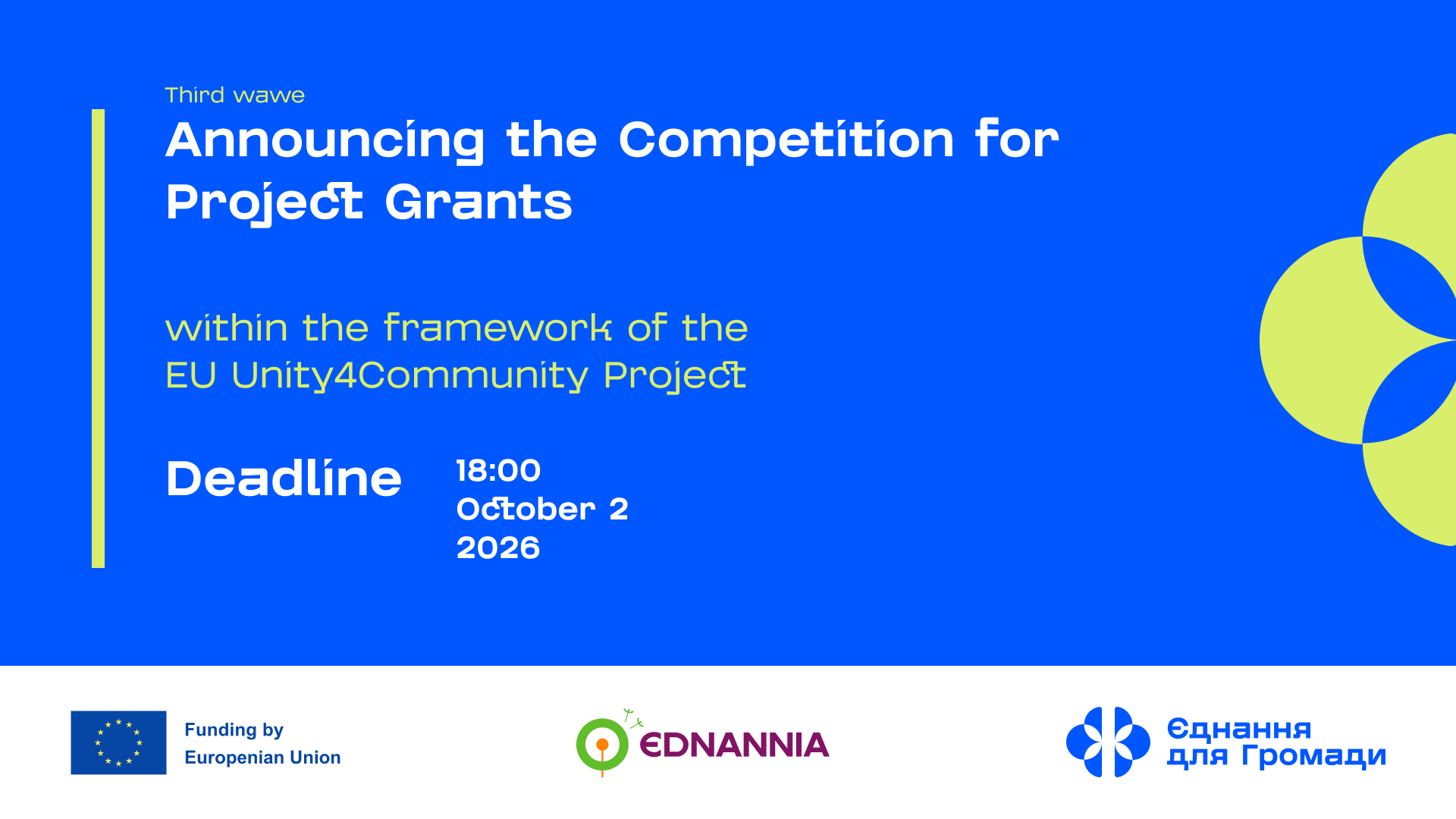
Third Wave: “EU4Community” Project Grants Competition
The purpose of the competition is to support civil society initiatives that contribute to systemic change and democratic transformation in Ukraine, strengthen its capacity for recovery, and bring the country closer to European Union membership.
The grant program is designed to strengthen the role of CSOs as active participants in reform, recovery, and European integration processes, to promote their interaction with state authorities and local self-government bodies, to engage citizens in decision-making, and to foster public dialogue on the changes taking place in Ukraine. Projects within the competition should contribute to the practical implementation of European approaches and standards, the realization of reforms necessary for the country's development, the recovery of communities and social processes affected by the war, and better public understanding of the European integration process and citizens' role in it.
Please note! The competition is primarily focused on achieving change, not on holding individual events. Each proposed project must be based on a clearly defined problem, offer a well-substantiated solution, and outline specific results demonstrating what exactly will change for the target groups, the community, a particular field, practice, or policy as a result of the project's implementation.
Project proposals must correspond to one or more of three thematic areas: REFORMS, RECOVERY, and EUROPEAN INTEGRATION.
Within these areas, the following types of activities may be supported:
- Development of analytical papers and research necessary for the implementation of policies and reforms (this requires cooperation with the government body responsible for developing and implementing the relevant policy or reform, confirmed by an appropriate letter at the application stage).
- Activities aimed at restoring disrupted or destroyed processes in the fields of education, healthcare, social protection, culture, the economy, and local self-government by strengthening interaction among citizens and building partnerships between civil society organizations, authorities at various levels, international structures, local communities, and business representatives.
- Advocacy campaigns aimed at the development and implementation of policies at both the local and national levels.
- Communication campaigns aimed at informing and engaging citizens in the processes of developing and implementing decisions and policies at both the local and national levels.
- Establishing cooperation between CSOs, local self-government bodies, and local media through joint projects (the partnership must be confirmed at the application stage).
- Educational programs and trainings for target audiences, including civic activists, journalists, civil servants, and youth.
- Media support for reforms, recovery, and European integration, including training activities for local CSOs on effective interaction with the media.
- Other well-substantiated project solutions related to reforms, recovery, and European integration that strengthen the role of CSOs in these processes.
Project geography: the entire territory under the control of the Government of Ukraine.
Projects within this competition can be implemented at three levels:
- local (within a single community or settlement),
- regional (at the oblast level or across several communities),
- national (across the entire territory of the country or involving representatives from all regions).
Applicants may submit several project proposals under this competition, but only one application may be supported.
What does the grant cover?
Financial support within the grant competition may be used to cover the following expenses:
Administrative expenses – costs related to project management: utility payments, office rent, use of web services, hosting, and other related expenses.
Project personnel costs – salaries for staff directly involved in project implementation.
Expert fees – engaging specialists to provide consulting, analytical, or training support.
Organization of project events – holding round tables, trainings, seminars, conferences, public discussions, etc., that contribute to achieving the project's goals.
Research and analytical services – conducting research, preparing analytical reports, recommendations, strategic documents, and other materials.
Procurement of goods for project implementation – purchasing equipment, materials, and other resources necessary to directly achieve the project's goals.
Other justified expenses – expenses necessary for the successful implementation of the project that are not on the list of prohibited costs.
Applications for this grant competition are accepted until 18:00 on October 2, 2026.
Approximately 20 organizations will be supported within this round.
Project duration – from 6 to 12 months. The estimated project implementation start date is no earlier than one month after the application deadline.
More details about the grant competition.
The grant competition is held within the framework of the EU Unity4Community project, implemented by ISAR Ednannia, funded by the European Union.
"I No Longer Work Blindly." How a Speed-Reading Coach from Rivne Became a Mental Health Consultant for Medical Workers and Veterans
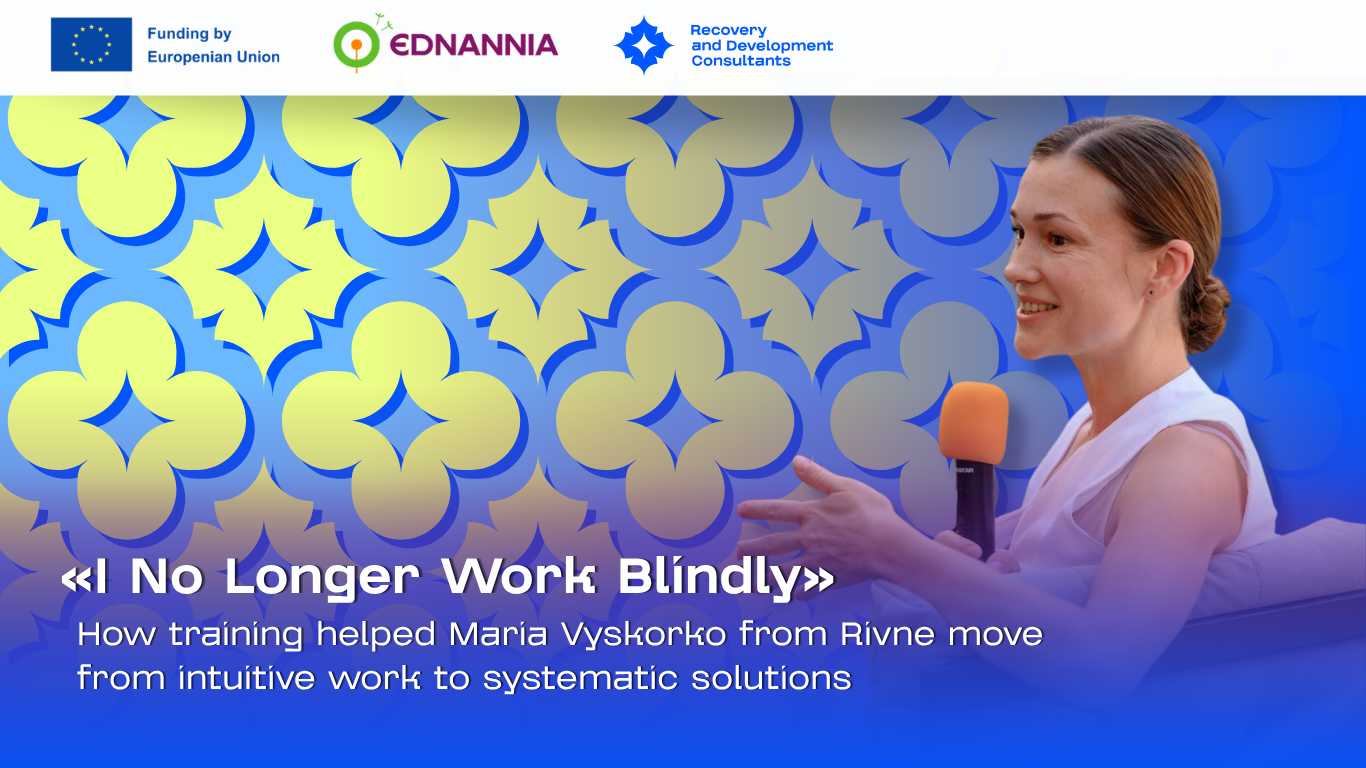
The "Consultants for Recovery and Development" program is a training initiative by ISAR Ednannia, implemented with support from the European Union. It prepares specialists who help communities recover and develop, build partnerships between authorities and citizens, launch local change projects, and attract funding. Participants include people from NGOs, local self-government, and business initiatives who are already working at the local level and want to do so more systematically.
From a Memory Coach to Hospital Corridors
Maria Vyskorko is from Rivne. She is a personnel development specialist at the Central City Hospital and a local consultant for Olena Zelenska's nationwide mental health program. She has been working in the civil sector for over six years now. Before that, she knew almost nothing about NGOs or social work and worked as a speed-reading and memory-training coach, developing cognitive skills in children.
After the start of the full-scale war, Maria offered her help at a hospital treating military personnel with concussions. There she began holding memory-development sessions: at first for small groups of five people, later growing to as many as thirty participants.
From there, Maria's path led her to the "Integration Center" NGO, where she worked in mobile psychosocial support teams, met evacuation trains together with her team, and accompanied displaced children, helping them adapt to their new community.
She later became a social manager at the Resilience Center of the Dubno territorial community, where she coordinated interaction with authorities, businesses, and the community, and was responsible for monitoring, analytics, reporting, and grant project management.
Training: Practice Instead of Dry Theory
Maria learned about the "Consultants for Recovery and Development" training while working at the Resilience Center, since the role required constantly upgrading her qualifications.
"I wanted to do more than just react to individual requests — I wanted to build systematic services within communities. I lacked a clear methodology: how to professionally conduct a community audit, coordinate interaction between business, authorities, and residents, and turn people's chaotic requests into concrete projects," she says.
Maria first went through selection for the consultants' course, and after the first wave, she also applied for the training-of-trainers program. According to her, she wanted to gain practical facilitation tools and learn how to build effective dialogue within a community, with a focus on developing human capital.
What she remembers most about the training is how practical it was:
"It wasn't dry theory. We worked through interactive exercises, design thinking, and real crisis case studies. Almost everything we learned could be applied directly in our work right away," Maria recalls.
Equally valuable to her was the exchange of experience with other participants.
"There were more than twenty of us consultants, and each one had enormous professional experience. At first I even thought, 'What am I doing here?' But listening to their stories and watching how they changed throughout the training, I realized how important it is to be among people like that," she says.
The final stage of the program was a practical exam. Together with fellow consultant Anna Slozanska, Maria conducted a training in a community in Ternopil region for local self-government representatives and educators on interaction between authorities and the public.
Life After the Training
The training brought the biggest changes to Maria's work. The main result, she says, was a push for career growth. She applies the tools she gained every day, both as a consultant for Olena Zelenska's program and as a personnel development specialist at the Rivne City Central Hospital. Above all, her overall approach to working with people has changed.
"Before, I did a lot of things intuitively — 'by feel,' as they say. Now I start any work with an analysis of the needs of the people I'm working with. First I try to understand what they actually need, and only after that do I build further interaction," Maria explains.
According to her, this approach helps her communicate more effectively with medical staff, local authorities, donors, and partners, attract funding, and launch new initiatives.
One such project is a program Maria is currently working on. It's meant to help build interaction between veterans and young people through joint training sessions and meetings. She is developing the idea using a design-thinking methodology, testing it together with veteran and youth organizations.
At the same time, Maria is developing another initiative — creating a dedicated space within the Mental Health Center for medical workers to recover and recharge.
"We talk a lot about rebuilding the country, but it's just as important to help people recover. I want doctors to have a place where they can spend even just a few minutes in silence, recover, and gather their strength," she says.
To those who are afraid to apply for the "Consultants for Recovery and Development" program, Maria advises not to hesitate:
"Wanting to help isn't enough — you need professional tools. The ISAR Ednannia training is an investment in yourself, in your capacity to create real change. It's not just a diploma — it's step-by-step approaches that work from day one," she says.
The programme is implemented within the framework of the EU Unity4Community project, funded by the European Union.
This publication was produced with the financial support of the European Union. Its contents are the sole responsibility of ISAR Ednannia and do not necessarily reflect the views of the European Union.