Home
Home
How the Head of the Boyarka City Council Department Builds Dialogue Between Authorities and Community
The "Consultants for Recovery and Development" program is a training initiative by ISAR Ednannia, implemented with support from the European Union. It prepares specialists who help communities recover and develop, build partnerships between authorities and citizens, launch local change projects, and attract funding. Participants include people from NGOs, local self-government, and business initiatives who are already working at the local level and want to do so more systematically.
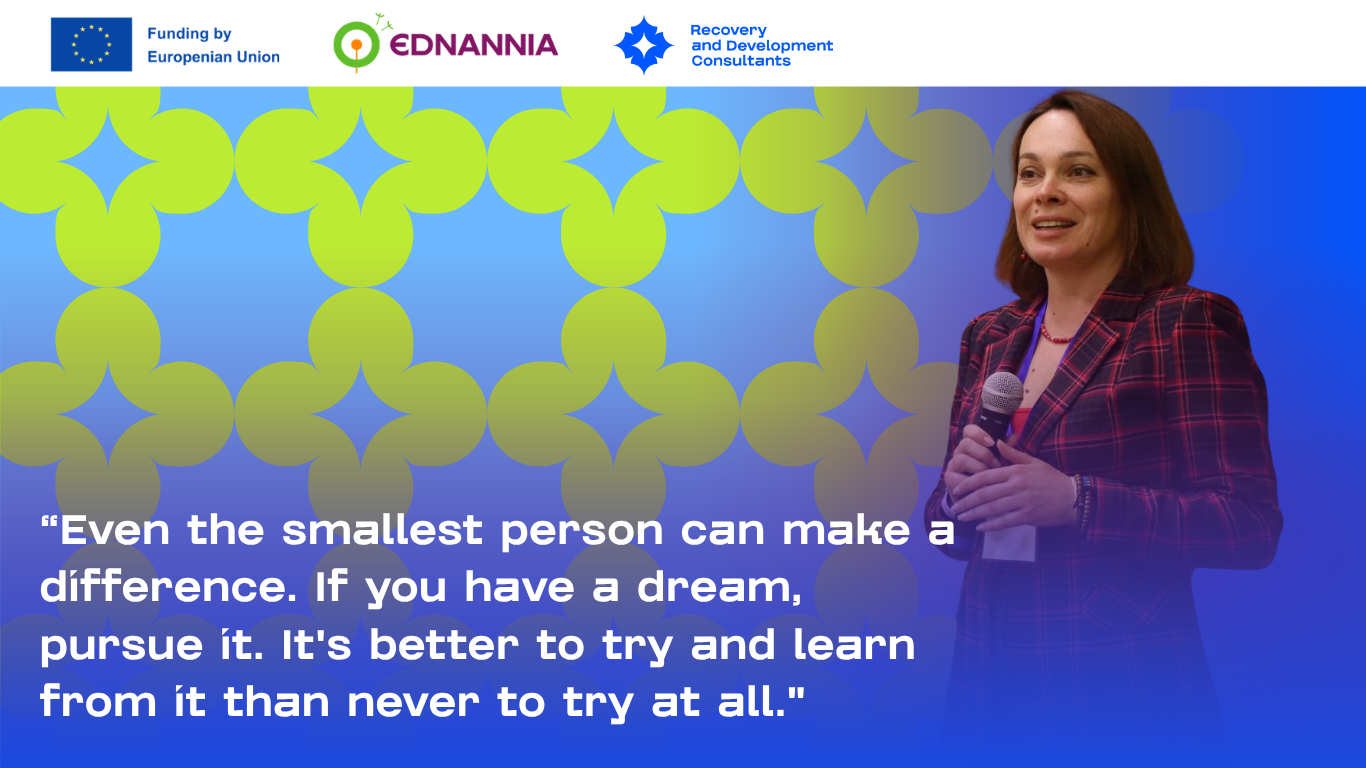
Olena Kovtun heads the Department of International Cooperation, Economic Analysis, Strategic Planning, and Communications of the Executive Committee of the Boyarka City Council. Before working in local self-government bodies, she spent 19 years running her own language school. After the start of the full-scale invasion in 2022, Olena joined the city council as a volunteer, and later moved into local self-government to be able to implement systemic changes in the community.
At the same time, she continues to work in the civil society sector: she helped create two youth spaces, actively supports the work and development of the Youth Council under the Boyarka City Council, and has developed and delivered a number of training programs for executive body employees and residents from socially vulnerable categories. A separate area of her work is developing veteran spaces, one of which was recognized in 2025 as one of the best veteran practices in Ukraine.
"We started uniting and building contacts with veteran organizations not only in Kyiv region, but also in Kharkiv, Zaporizhzhia, and Kherson regions," Olena says.
Partnership Instead of Confrontation
When Olena Kovtun saw the announcement about recruitment for the "Consultants for Recovery and Development" program on ISAR Ednannia's page, she immediately decided to join. What interested her most in the program was the part dedicated to building dialogue and partnership between authorities and the community.
"What interested me most was the module on building dialogue and partnership between the community and authorities. That's exactly what we're lacking most today. That's when I thought: I definitely need this training. Because I really want us to be able to sit down at the same table, discuss our problems and challenges together, and look for solutions jointly," Olena says.
After completing the basic program, she also applied for the trainers' program.
Olena says one of the program's advantages was the combination of online and offline learning. What she remembers most is the live communication with like-minded people, since it was during these conversations that participants shared their own experience, ideas, and solutions that had already worked in their communities.
"You go for a coffee break, start sharing your experience, and someone tells you how a similar problem was solved in their community. And then you see how knowledge works in real life and which solutions actually worked," she says.
Life After the Training
Olena delivered her training within the trainers' program together with Myroslava Zhylina from the "Podilska Hromada" Community Foundation. Enrollment was open, so anyone interested could join. The group included representatives of local self-government, the youth council, people with experience of losing their homes, and veterans. The topic of the meeting was participatory engagement, dialogue, and partnership.
"We wanted to bring together people with completely different experiences, different stories, from different regions, and show them that they have points of connection and shared pain," Olena says. "The key realization is that partnership is possible between different roles, if there's a will to build it," she adds.
After the training, Olena felt more confident in her knowledge and began consulting not only her own community but also communities from Kharkiv, Zaporizhzhia, Kherson, and Mykolaiv regions.
One of the first results after the training was work on the Medium-Term Priority Public Investment Plan (MTPPIP). Boyarka was the first in the region to take on this new tool, so initially few understood how it worked. Olena figured out all the requirements on her own and later trained city council employees and deputies.
"We can plan projects based on our own vision, while residents may not see the need for them. That's why it's important for the investment council to have equal representation of both executive bodies and the residents themselves — the people we're making these projects for," she explains.
When Boyarka became one of the first to develop an MTPPIP, colleagues from other communities began reaching out for advice. Olena shared her experience, documents, and developments, and talked about participation in international programs, cooperation with partners, and implementation of various projects.
The "Consultants for Recovery and Development" program also helped within the city council itself. Boyarka became the first community in Kyiv region to approve a 1325 Action Plan on gender equality.
"Gender equality here is perceived exclusively as a feminist movement. But Resolution 1325 is much more than that. And it's the kind of policy a community needs, especially if it wants to participate in European Union programs," Olena says.
Olena is currently preparing the program for an international forum together with the team from the city's sister city in Latvia. The forum will address how communities can cope with challenges and become stronger amid war and uncertainty. Veterans will also share their stories and experience at the forum.
The main conclusion Olena drew for herself after the program is that knowledge only works when it's applied in practice. And real change in communities begins with trust, not with positions or status.
That's why Olena encourages other organizations not to be afraid to apply for the "Consultants for Recovery and Development" program:
"Even the smallest person can change something. If you have a dream, go after it. It's better to try and draw conclusions than not to try at all," she says.
According to her, participation in the program provides knowledge, confidence, and new opportunities — and most importantly, an understanding of how to keep developing and where to seek new knowledge, since it's constantly changing.
The programme is implemented within the framework of the EU Unity4Community project, funded by the European Union.
This publication was produced with the financial support of the European Union. Its contents are the sole responsibility of ISAR Ednannia and do not necessarily reflect the views of the European Union.
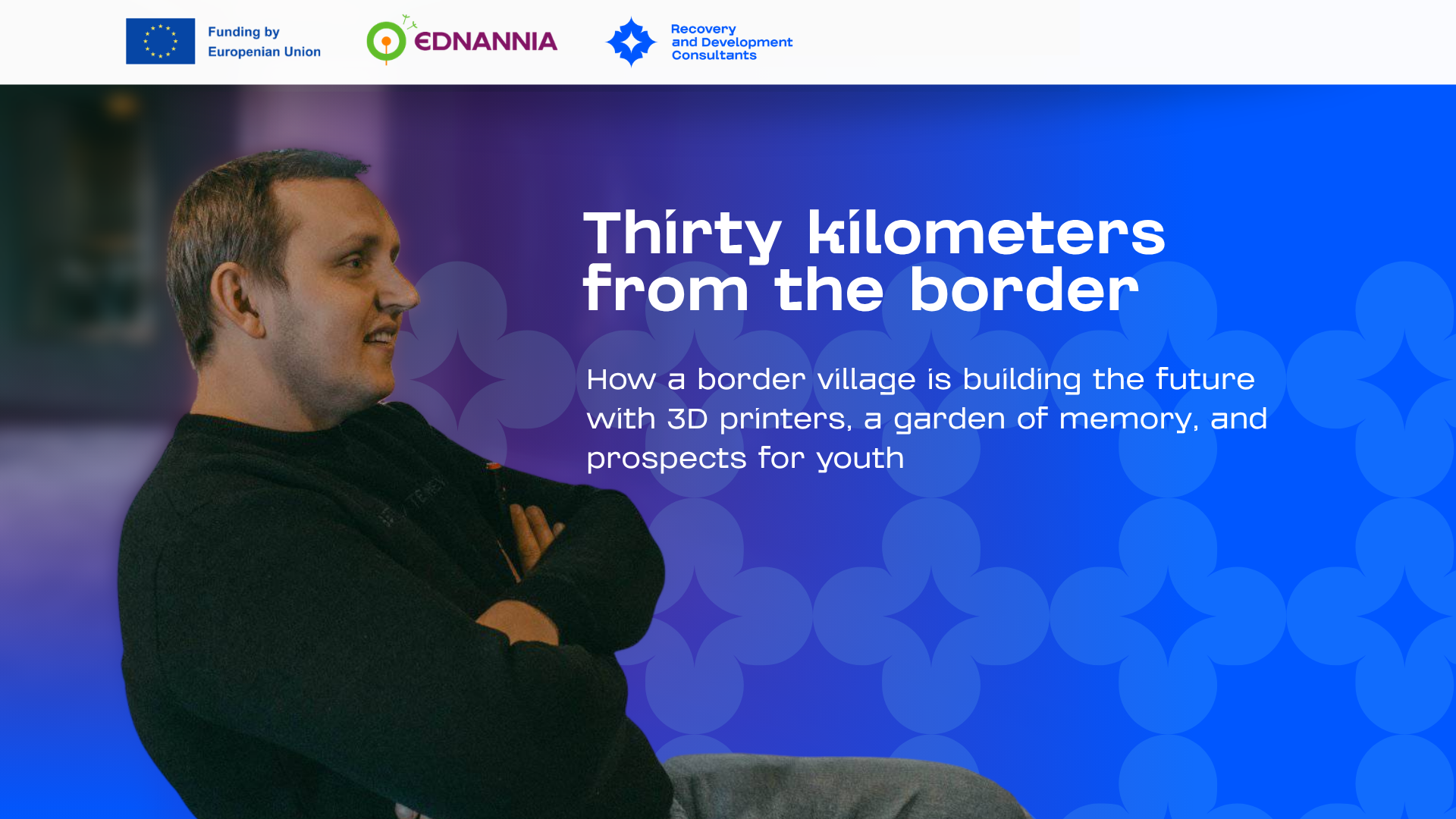
Thirty kilometers from the border: How a border village is building the future with 3D printers, a garden of memory, and prospects for youth
The village of Vykhvostiv in Chernihiv region is located thirty kilometers from the border with two countries — Belarus and Russia. Although many people left the village back in 2022, there is work here: fields are cultivated, a mill operates, and there's a large cattle-farming operation. Internally displaced families from more dangerous areas are moving to Vykhvostiv. For example, one family arrived with six school-age children.
Mykola Sylenko has been the director of the local school for five years now. At the same time, he headed the STO initiative group — "Brave to Create and Unite" (Smilyvi Tvoryty ta Ob'yednuvaty).
"Our biggest idea is to make the community so comfortable that young people stay to live here, adults feel at ease, and young families don't worry about having nowhere to go or work with their children," he says.
From a Trampoline to a 3D Printer
The Tupychiv community, which includes Vykhvostiv, is small, but there weren't enough resources for everyone.
"So our initiative group looked for opportunities, learned to write project proposals, and took part in various competitions — and gradually results started to appear."
Now the village has a youth educational space, a 3D-modeling club with two printers that children work with. In two greenhouses, schoolchildren grow plants, and the sixth grade grows seedlings for sale so the money raised can go toward renovating their classroom.
Another initiative is the "Alley of Unbreakability," which grew into an entire garden. It was planted by a school graduate who became passionate about agronomy and growing seedlings. When he went to serve in the army, he passed all the seedlings on to the school.
"Now we have a really wonderful garden. It's a memorial to our defenders — everyone who serves," says Mykola Sylenko.
"If You Don't Try — It Definitely Won't Work"
Mykola Sylenko learned about ISAR Ednannia through the NGO "Agency of Urban Initiatives," partners of the initiative group who helped open the space in the community.
Applying was a bit frightening, since competition for the first wave was fierce.
"While filling out the application, I tried to read every single detail and do everything the form asked. Honestly, at first I didn't believe I'd get through. Many really impressive organizations applied, and I wasn't coming from a registered organization but from an initiative group. So when I received the invitation to join the program, I was very happy," he recalls.
Mykola Sylenko says that before joining the program, he lacked a number of important skills and knowledge. First, the ability to write project applications: out of ten submitted, only one would be approved, and that was already considered a success. Second, he lacked experience cooperating with local government bodies. Third, he barely understood how international organizations work and how to interact with them.
The Training: "It's Not All That Complicated"
The first day of training turned out to be the hardest and, at the same time, the most memorable.
"When we met the participants and trainers, I realized I was surrounded by really great people who had already accomplished a lot in their lives. There were strong representatives of local government and civil society. And everyone was so different, so interesting. I just wanted to keep asking questions and listening," he shares.
During the program, participants were constantly mixed into different groups, pushed to step outside their comfort zones, and not allowed to stay in a familiar environment. According to Mykola Sylenko, the program is designed so participants can better understand the value of people and the interactions between them.
The training had almost no lectures in the usual sense. Instead, there was communication among participants, exchange of experience, and practical exercises.
"It felt like we kept arriving at the right answers ourselves. It turned out that everyone actually already knew everything: you just had to remember it, systematize it, and structure the knowledge. What seemed very difficult to me during the first and second days of training later turned out to be simple and easy," he says.
After the first wave, when the opportunity arose to apply for the trainers' program, Mykola Sylenko decided to try that too.
"It would have been embarrassing not to apply," he laughs. He got through that selection as well.
Life After the Training
According to Mykola Sylenko, after taking part in the "Recovery and Development Consultants" program, it became much easier for him to communicate both with grant providers and with local residents.
One result was negotiations with the organization Save Aid, which had opened 2 educational spaces in the community. After the negotiations, the organization agreed to expand one of them, which operates on the basis of the gymnasium. Renovation is currently underway there, and the space will triple in size thanks to the addition of adjacent premises.
At the same time, the community is implementing an ISAR Ednannia project — creating "Ednannia Park" next to the educational space. The idea is for it to be a place for community residents to relax and socialize. Plans include setting up a Wi-Fi zone, children's entertainment, and photo zones.
Another successful initiative was an engineering festival held with the participation of local government bodies and residents. During the event, children together with their parents built various engineering structures and creations.
"It was an entertaining and educational event. We managed to get funding to hold it, and also got people interested enough to come," Mykola Sylenko says.
The community also regularly organizes communal work days (toloky) and joint events that help bring residents together around the development of the settlement. Recently, residents cleaned up the village park together.
"If before we thought we constantly lacked people, now it turns out we have enough people. They're active and creative, and we no longer search for them. We search for ideas and learn how to communicate them properly, and the people find us themselves," he says.
According to Mykola, an important change was rethinking approaches to working with the community.
"We've always had a lot of ideas, but implementing them and communicating them properly to people — that was the hard part for us. Now we handle that more easily," he sums up.
Together with the "Agency of Urban Initiatives," Mykola Sylenko developed a 5-year strategic development plan for the organization as its regional representative. At the same time, the community and the agency are working together on a recovery plan.
Attitudes toward grants have also changed:
"Before joining this project, we tried to look for opportunities where it was easier — where it was simpler to get through and competition was lower. Back then we only managed to get through one out of ten selections, and that was already considered a success. Now, even one successful selection out of five feels like too little for us."
Another important change is understanding the value of human contacts. After the program, Mykola Sylenko began traveling on business trips more often, because he realized that "warm contacts" are one of the most important resources.
"Without a doubt, first place goes to people, and people again," he sums up.
And to those who are still hesitant about whether to apply for the "Recovery and Development Consultants" program, Mykola Sylenko says simply: if you have a goal and a mission — don't think twice. Try it — it's definitely worth it. Because if you don't try, it definitely won't work.
Освіта, яка змінила 70 життів. За кулісами проєкту для жінок з деокупованих територій від USAID, ІСАР Єднання та ГО “Фундація Проджектор”
Економічне посилення жінок з українських деокупованих територій - це значний виклик у контексті післявоєнного відновлення.
Під час переходу цих регіонів з режиму військової окупації до реінтеграції у національну структуру жінки стикаються з унікальними перешкодами у відновленні своєї економічної незалежності та відбудові свого життя.
Під час війни багато з них втратили свої домівки, роботу та бізнес. Це призвело до гострої потреби у працевлаштуванні та професійній підготовці.
Крім того, психологічні травми та соціальні стигми ускладнюють їх повернення на ринок праці.
Є потреба, є відповідь
Розпізнавши цю критичну потребу, громадська організація “Фундація Проджектор”, яка реалізувала цей проєкт за підтримки ІСАР Єднання у межах проєкту «Ініціатива секторальної підтримки громадянського суспільства», запустила спеціальну програму з метою надання цим жінкам можливості відновити власну економічну незалежність. Орієнтуючись на стійкі до зовнішніх впливів сфери креативних та ІТ-індустрій, які відомі своєю адаптивністю та можливістю віддаленої роботи, проєкт запропонував жінкам реальний шлях до їх економічного зростання.
Маючи глибоке розуміння перешкод, з якими зіштовхуються ці жінки, ГО “Фундація Проджектор” розробила інклюзивну програму, яка ґрунтується на неформальній освіті. Вона запропонувала гнучкий, доступний та практичний шлях набуття навичок та економічного розвитку для 70 жінок і дівчат з деокупованих територій.
Спеціалізовані навчальні програми і семінари на такі популярні теми, як вебдизайн, управління ІТ-проєктами та SMM, забезпечили учасниць навичками та портфоліо проєктів, необхідними для успіху у креативних та ІТ-індустріях.
Крім технічних навичок, проєкт забезпечив доступ до кар’єрних консультацій та менторської підтримки - а це, своєю чергою, підвищило конкурентоспроможність учасниць на ринку праці.
Випускниці отримали готове резюме та підтримку у пошуку роботи за допомогою консультацій. Особлива увага приділялася психологічній підтримці, критичну роль якої у загальному успіху учасниць та їх адаптації до нових умов важко переоцінити.
Нові навички та знання учасниць проєкту відтепер сприятимуть економічному розвитку регіонів та відновленню деокупованих територій.
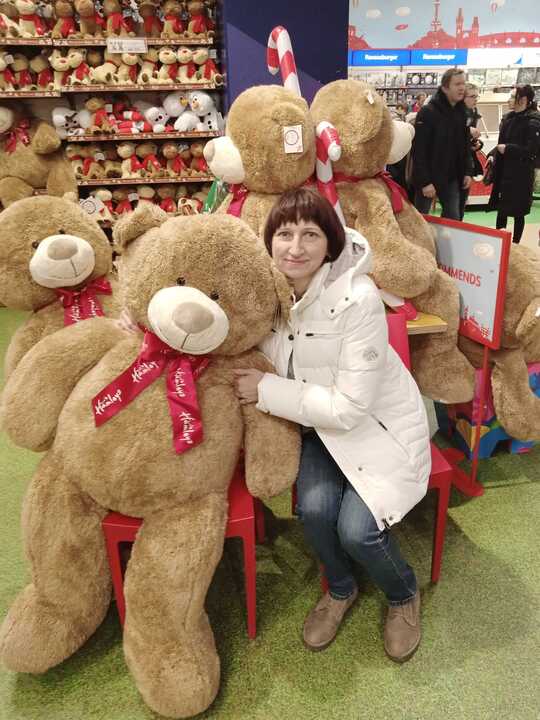
"Мої очікування справдилися і навіть більше. Я зрозуміла, що не буду після трьох місяців навчання справжнім спеціалістом, але отримала розуміння професії, достатньо добре освоїла Figma. Я вагалася тільки з питанням, чи зможу, чи вистачить сил та часу. Бо знала, що це потребує зусиль. Та добре, що усе було в запису. Багато жінок відчувають просто патологічну невпевненість, яку ми отримали втративши усе, що мали. На нас усіх важким каменем лежить війна і втрати. Але хай там що говорять, ми мусимо жити. Я обираю бути сильною заради моєї донечки, яка поруч; заради сина, який там на передовій", - каже Анастасія Полянська, учасниця програми.
Вплив реалізованого проєкту вже вийшов за межі індивідуального економічного зростання учасниць. Демонструючи успішні історії жінок та дівчат у цих сферах, він кинув виклик застарілим гендерним стереотипам і підкреслив важливість інклюзивності й різноманіття у розвитку інновацій та економічному зростанні. Комунікаційна кампанія та публікація успішних історій надихають інших жінок і дівчат слідувати подібним шляхом, приносячи користь всьому суспільству.
Цей проєкт довів, що такі ініціативи й правильно організоване навчання можуть змінювати життя.
Проєкт надав не лише освітні можливості, але й створив умови для професійного розвитку і включення у ринок праці 70 жінок й дівчат із деокупованих територій, сприявши побудові довгострокової стійкості і боротьбі з гендерною нерівністю.
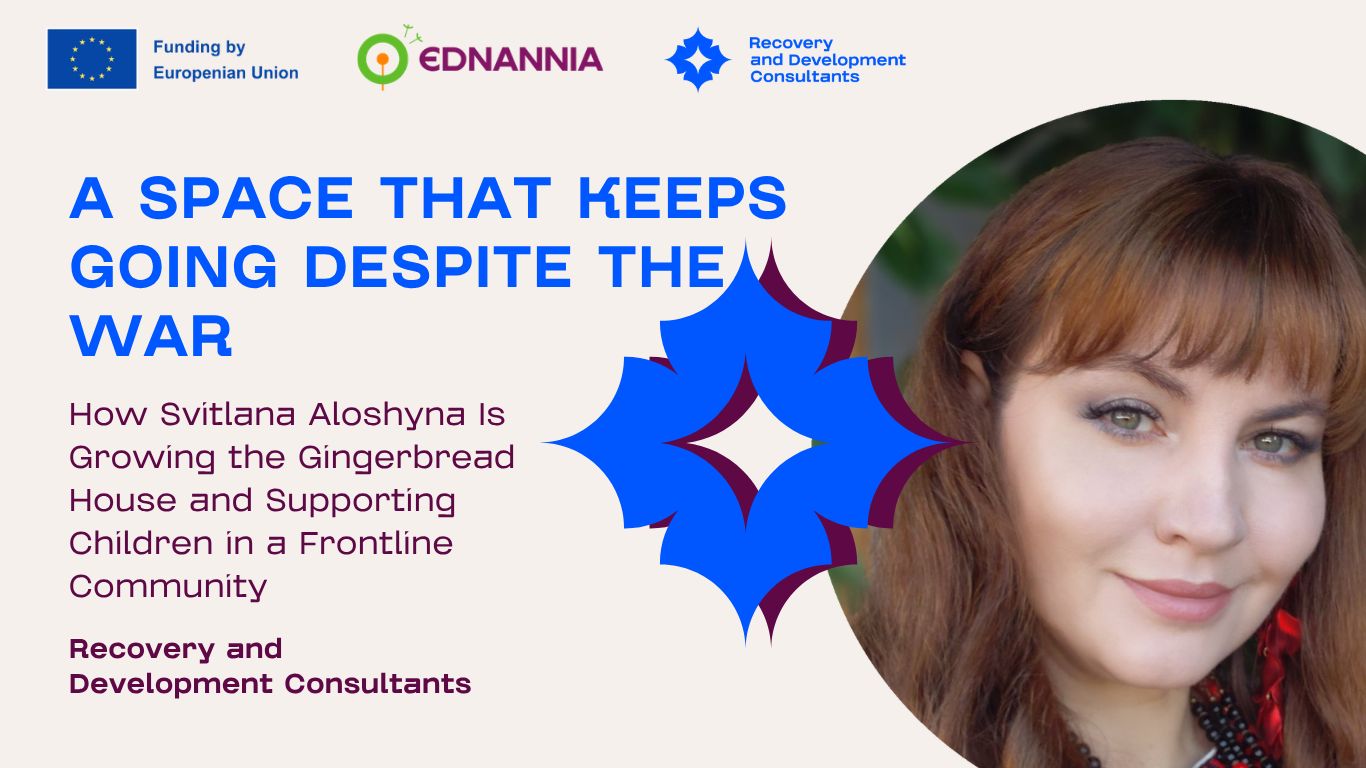
The Gingerbread House in a Frontline Community: How Children Learn Creativity in a Shelter in Kharkiv Region
The Recovery and Development Consultants Programme is a training initiative by ISAR Ednannia, supported by the European Union. It prepares professionals who help communities recover and develop, build partnerships between local authorities and residents, launch local change initiatives, and attract funding. Participants include people from NGOs, local government, and business initiatives who are already working at the local level and want to make their work more systematic.
The Novopokrovska community in Kharkiv region lies between Kharkiv and Chuhuiv. Shelling is part of everyday life here.
“If it’s not a direct hit, it’s a downed drone that falls and explodes. This happens every day,” says Svitlana Aloshyna, head of the NGO Smak Zhyttia (“Taste of Life”).
Around 26,000 people live in the community, including more than 12,000 internally displaced people. This year, for the first time in seven years, the community introduced a blended learning format. To make this possible, a learning space was set up inside the shelter of the local cultural centre, where the Gingerbread House, a space founded by Svitlana, has been operating for several years. Despite the war, activities for children and young people continue there.
“We understood that children needed not only a safe place to learn, but also somewhere they could socialise, create, and grow,” Svitlana explains.
From economics to a creative space for children
Svitlana Aloshyna entered the civil society sector in 2017. A year later, she and her sister, Iryna Voronova, officially registered the NGO Smak Zhyttia. Before that, Svitlana had worked as head of the economics department at the Chuhuiv District Administration and lived in Chuhuiv, although she was originally from Novopokrovka.
One day, while reviewing reports from her home settlement, she came across a statistic: 99% of children were reportedly enrolled in extracurricular activities. Svitlana decided to check this figure for herself and visited the local cultural centre on a weekend. But the doors were locked, and no children were attending any activities.
She then reached an agreement with the centre’s director to run sessions herself every Saturday. Seven or eight children came at first, but their numbers gradually grew.
“At first, I thought it would be a small initiative for a few children. But they started bringing their friends, and every week there were more and more of us,” Svitlana recalls.
The children drew, did arts and crafts, baked gingerbread, and decorated it. Eventually, so many children joined that Svitlana was running four sessions back-to-back. As the initiative grew far beyond an ordinary extracurricular club, the team decided to officially register an NGO. The first project received support from the Kharkiv Regional Council, and the space was named the Gingerbread House — a name it still carries today.
“The name has been with us since the very first sessions. The children made gingerbread houses, and this place became just as warm and welcoming for them,” Svitlana says.
Since then, the space has continued operating, even after Russia’s full-scale invasion began. The Gingerbread House gives children opportunities to try different activities and discover what truly interests them. Artists, chefs, authors, and robotics specialists have all been invited to lead sessions. Children have explored drawing, confectionery, handicrafts, and robotics.
After the full-scale invasion began, activities moved into the shelter of the same cultural centre. The NGO’s team renovated the space and held events there throughout the year. Children travel from different settlements across the community to attend Smak Zhyttia’s activities. Some are brought by their parents, while the local council helps arrange transport for registered participants.
The organisation also works beyond children’s activities. Its team has contributed to renovating outpatient clinics, repairing the cultural centre’s roof, and implementing other infrastructure projects. It also helps secure external funding when local budgets are insufficient.
“We already had the experience, but we needed new tools”
Svitlana joined the Recovery and Development Consultants Programme with extensive experience working in her community. At the same time, she wanted to organise her knowledge more systematically and learn from experienced trainers and facilitators.
“We often organise events ourselves. I’m practically a trainer in my community every day. I wanted to see how an experienced, effective trainer works,” she says.
Meeting the programme’s trainer, Alona Dolia, proved particularly valuable.
“When I met Alona Dolia in person, all my doubts disappeared. I wanted to absorb everything she shared like a sponge. And it really works,” Svitlana recalls.
It was also useful to experience the training from the participant’s perspective rather than as a trainer.
“When you’re on the other side of the table — not as a trainer, but as a participant — you can experience for yourself which games and exercises really engage people and which ones they resist,” she explains.
From training to community action
Taking part in the Recovery and Development Consultants Programme helped Svitlana’s team implement a project on European integration for young people. During the training, she gained practical advice on working with different audiences, facilitating group sessions, and responding to unexpected situations.
These skills proved useful from the very first day of the project. The team realised that a lecture-based format was not working for the young participants, so they redesigned the programme overnight.
“We added games, screened a film about Paddington and discussed European values, and organised a live conversation with people in Europe. That’s how we learned to adapt the programme quickly to participants’ needs and not be afraid to change the original plan.”
She also applies her facilitation skills in her day-to-day work, as Svitlana is now deputy head of the Novopokrovska settlement council.
“For me, running a meeting or a training session is now much the same. You need to prepare, draw up a plan, and keep track of the timing,” she says.
Svitlana once delivered a training session with a colleague right inside a shelter. Shelling caused the internet connection to go down, so the team had to adapt the programme on the spot and look for a mobile signal.
Another important outcome, she says, has been the connections she made with other programme participants.
“We still keep in touch in our group chat and follow each other on social media. And you feel happy when you see things working out for someone else. If one person can do it, others can too,” she says.
For those who are unsure whether to apply for the programme, Svitlana advises them not to let fear keep them from trying something new:
“If you feel afraid, that’s a sure sign you should go exactly where you’re most afraid to go. Where you feel no fear, you’re already completely at home. You need to step outside that comfort zone.”
The programme is implemented within the framework of the EU Unity4Community project, funded by the European Union.
This publication was produced with the financial support of the European Union. Its contents are the sole responsibility of ISAR Ednannia and do not necessarily reflect the views of the European Union.
By Elia Serkozhaieva